
Issues
The client was a large healthcare provider managing multiple hospitals, ambulatory centers, and specialty units across Saudi Arabia. They sought to establish a robust benchmarking system to measure performance against local and global healthcare standards. With increasing expectations for quality, efficiency, and compliance under Vision 2030, the organization needed a structured, transparent approach to identify gaps, track progress, and drive continuous improvement across clinical, operational, and financial indicators.
Solution
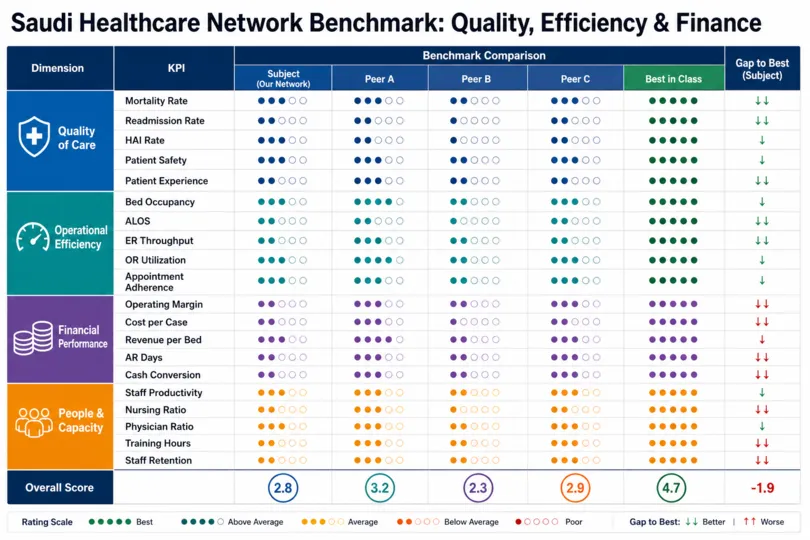
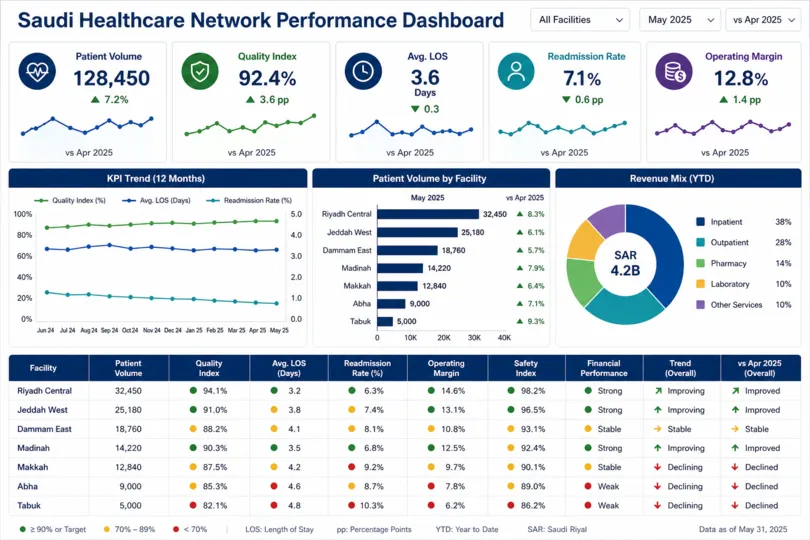
We developed a comprehensive benchmarking framework covering clinical quality, operational efficiency, financial performance, patient experience, and digital readiness. The solution began with the identification of critical KPIs based on Saudi regulatory standards and international best practices. A cross-functional data-validation process ensured accurate, comparable metrics across facilities. Performance dashboards provided real-time visibility into key indicators, while a structured benchmarking methodology compared performance against best-in-class standards and peer groups. The solution also included a performance-improvement playbook providing recommended interventions for underperforming areas and best-practice guidelines for high-performing departments.
Approach
Our benchmarking approach followed a systematic, multi-layered process:
- KPI definition and alignment across clinical, operational, financial, and patient-experience categories.
- Data validation and harmonization to ensure consistent, comparable reporting across all facilities.
- Benchmarking model development using peer groups and best-in-class performance levels.
- Performance dashboard implementation enabling real-time visibility and leadership decision support.
- Improvement-opportunity mapping identifying high-impact areas requiring targeted interventions.
- Best-practice documentation to ensure knowledge sharing across all sites.
Recommendations
Recommendations provided a clear pathway to long-term performance excellence:
- Institutionalize benchmarking dashboards across all facilities with monthly reporting cycles.
- Develop targeted improvement plans for departments falling below benchmark thresholds.
- Recognize and replicate best-performing units to promote consistency across the network.
- Strengthen data governance to ensure accurate and timely reporting.
- Align performance incentives with benchmark improvements and KPI achievements.
- Integrate benchmarking with strategic planning to guide investments and resource allocation.
Engagement ROI
The benchmarking initiative produced significant improvements in performance visibility and operational outcomes. Data consistency improved by 37%, while KPI reporting accuracy increased by 41%. Clinical quality indicators rose by 14% on average, driven by targeted improvements in underperforming departments. Operational efficiency gains delivered cost savings of 8–12% across facilities. Leadership decision-making improved due to real-time dashboard visibility, reducing planning cycles by over 25%. The benchmarking framework positioned the client to achieve long-term performance excellence aligned with Saudi healthcare standards.