Issues
The client was a healthcare investor preparing to develop a new multi-specialty hospital in Saudi Arabia. They required a full-scale hospital planning framework addressing facility design, service distribution, clinical adjacency, workflow optimization, staffing models, digital infrastructure, and long-term capacity needs. The client wanted to ensure that the new hospital met future demand, regulatory requirements, and patient-experience expectations while aligning with Vision 2030 healthcare transformation goals.
Solution
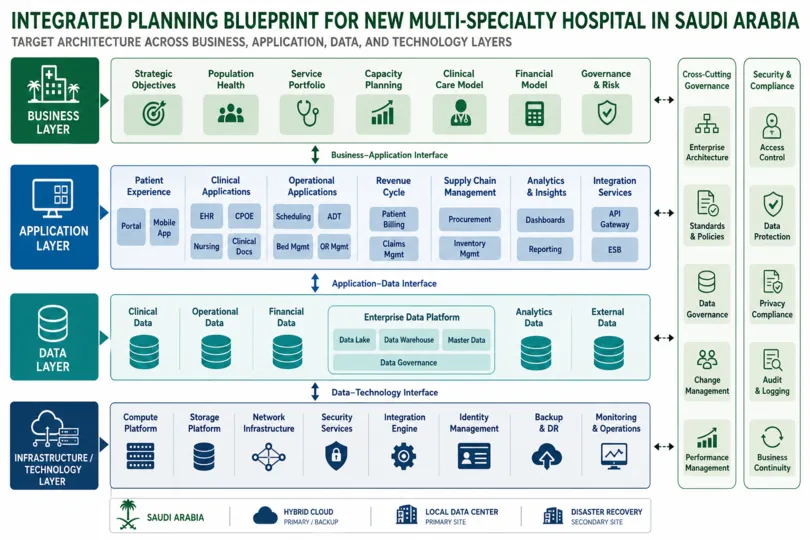
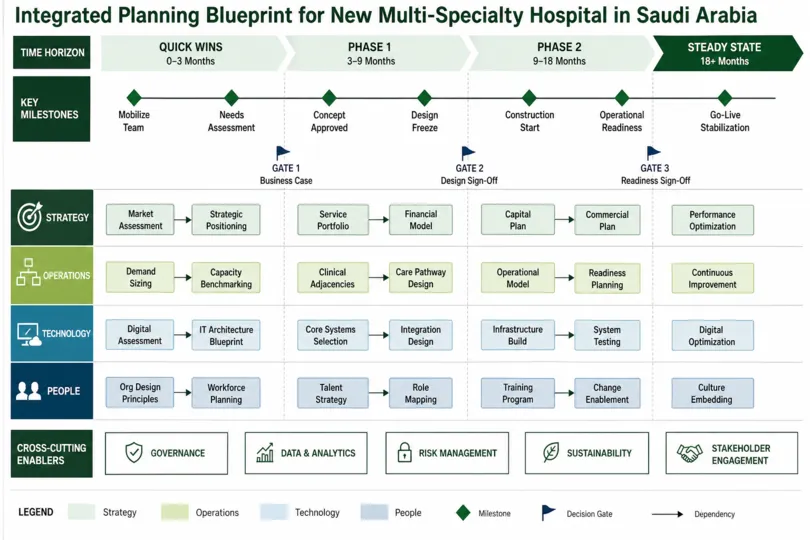
We developed a complete hospital planning blueprint covering master planning, capacity modeling, specialty selection, architectural design guidelines, operational planning, workforce structures, and digital systems. The solution began with demand modeling based on population demographics, regional disease prevalence, and unmet specialty needs. We designed clinical-service distributions, bed capacity allocation, ICU and emergency layouts, diagnostic footprints, and support-service requirements. Architectural guidelines included adjacency models, workflow zoning, and future expansion pathways. Digital infrastructure recommendations covered HIS, PIS, IoT systems, clinical devices, and cybersecurity. Financial modeling projected CAPEX, OPEX, revenue potential, and long-term sustainability. The result was a future-proof, scalable hospital plan ready for implementation.
Approach
Our hospital planning methodology followed an integrated process:
- Demand forecasting based on epidemiological trends, demographics, and regional healthcare gaps.
- Service-line planning to determine specialty mix, diagnostic needs, and clinical priorities.
- Capacity and bed modeling aligned with Saudi guidelines and best-practice ratios.
- Architectural planning including zoning, adjacencies, circulation, and facility flow.
- Digital infrastructure design specifying HIS, PIS, device integration, and cybersecurity.
- Financial viability modeling analyzing CAPEX, OPEX, and long-term returns.
Recommendations
Key recommendations for effective hospital planning included:
- Adopt modular facility layouts allowing future expansion with minimal disruption.
- Design evidence-based clinical adjacencies ensuring optimal flow between emergency, diagnostics, and inpatient units.
- Prioritize digital integration early to avoid costly rework and support advanced clinical capabilities.
- Optimize staffing models based on projected patient volumes and specialty requirements.
- Implement energy-efficient infrastructure aligned with Vision 2030 sustainability objectives.
- Use phased development strategies to balance CAPEX commitments and market readiness.
Engagement ROI
The hospital planning framework reduced design inefficiencies by over 25% through optimized layouts and adjacency models. Capacity modeling improved bed-utilization forecasts, minimizing risk of overbuilding or underbuilding by 18%. Workflow optimization projected a 21% increase in patient throughput, while digital infrastructure planning reduced future IT retrofit costs by 14%. Financial modeling improved investment visibility, enabling the client to secure funding under favorable terms. Overall, the structured planning approach significantly strengthened the feasibility and performance potential of the new hospital.