
Issues
The client was a healthcare group operating hospitals, specialty centers, and outpatient clinics across Saudi Arabia. With rapid digitalization occurring across the Saudi healthcare sector, the organization sought to modernize its clinical workflows, administrative systems, and patient-engagement platforms. The client wanted to transition from legacy systems to an integrated digital-health ecosystem aligned with Vision 2030 and national digital-health standards, enabling more efficient service delivery and greater data transparency across the network.
Solution
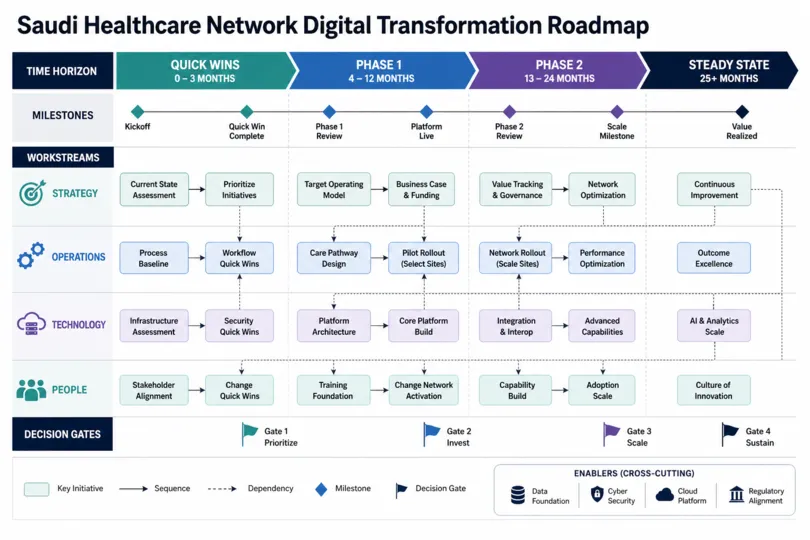
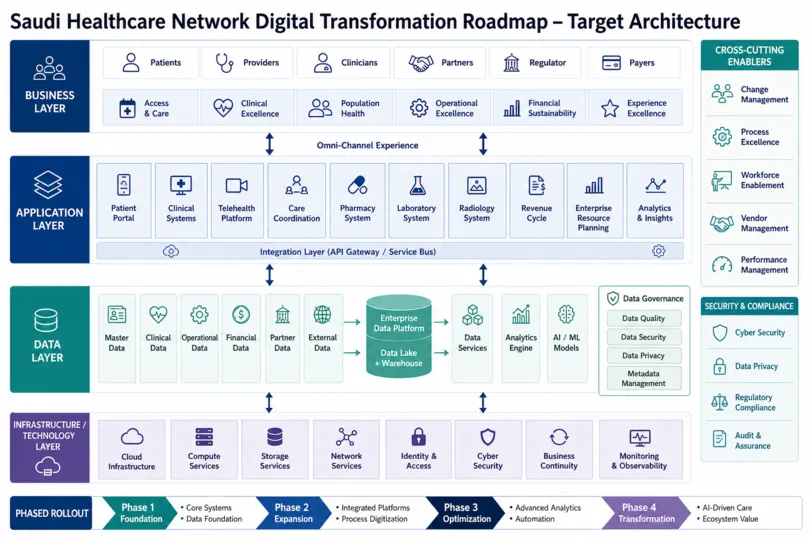
We developed a comprehensive digital transformation roadmap covering HIS modernization, PIS integration, telehealth expansion, data governance, cyber readiness, and patient-engagement technologies. The solution began with a digital maturity assessment evaluating system performance, interoperability gaps, workflow inefficiencies, and user adoption issues. Based on these insights, we outlined a phased transformation strategy introducing unified HIS/PIS platforms, centralized data warehouses, automated clinical workflows, AI-enabled diagnostics, telemedicine systems, and mobile patient portals. The plan also included cybersecurity protocols, digital governance frameworks, and staff training programs to ensure smooth technology adoption. Implementation sequencing was optimized to minimize disruption to critical services while maximizing ROI.
Approach
Our digital transformation approach followed an end-to-end methodology:
- Digital maturity assessment covering system performance, interoperability gaps, and workflow inefficiencies across all sites.
- Clinical workflow re-engineering to optimize documentation, diagnostics, medication management, and care coordination.
- Unified HIS/PIS architecture blueprinting defining data standards, integration layers, and cybersecurity baselines.
- Telehealth strategy development including remote consultations, virtual triage, and chronic disease monitoring.
- Data governance model design establishing data owners, access protocols, and quality standards.
- User training and adoption programs to ensure clinical and administrative staff could effectively utilize new digital tools.
Recommendations
We provided targeted recommendations to enable sustainable digital transformation:
- Adopt a single unified HIS platform for all facilities to improve interoperability and reduce long-term IT costs.
- Implement standardized digital workflows across clinical and administrative functions to improve consistency and reduce manual work.
- Expand telehealth capabilities to enhance access for remote areas and reduce unnecessary in-person visits.
- Develop a centralized data warehouse to support analytics, reporting, and AI-driven decision-making.
- Strengthen cybersecurity controls through encryption, multi-factor authentication, and regular system audits.
- Establish a digital governance council to monitor adoption, oversee system enhancements, and manage transformation KPIs.
Engagement ROI
The digital transformation roadmap generated significant efficiency and performance improvements. HIS/PIS standardization reduced system maintenance costs by 22% and improved clinical documentation accuracy by 31%. Workflow automation led to an estimated 18% reduction in administrative workload, enabling staff to focus more on patient care. Telehealth adoption increased virtual visits by over 240%, supporting better chronic-disease management. Analytics-driven reporting improved decision-making speeds by 40%, while cybersecurity enhancements decreased security incidents by over 60%. Overall, the transformation provided a strong foundation for future innovation, scalability, and digital excellence.