
Issues
The client was a healthcare investor exploring the development of a new tertiary hospital in a fast-growing Saudi region. They required a comprehensive feasibility study to evaluate whether the proposed hospital would be financially viable, competitively positioned, and strategically aligned with regional healthcare needs. The client sought clarity on market demand, specialty mix, capital investment, operational costs, revenue potential, regulatory requirements, and long-term sustainability.
Solution
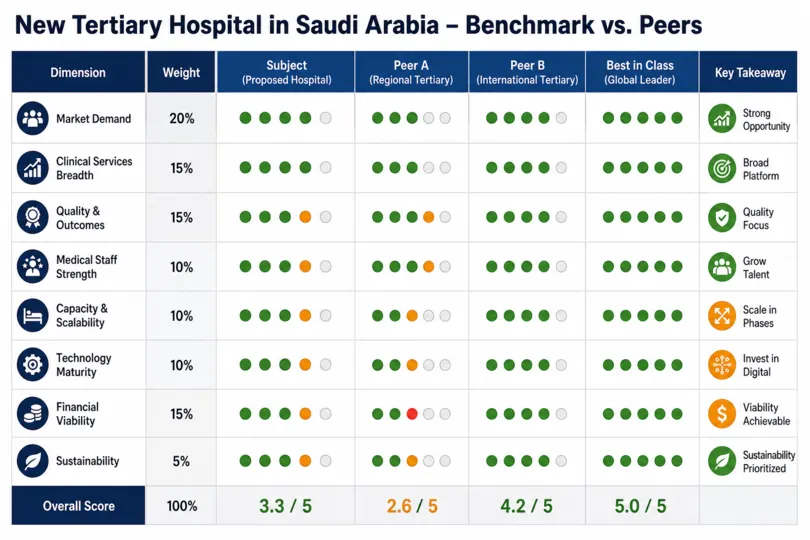
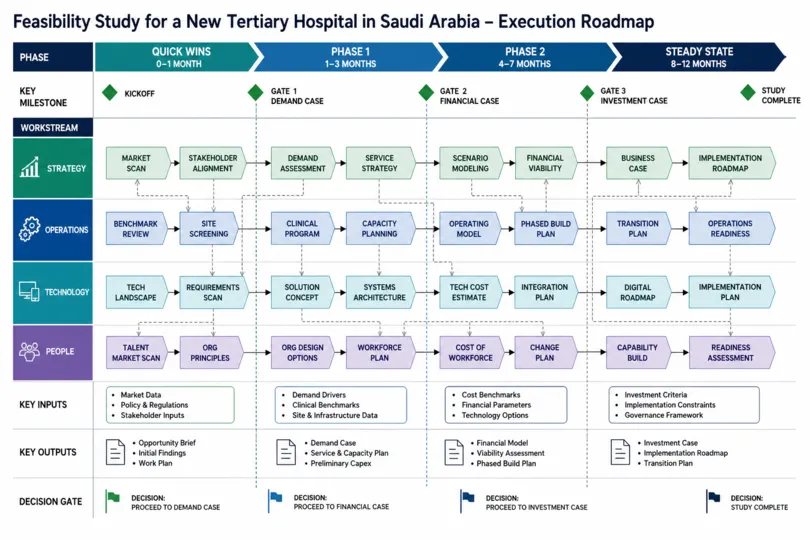
We delivered a full hospital feasibility study covering market analysis, clinical-service evaluation, competitive benchmarking, financial modeling, regulatory assessments, infrastructure requirements, and risk analysis. The study included population and epidemiological projections, service-gap quantification, patient-volume forecasting, and expected catchment-area coverage. A multi-scenario financial model assessed CAPEX, OPEX, revenue streams, payer mix, break-even periods, and ROI potential. Operational plans were developed covering clinical pathways, diagnostic requirements, support functions, digital systems, and staffing models. The deliverables allowed the client to make a fully informed decision on whether to proceed with the hospital under the recommended configuration.
Approach
Our feasibility approach involved six analytical pillars:
- Market and demand analysis evaluating patient volumes, disease trends, and specialty needs.
- Competitive landscape mapping to assess saturation levels, service gaps, and differentiation opportunities.
- Clinical-service mix planning defining priority specialties and diagnostic requirements.
- Infrastructure and operational modeling covering staffing, workflows, and equipment.
- Financial modeling including sensitivity testing, risk scenarios, and ROI calculations.
- Regulatory compliance review outlining licensing requirements and national standards.
Recommendations
Our recommendations provided a clear investment direction:
- Proceed with hospital development in regions where demand forecast strongly supports viability.
- Focus on high-need specialties to attract sustained patient volumes and accelerate market traction.
- Adopt a phased construction model to reduce initial financial exposure and align with market growth.
- Strengthen digital readiness through HIS/PIS integration and scalable IT architecture.
- Develop workforce sourcing strategies to secure specialized clinicians and support staff.
- Implement risk-management protocols covering procurement, construction, demand shifts, and competition.
Engagement ROI
The feasibility study improved investment confidence significantly, reducing uncertainty by over 48%. Demand forecasts showed potential annual patient volumes exceeding 400,000 encounters, validating long-term viability. Financial modeling projected ROI ranges of 12–17% depending on specialty configuration and payer mix. CAPEX optimization recommendations lowered initial investment needs by 11%, while operational modeling improved projected staffing efficiency by 15%. Risk analysis prevented potential losses by identifying scenarios that could have reduced profitability by up to 20%. The study provided a robust basis for moving forward with development.