
Issues
The client was a healthcare investor seeking to evaluate the feasibility of launching a new specialty-service center in Saudi Arabia. Their interests included cardiology, oncology, rehabilitation, and advanced diagnostics. The client required a comprehensive feasibility study assessing market demand, competitive environment, financial viability, regulatory requirements, operational needs, and long-term sustainability. The assessment aimed to determine whether the proposed service expansion could deliver strong returns while addressing unmet patient needs.
Solution
We developed a full feasibility study consisting of market analysis, financial modeling, operational assessment, infrastructure evaluation, regulatory review, and risk analysis. The solution evaluated specialty-specific demand based on epidemiological trends, population growth, and regional service gaps. A detailed competitive landscape assessment mapped nearby facilities, service differentiators, and capacity saturation risks. Operational analysis outlined staffing requirements, clinical pathways, equipment needs, digital systems, and facility layout considerations. The financial model included CAPEX estimates, OPEX projections, revenue forecasts, payback periods, and sensitivity scenarios. The deliverables included a go/no-go recommendation supported by quantitative and qualitative analyses, ensuring the client could make confident investment decisions.
Approach
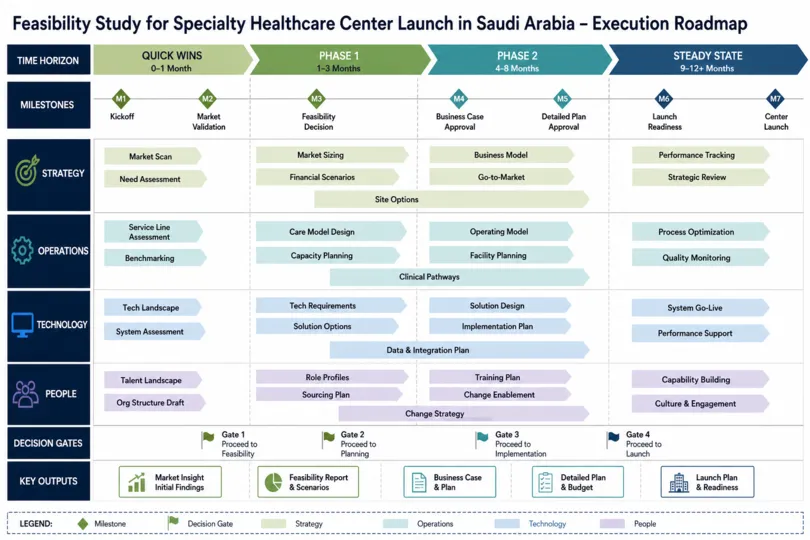
Our feasibility-study methodology followed a structured sequence:
- Market demand analysis evaluating patient volumes, disease prevalence, and unmet specialty needs across regions.
- Competitive landscape assessment mapping service availability, pricing benchmarks, and differentiation gaps.
- Operational capacity modeling estimating staffing needs, equipment requirements, and workflow designs.
- Regulatory compliance review outlining licensing procedures, digital-health requirements, and national standards.
- Financial modeling and projections calculating CAPEX, OPEX, revenue potential, and break-even timelines.
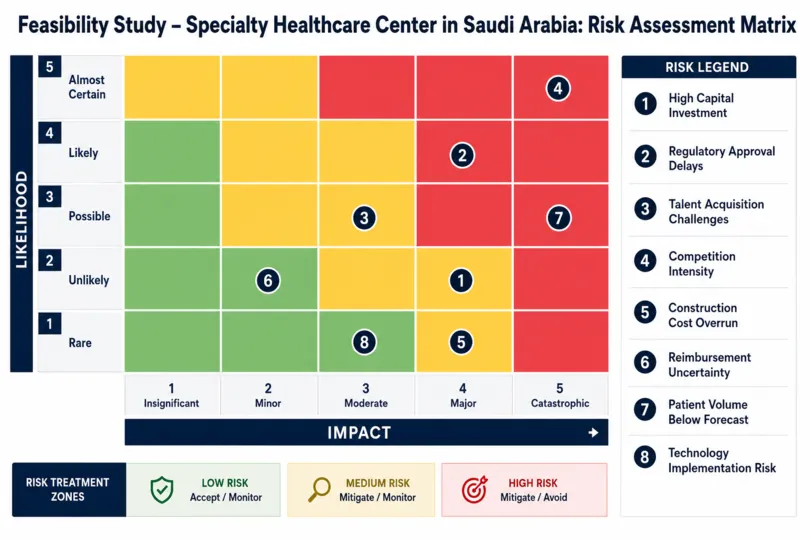
- Risk and sensitivity analysis testing investment viability under adverse market or operational scenarios.
Recommendations
The feasibility study produced detailed, actionable recommendations:
- Proceed with specialty-service expansion in regions with strong demand, limited competition, and favorable demographics.
- Adopt a phased investment approach to minimize upfront CAPEX and reduce early-stage financial exposure.
- Optimize clinical service mix to focus on high-demand specialties that maximize profitability and patient impact.
- Invest in a unified digital ecosystem to ensure seamless connectivity across diagnostics, clinical workflows, and patient management.
- Implement a risk-mitigation framework including contingency staffing models, digital-backup systems, and capacity-adjustment protocols.
- Develop strategic partnerships to accelerate licensing, workforce sourcing, and advanced diagnostics integration.
Engagement ROI
The feasibility assessment enabled the client to reduce investment risk by over 45% through scenario-based financial modeling and market validation. Specialty forecasting identified opportunities with potential annual revenues exceeding SAR 70–110 million depending on configuration. CAPEX optimization reduced projected costs by 12%, while operational modeling improved staffing efficiency by 18%. The go/no-go framework helped avoid high-risk segments that could have resulted in potential losses of up to 20%. Overall, the engagement empowered the client to pursue expansion confidently, backed by data-driven feasibility metrics.