
Issues
The client was a large healthcare provider operating hospitals and clinics across several regions in Saudi Arabia. As the organization increasingly relied on digital systems for clinical documentation, diagnostics, and administrative workflows, data fragmentation emerged as a major obstacle. To support better clinical decision-making, regulatory compliance, and digital transformation initiatives, the client needed a structured data management solution enabling accurate, accessible, and interoperable information across departments and facilities.
Solution
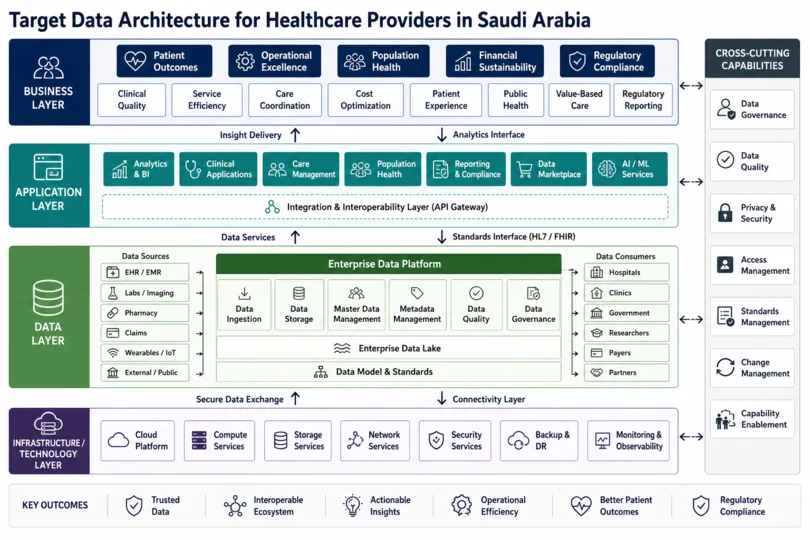
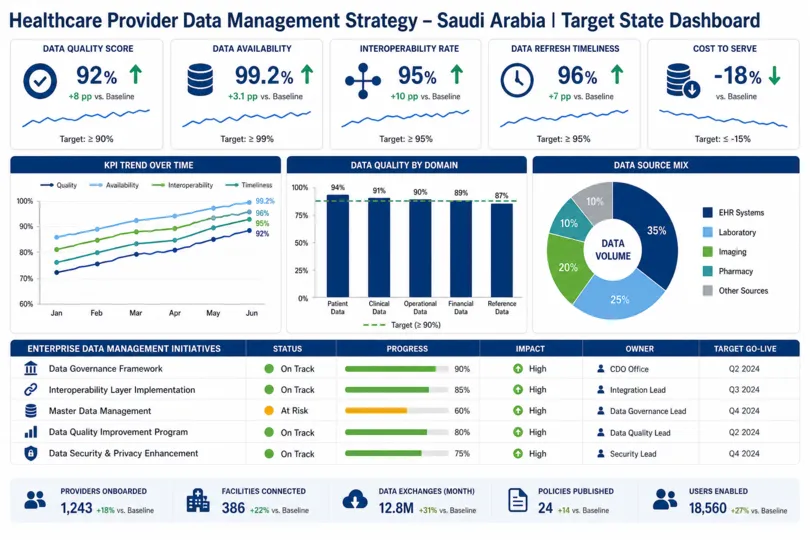
We developed a comprehensive healthcare data-management strategy covering data-quality improvement, architecture redesign, governance structures, interoperability enhancement, and workforce training. The solution included establishing a unified data model for clinical, operational, and administrative information, supported by master-data management (MDM) practices to eliminate duplicate records and ensure consistency. Data governance frameworks were implemented to define data ownership, quality standards, validation rules, and security protocols. Interoperability layers were designed to facilitate seamless information exchange between HIS, PIS, EMR, diagnostic systems, and external platforms. Advanced data-quality tools were deployed to automate error detection, while dashboards provided real-time visibility into data integrity metrics. The strategy supported both immediate improvements and long-term digital readiness.
Approach
Our structured data-management methodology included:
- Data-quality assessment identifying gaps in accuracy, completeness, consistency, and timeliness.
- Master-data management design consolidating patient, provider, and facility records into unified structures.
- Interoperability framework development enabling seamless data exchange across systems.
- Data-governance model creation defining roles, responsibilities, access levels, and validation protocols.
- Automation of data-cleaning processes using rule-based and AI-enabled validation tools.
- Training programs to ensure staff adherence to new standards and documentation requirements.
Recommendations
We provided actionable recommendations for sustainable data excellence:
- Adopt unified data standards across all digital systems to eliminate inconsistencies.
- Implement automated quality-check tools to maintain accurate, real-time records.
- Establish a data-governance council responsible for oversight, compliance, and policy updates.
- Integrate all digital platforms through a centralized interoperability layer.
- Provide continuous staff training to ensure high-quality documentation practices.
- Enhance cybersecurity controls to protect sensitive patient data and strengthen system resilience.
Engagement ROI
Data management improvements increased overall data accuracy by 38% and reduced duplicate records by over 70%. Automated data-cleaning tools reduced manual correction time by 41%, enabling staff to focus on value-added tasks. Interoperability enhancements improved reporting speed by 29%, supporting faster operational and clinical decisions. Data-governance frameworks reduced compliance risks by 22%, while improved data quality enhanced analytics capabilities, strengthening planning accuracy by over 30%. The engagement established a strong foundation for digital transformation and regulatory alignment.