
Issues
The client was a large healthcare operator overseeing multiple hospitals and outpatient clinics across Saudi Arabia. Due to rising patient volumes and evolving regulatory requirements, the organization aimed to achieve operational excellence across clinical, administrative, and support functions. The client sought a structured framework to improve workflow efficiency, reduce waste, optimize resource utilization, enhance coordination between departments, and strengthen compliance with national healthcare standards.
Solution
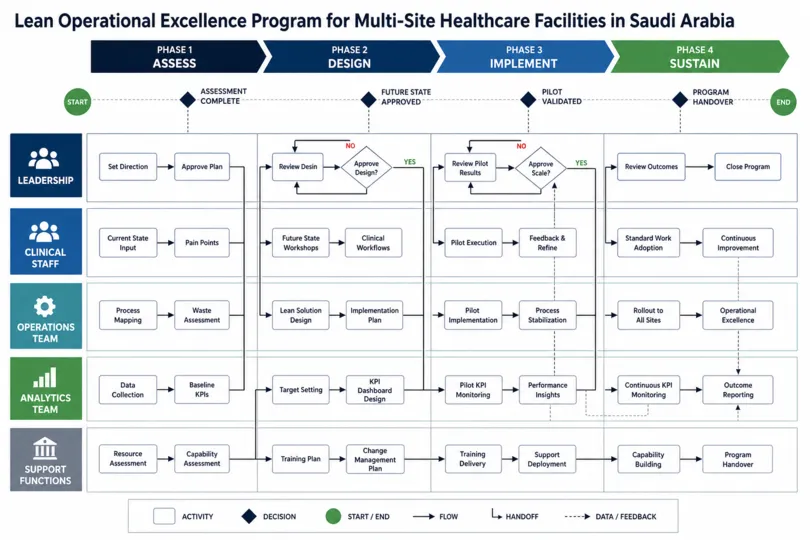
We implemented a comprehensive operational excellence program grounded in Lean healthcare principles, workflow redesign, data-driven decision-making, and performance-monitoring frameworks. The solution covered process-mapping, bottleneck identification, workload balancing, digital workflow enhancement, and KPI standardization. We redesigned clinical and administrative processes such as appointment scheduling, triage, diagnostics coordination, inpatient admissions, discharge planning, and supply chain operations. A performance dashboard was introduced, enabling real-time monitoring of key operational metrics. Staff capability-building workshops strengthened the workforce’s ability to maintain and sustain operational excellence improvements.
Approach
Our operational excellence methodology included:
- End-to-end process mapping to identify inefficiencies, redundancies, and delays in clinical and administrative workflows.
- Lean-based workflow redesign reducing waste, improving throughput, and standardizing critical processes.
- Workforce optimization modeling aligning staffing levels with demand patterns across departments.
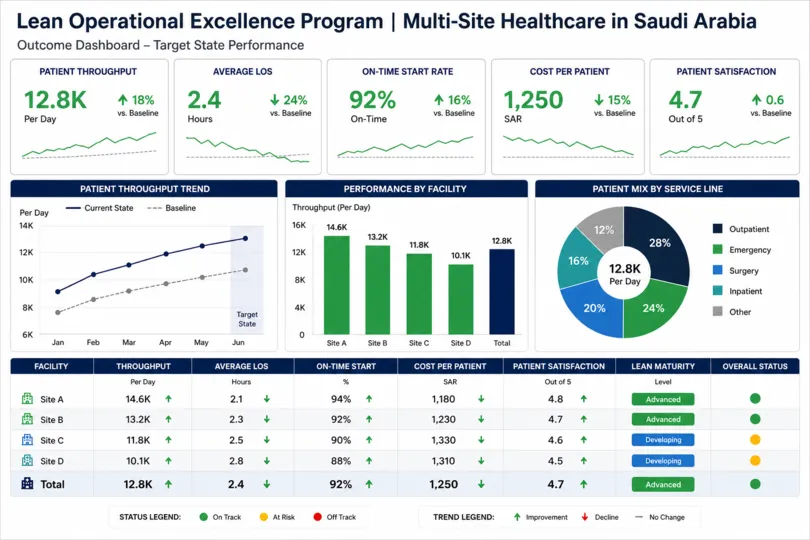
- Performance dashboard development enabling data-driven decision-making and KPI visibility.
- Supply chain and inventory optimization to reduce wastage, stockouts, and holding costs.
- Training programs for continuous improvement equipping staff with tools to sustain operational gains.
Recommendations
The recommendations provided clear pathways for sustainable operational improvement:
- Standardize operational KPIs to monitor performance consistently across all facilities.
- Implement continuous-improvement cycles with structured reviews, audits, and rapid corrective actions.
- Adopt demand-driven scheduling models to balance workload and reduce wait times.
- Strengthen cross-department coordination through integrated communication workflows and centralized oversight.
- Enhance digital workflow tools to reduce manual tasks and improve process adherence.
- Establish operational-governance committees to oversee performance and sustain excellence initiatives.
Engagement ROI
The operational excellence program delivered substantial improvements across workflows and resource utilization. Patient-flow optimization increased outpatient throughput by 22% and reduced diagnostic turnaround times by 19%. Workforce balancing improved staff utilization efficiency by 14%, while supply-chain enhancement reduced inventory waste by 11%. Standardized KPIs improved leadership visibility, reducing operational deviations by over 30%. Overall, the engagement translated into a projected 10–13% reduction in operating costs and significantly improved service quality.