
Issues
The client was a healthcare insurance provider operating across multiple regions in Saudi Arabia, serving both individual and corporate policyholders. With rising claim volumes, increasing regulatory requirements, and growing expectations around transparency and efficiency, the insurer sought to improve claims processing, enhance cost predictability, and strengthen provider relationships. The client required a comprehensive assessment of claims workflows, fraud-prevention systems, actuarial forecasting, digital capabilities, and customer experience.
Solution
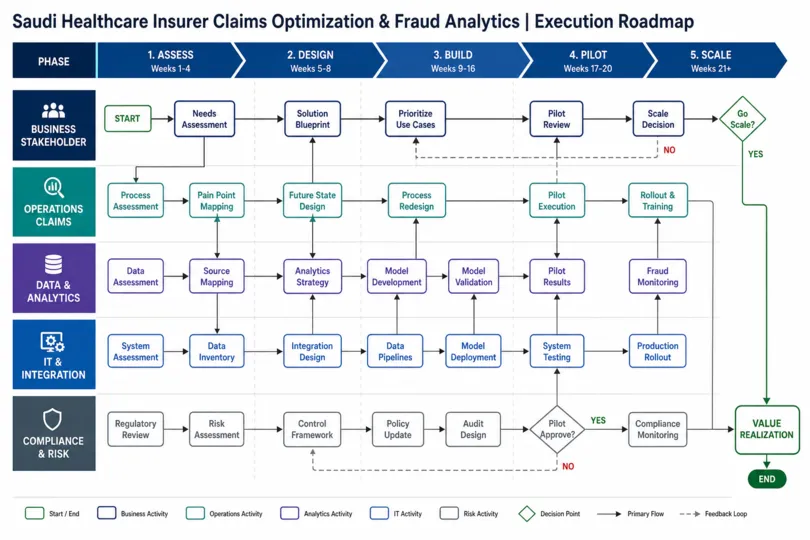
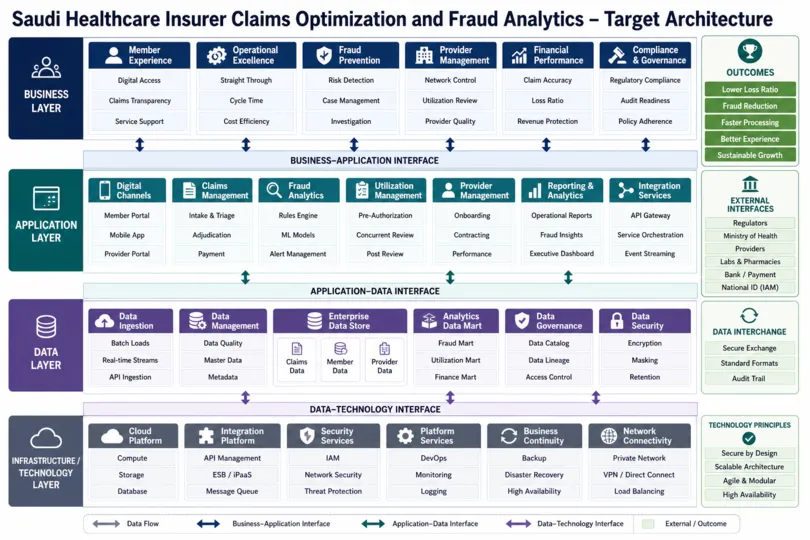
We developed an integrated solution to enhance operational efficiency, strengthen fraud detection, and optimize claims workflows. The solution included end-to-end process mapping, digital-automation opportunities, actuarial analysis, and data integration between insurer and provider systems. Claims processing was redesigned to incorporate automated validation, structured claim-coding checks, and electronic medical record integration. Fraud detection algorithms were introduced using rules-based and predictive analytics approaches. Customer experience improvements focused on digital self-service portals, real-time claim tracking, and simplified policy communications. A financial-risk model provided improved forecasting accuracy and premium-adjustment insights, enabling the client to maintain profitability while improving service quality.
Approach
Our methodology applied a multi-dimensional framework:
- Claims workflow diagnostics identifying bottlenecks, manual tasks, and documentation gaps.
- Digital automation mapping outlining opportunities for robotic processing, auto-verification, and EMR integration.
- Fraud detection model development using analytic triggers, rule sets, and anomaly detection.
- Actuarial-risk forecasting incorporating historic cost data, claim frequency trends, and demographic profiles.
- Customer-experience assessment evaluating clarity, accessibility, and responsiveness across touchpoints.
- Provider-integration framework establishing standardized documentation and data-sharing guidelines.
Recommendations
Key strategic recommendations included:
- Deploy claim-automation systems to reduce manual processing and accelerate turnaround times.
- Strengthen provider data integration to ensure consistent documentation, reduce disputes, and improve visibility.
- Enhance fraud-prevention mechanisms by integrating analytics-driven detection and audit workflows.
- Implement customer-facing digital portals with transparent claim updates and simplified policy information.
- Adopt actuarial models for forecasting risk exposure and premium adjustments.
- Establish regular performance reviews with providers to align coding practices and reduce claim rejections.
Engagement ROI
The engagement generated significant operational and financial improvements. Claims-processing time decreased by 38%, while automation reduced manual workload by over 45%. Enhanced fraud detection lowered financial leakage by 9–12%, translating to substantial annual savings. Actuarial forecasting accuracy improved by 28%, enabling better premium-setting strategies. Customer satisfaction increased by 21% due to improved transparency and digital access. Provider-alignment initiatives reduced claim disputes by 31%. Overall, the insurer gained stronger cost control, improved service quality, and enhanced profitability.