
Issues
The client was a healthcare provider seeking to modernize its patient-data management capabilities by implementing a centralized Patient Information System (PIS). They aimed to establish a unified, secure, and accessible repository of patient information that could improve clinical accuracy, enhance communication between departments, and support digital-health initiatives across multiple sites. The organization recognized that fragmented patient data reduced quality of care, delayed decisions, and limited the effectiveness of digital platforms.
Solution
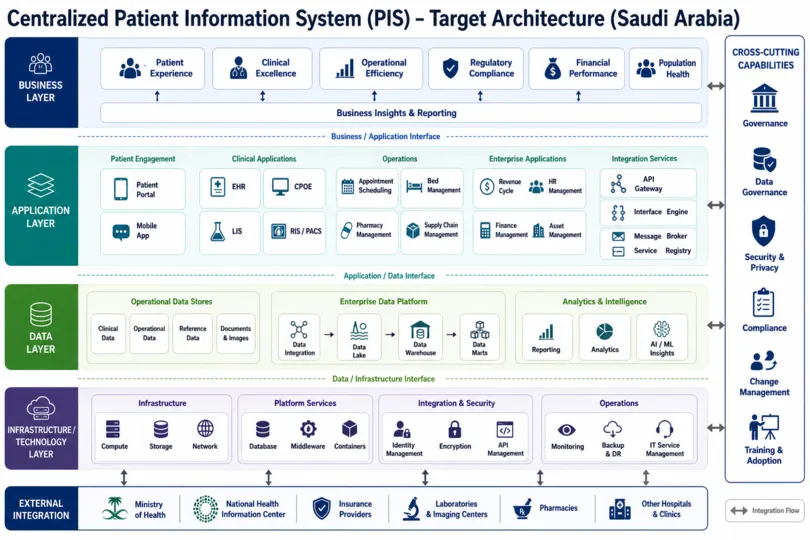
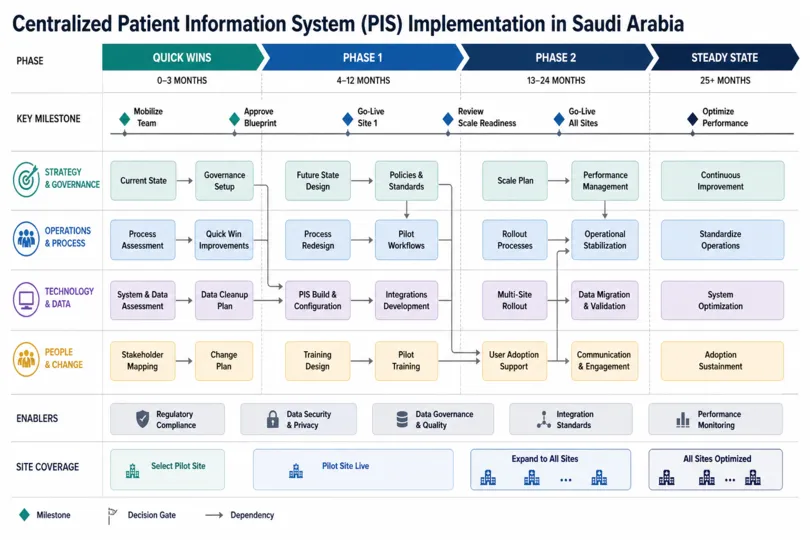
We developed a comprehensive PIS implementation strategy encompassing system architecture, data governance, integration frameworks, workflow redesign, and patient-access features. The solution included a unified data model capable of storing complete patient histories, diagnostic results, treatment plans, medications, and follow-up details. Integration with HIS, EMR, and diagnostic systems ensured seamless data flow across the organization. A secure patient portal offered patients controlled access to their records, improving transparency and engagement. Staff training, phased implementation, and data-cleaning protocols ensured high-quality adoption and long-term sustainability.
Approach
Our PIS implementation followed a structured approach:
- Data-architecture design defining fields, storage structures, and interoperability layers.
- Integration blueprinting to ensure connectivity with HIS, EMR, diagnostics, and digital-health tools.
- Data-cleaning and migration workflows improving quality and completeness before system launch.
- User interface and workflow redesign to ensure clinical usability and reduce data-entry burden.
- Patient portal development enabling secure, easy access to personal health information.
- Governance model establishment covering data privacy, access control, and continuous monitoring.
Recommendations
We provided detailed recommendations for achieving long-term PIS excellence:
- Centralize all patient records under the PIS to eliminate data fragmentation and duplication.
- Adopt strong privacy protocols aligned with national regulations and international best practices.
- Enable patient-facing digital features to support engagement, transparency, and self-management.
- Strengthen analytics capabilities powered by integrated, high-quality patient datasets.
- Develop continuous training programs ensuring staff competency and consistent use of the PIS.
- Integrate PIS with telehealth and remote monitoring tools to expand digital care capabilities.
Engagement ROI
The PIS implementation significantly improved data accuracy, clinical efficiency, and patient empowerment. Record completeness increased by over 44%, while documentation errors decreased by 31%. Clinicians accessed patient data 27% faster, enhancing diagnosis and treatment coordination. The patient portal improved engagement levels, with over 48% of active patients using digital features within the first year. Data-quality improvements enabled more accurate analytics, reducing reporting time by 36%. Overall, the engagement delivered long-term digital readiness and strengthened the client’s patient-centered care model.