
Issues
The client was a major healthcare infrastructure investor operating several medical facilities across Saudi Arabia, including medium-sized hospitals, specialty clinics, and diagnostic centers in key metropolitan regions. As part of a broader expansion strategy aligned with Saudi Arabia’s Vision 2030 healthcare reforms, the organization sought to modernize its aging infrastructure, expand patient capacity, and improve system resilience to handle population growth and rising demand for specialized services. The client needed a comprehensive roadmap that evaluated current facility performance, assessed technical and operational gaps, and developed a prioritized transformation plan supported by data-driven investment decisions.
Solution
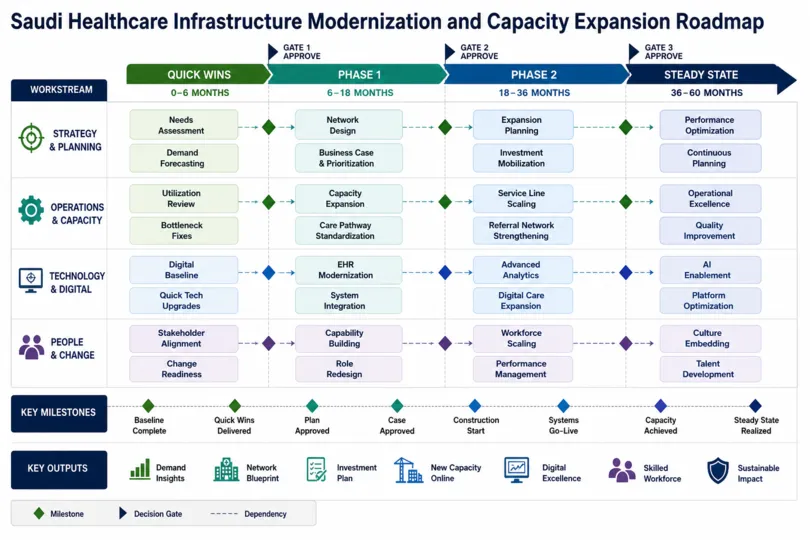
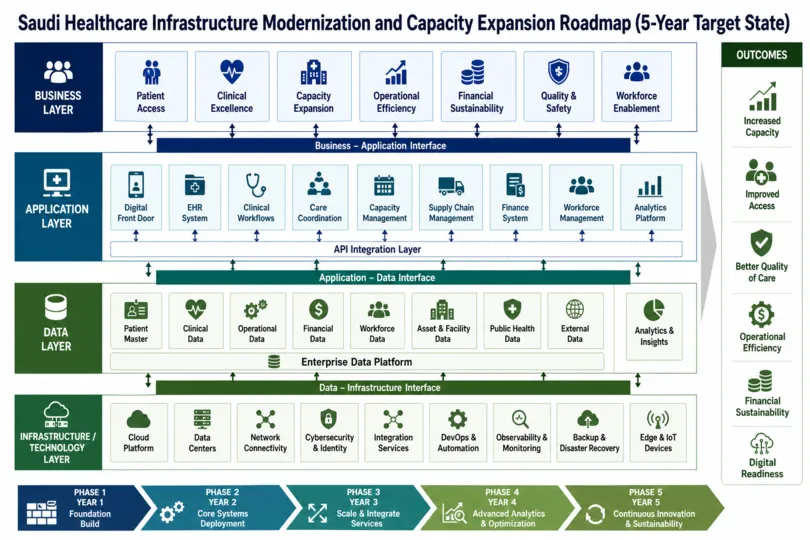
Our team designed a full healthcare infrastructure development strategy that provided the client with a scalable, evidence-based roadmap to upgrade, expand, and future-proof its facilities. The solution began with a technical diagnostic across all sites, covering structural integrity, clinical adjacency compliance, mechanical and electrical systems, digital readiness, and patient-flow bottlenecks. Using regional demographic projections and epidemiological trends, we forecasted demand for specialty services and translated these into infrastructure capacity requirements. The solution also introduced a standardized hospital infrastructure model specifying optimal bed ratios, modular expansion options, emergency and ICU configuration standards, and digital infrastructure requirements for HIS, PIS, and IoT-enabled medical devices. Future expansion scenarios were simulated through a financial model to determine ROI, capital allocation priority, and phasing, ensuring the client could optimize its investment pipeline while aligning with Vision 2030 regulatory frameworks.
Approach
Our approach followed an integrated, multi-layered methodology aligned with Saudi Arabian healthcare guidelines and international facility-planning standards. Key steps included:
- Comprehensive infrastructure audits assessing structural conditions, utility systems, and clinical area suitability using standardized diagnostic checklists.
- Detailed patient-flow mapping across emergency, outpatient, inpatient, and diagnostic pathways to identify congestion points and space misalignment.
- Demand modeling and capacity forecasting based on population trends, disease-burden data, regional service gaps, and projected specialty-mix requirements.
- Infrastructure benchmarking against comparable Saudi healthcare systems to define optimal bed-to-population ratios, ICU capacity norms, and diagnostic coverage.
- Scenario-based master planning workshops involving engineering, clinical, and administrative stakeholders to co-design expansion models under multiple budget envelopes.
- Cost and phasing model development capturing CAPEX requirements, lifecycle maintenance, and operational efficiency gains through infrastructure modernization.
- Digital readiness assessment evaluating HIS/PIS integration capability, network coverage, and IoT device compatibility requirements for future smart-facility integration.
Recommendations
Following the assessment, we provided targeted recommendations to guide infrastructure investment and modernization over a five-year horizon:
- Adopt a standardized infrastructure blueprint including modular room layouts, unified diagnostic configurations, and scalable ICU/emergency designs across all new projects.
- Prioritize expansion in high-demand regions where population growth and service gaps indicated immediate need for additional beds, diagnostic centers, or specialty units.
- Establish a phased CAPEX execution plan enabling the client to allocate funds efficiently across structural upgrades, digital modernization, and new site expansion.
- Integrate smart-facility technology such as IoT-enabled asset tracking, digital patient-flow systems, and centralized facility-monitoring dashboards.
- Implement preventive-maintenance programs with clear KPIs and compliance standards to reduce infrastructure downtime and extend asset lifecycles.
- Align all future projects with Vision 2030 standards including energy efficiency, infection control requirements, and national digital interoperability guidelines.
Engagement ROI
The engagement delivered measurable value across operational, financial, and patient-experience outcomes. Through infrastructure standardization, the client reduced design and engineering costs by 18% across future projects. Patient-flow improvements supported a projected 22% increase in outpatient throughput and up to 15% faster ER cycle times. Digital-readiness enhancements enabled the integration of HIS and PIS platforms with an implementation cost reduction of 12% due to early-stage planning. The capacity forecast allowed the client to allocate capital more efficiently, improving long-term ROI visibility while ensuring compliance with Saudi health-sector regulations. Overall, the roadmap positioned the organization to support an estimated 1.6 million patient encounters annually, representing a strategic transformation of its infrastructure portfolio.