
Issues
The client was a large healthcare organization managing multiple hospitals, outpatient clinics, and community medical centers across Saudi Arabia. With a diverse service portfolio and an expanding footprint in both urban and semi-urban regions, the organization sought to develop a unified strategic healthcare plan aligned with the evolving expectations of the Saudi population and the national transformation agenda under Vision 2030. The client needed a structured, long-term roadmap that addressed operational gaps, emerging specialty demands, workforce planning, digital transformation priorities, and regional service disparities, ensuring sustainable growth over the next 10–15 years.
Solution
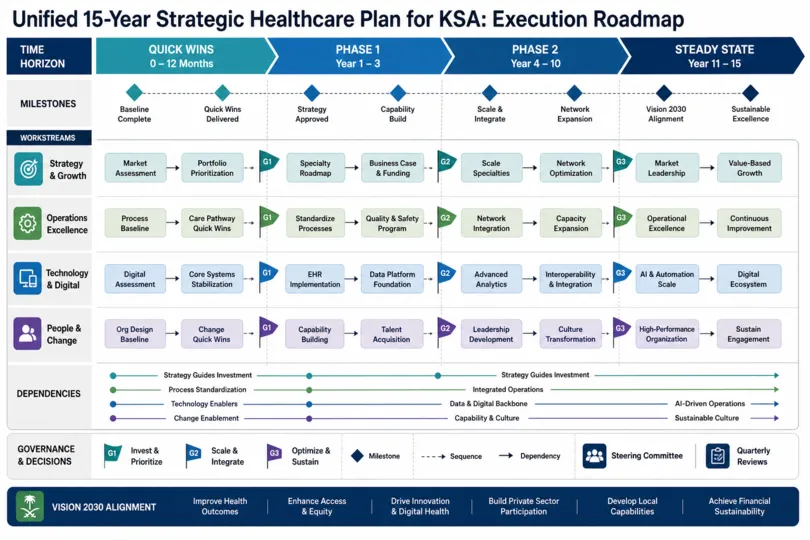
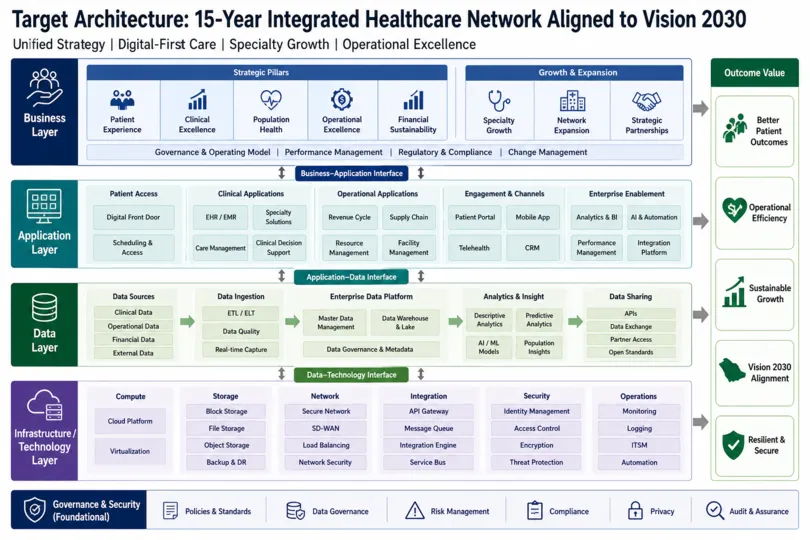
We developed a comprehensive strategic healthcare plan that enabled the client to align operational, clinical, digital, workforce, and infrastructure strategies under a single cohesive framework. The solution began with a detailed diagnostic of the client’s existing service portfolio, patient demographics, clinical outcomes, workforce mix, and operational KPIs. Using scenario-based modeling, we projected future service demand under multiple growth trajectories considering disease burden shifts, regional population growth, and evolving patient preferences. The strategy outlined clear priorities for specialty development, clinical differentiation, workforce upskilling, digital transformation, infrastructure expansion, payer integration, and financial sustainability. Each strategic pillar was supported by actionable programs, governance structures, and five-year implementation pathways. A financial impact assessment quantified the implications of each strategic initiative, ensuring capital allocation remained aligned with expected ROI and regulatory standards in Saudi Arabia.
Approach
Our methodology combined analytical rigor with industry best practices to build a practical and future-ready strategy:
- Holistic organizational assessment capturing clinical performance, patient satisfaction, cost efficiency, workforce profiles, and strategic positioning.
- Market and demand forecasting based on disease-burden changes, competitive landscape evolution, and regional service gaps across Saudi Arabia.
- Strategic scenario-building to compare long-term development pathways under different investment, regulatory, and demographic conditions.
- Clinical service-line optimization defining priority specialties, consolidation opportunities, and centers-of-excellence potential.
- Workforce planning model estimating future staffing requirements for physicians, nurses, technicians, and administrative roles.
- Digital transformation roadmap specifying critical HIS, PIS, telehealth, and analytics capabilities required to support the strategy.
- Implementation governance detailing KPIs, monitoring frameworks, and cross-department alignment mechanisms.
Recommendations
We provided a structured set of recommendations designed to maximize long-term competitiveness and operational strength:
- Integrate all facilities under a unified strategic planning framework with consistent KPIs, reporting mechanisms, and service-distribution principles.
- Prioritize development of high-demand specialties such as cardiology, oncology, and rehabilitation services in regions experiencing rapid population growth.
- Invest in digital health ecosystems including telemedicine, AI-enabled diagnostics, and centralized patient-information systems.
- Strengthen workforce development programs through targeted recruitment, structured residency partnerships, and advanced clinical training initiatives.
- Adopt financial sustainability models incorporating bundled payments, payer integration strategies, and data-driven cost optimization.
- Establish a long-term infrastructure expansion blueprint aligned with projected demand and Vision 2030 regulatory expectations.
Engagement ROI
The strategy enabled the client to improve planning efficiency, resource distribution, and overall organizational coherence. By transitioning to a unified strategic framework, the client reduced planning inconsistencies by over 30% and improved investment alignment across facilities. Specialty optimization supported a projected 17% increase in high-margin service lines, while workforce planning reduced annual recruitment inefficiencies by 12%. The digital roadmap improved readiness for HIS/PIS integration and reduced future implementation costs by an estimated 15%. The market-forecasting model supported better capital allocation, preventing unnecessary investments and increasing projected long-term ROI by 9–11%. Overall, the engagement positioned the client to strengthen quality, efficiency, and competitiveness over a 15-year horizon.