
Issues
The client was a healthcare network seeking to replace its fragmented legacy systems with a unified Health Information System (HIS) that could support integrated care delivery across hospitals and clinics. They aimed to enhance documentation accuracy, streamline workflows, reduce manual processes, and provide clinicians with real-time access to patient information. As national digital-health requirements increased, the client needed an HIS capable of meeting interoperability standards and supporting advanced digital-health initiatives.
Solution
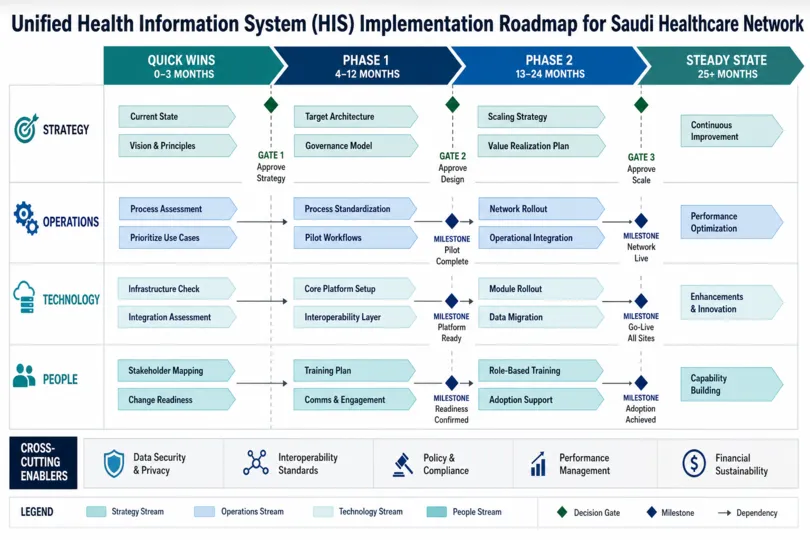
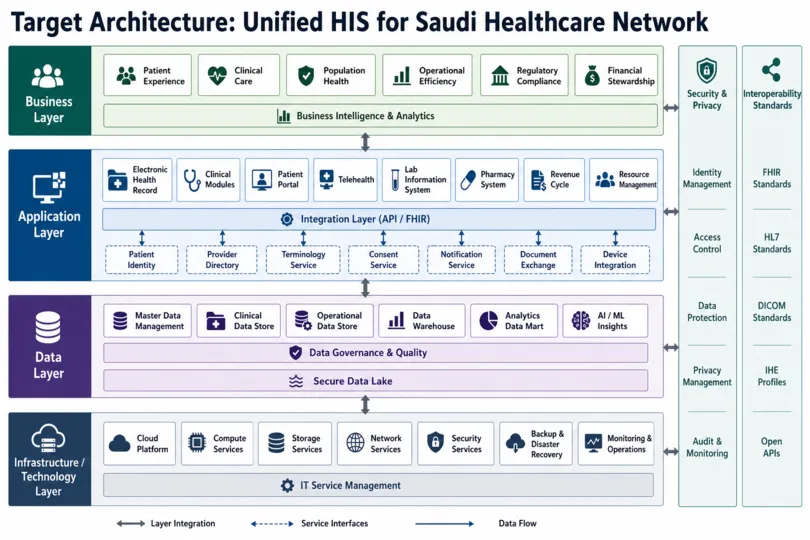
We designed an end-to-end HIS implementation roadmap covering system selection, data migration, workflow redesign, integration architecture, testing protocols, and change management. The solution began with a digital-maturity assessment followed by the definition of HIS functional requirements aligned with clinical and operational needs. A unified data model and integration layer were developed to ensure interoperability with diagnostic devices, PIS systems, and external healthcare platforms. The roadmap included phased deployment, ensuring minimal disruption to services. Comprehensive training programs prepared staff for adoption, while governance structures ensured ongoing performance monitoring and system enhancements.
Approach
Our HIS approach included six structured components:
- Functional requirement definition involving clinicians, administrators, and IT teams.
- Vendor assessment and system selection based on capability, scalability, and compliance alignment.
- Integration architecture design enabling seamless connectivity with PIS, EMR, and diagnostic systems.
- Data migration planning ensuring accuracy, completeness, and confidentiality. User adoption and training programs to maximize engagement and reduce resistance.
- Testing and phased rollout ensuring stability and minimizing clinical disruption.
Recommendations
We delivered recommendations covering HIS implementation and long-term sustainability:
- Adopt a unified HIS across all facilities to ensure data consistency and workflow standardization.
- Establish strong data-governance frameworks covering validation, security, and quality control.
- Deploy cloud-enabled architecture to support scalability and advanced analytics.
- Strengthen cybersecurity protocols including encryption, multi-factor authentication, and threat monitoring.
- Implement a long-term HIS optimization plan driven by user feedback and system performance.
- Integrate HIS with digital health tools such as telemedicine, remote monitoring, and patient portals.
Engagement ROI
The unified HIS implementation produced major improvements in efficiency, data quality, and clinical coordination. Documentation accuracy increased by 35%, and administrative workload decreased by 21% due to automated workflows. Clinicians gained faster access to patient records, contributing to a 29% improvement in clinical decision-making speed. Reporting time decreased by over 40%, while interoperability improvements enabled smoother coordination between departments. Improved data governance reduced errors by 18%, and overall operational efficiency improved by 12–15%, supporting long-term digital health advancement.