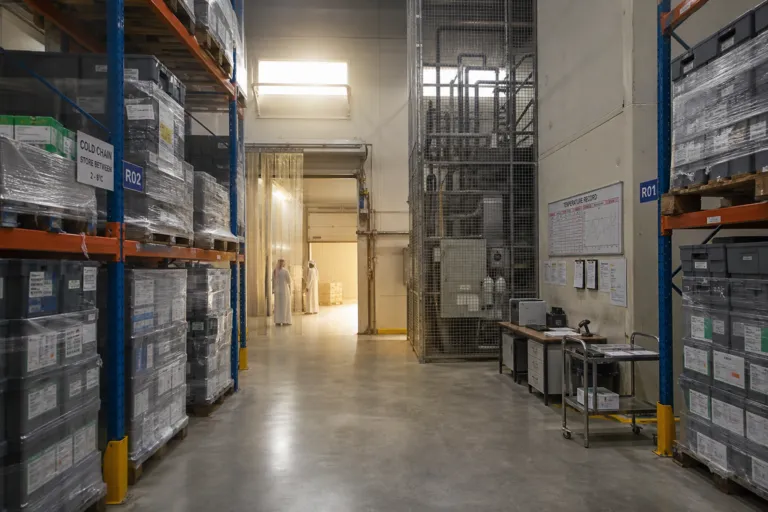
Saudi Arabia’s pharmaceutical growth story increasingly depends on one operational discipline: keeping temperature-sensitive products stable from import docks to patient handoff. Cold chain logistics exists because small temperature changes can ruin a vaccine, insulin, or other high-value medicines. During the COVID-19 pandemic, the system was stress-tested as millions of mRNA doses required an unbroken chain of freezers, GPS-monitored vans, and temperature sensors. In the GCC, the basics are harder because summer temperatures often exceed 45°C, making controlled transport, storage, and handling a daily requirement rather than an optimization project.
Market signals show why executives are treating the Saudi pharma cold chain as a strategic backbone, not a support function. IMARC Group values the Saudi Arabia cold chain market at USD 3.5 billion in 2025 and projects USD 15.9 billion by 2034, with a CAGR of 18.31% from 2026–2034. In pharma logistics specifically, Mordor Intelligence values Saudi Arabia’s pharmaceutical logistics market at USD 3.28 billion in 2025, with estimates rising from USD 3.48 billion in 2026 to USD 4.62 billion by 2031 at a 5.84% CAGR. Those trajectories matter because they point to more SKUs, more delivery points, and higher compliance pressure across the same corridors.
What “Cold Chain” Means in Day-to-Day Saudi Pharma Operations
Cold chain work spans storage, transportation, and handling under controlled conditions, with typical ranges including chilled 0–5°C, frozen -18°C and below, and ultra-low -70°C for certain biologics and vaccines. Enforcement is not optional. Agencies such as the Saudi Food and Drug Authority and the Ministry of Health mandate specific storage and handling conditions for food and pharma products. Mordor Intelligence also notes that non-cold-chain logistics represented 59.97% of the pharmaceutical logistics market size in 2025, while cold-chain logistics is forecast to grow at a 7.84% CAGR through 2031—signaling a shift toward more controlled lanes as product mixes evolve.
Vision 2030 adds momentum by increasing in-country production and raising the bar for domestic distribution readiness. One cited target is 75% localisation of pharmaceutical manufacturing by 2030, which increases the need for reliable storage, tracking, and distribution inside the Kingdom. Import reliance still keeps inbound lanes important: Mordor Intelligence states Saudi Arabia relies on imports for 70% to 80% of its pharmaceutical supply. At the same time, SFDA projects the Kingdom’s pharmaceutical market will reach SAR 50 billion by 2026, growing at a CAGR of 5.5%, reinforcing why capacity, compliance, and visibility must scale together.
Execution gaps are now the growth constraint. One source estimates cold chain operational costs at around SAR 3 billion annually, while access remains uneven, with about 30% of Saudi Arabia’s population living in remote areas with inadequate cold chain infrastructure. Technology is positioned as a lever: AI-powered IoT sensors are estimated to cut product spoilage by up to 40% and reduce cooling energy use by 20% through real-time monitoring and optimization. These gains are most valuable when paired with stricter processes such as temperature deviation reporting, serialization support, and direct-to-patient fulfillment, which are increasingly part of the value-added service mix.
What makes Saudi Arabia’s pharma cold chain so critical?
What temperatures do cold chain operators typically manage for pharmaceuticals?
How fast is Saudi Arabia’s cold chain market projected to grow?
How big is the Saudi Arabia pharmaceutical logistics market today and where is it heading?
What are the biggest operational challenges for reliable cold-chain delivery across the Kingdom?