Antimicrobial resistance is often called a silent threat because it builds in the background while care continues as usual. In Saudi Arabia, the response is increasingly shaped by health system transformation, infection control priorities, and the push for technology-enabled care aligned with Vision 2030 goals. Industry reporting describes Saudi Arabia as a strategic market for antibiotic resistance solutions in the Middle East and Africa, pointing to expanding healthcare infrastructure and strong public health initiatives that create a pull for stewardship and rapid diagnostics. At the same time, global market momentum shows how quickly AMR solutions are becoming a central focus for healthcare innovation, with the global antibiotic resistance market growing from USD 8.4 billion in 2022 to USD 9.4 billion in 2024.
Inside the Kingdom, policy is not only about new drugs. It is also about reducing inappropriate use and improving testing and reporting. Ken Research states that the Ministry of Health National Action Plan for Combating Antimicrobial Resistance was launched in 2017 and updated in 2022, describing measures such as stringent regulations on antibiotic prescriptions, mandatory antimicrobial susceptibility testing, and mandated infection control protocols across healthcare facilities. This same source values the Saudi Arabia antibiotic resistance market at USD 1.1 billion based on a five-year historical analysis, tying growth to rising resistant infections, healthcare spending, and greater stewardship awareness. A separate outlook from Grand View Research reports Saudi Arabia antibiotic resistance market revenue of USD 30.6 million in 2023, expected to reach USD 46.8 million by 2030, and notes the country accounted for 0.4% of the global market in 2023.
Stewardship Becomes a Systems Issue, Not a Side Project
Saudi surveillance and hospital-level studies underline why stewardship is moving from guidance to governance. A ScienceDirect pharmacovigilance paper cites a cross-sectional study at one tertiary medical center in Saudi Arabia finding that 10% of outpatient prescriptions and 47% of emergency department prescriptions contained at least one antibiotic, with more than 50% of these prescriptions not associated with an infection. That pattern matters because broad-spectrum classes are widely used and misuse can intensify resistance pressure. On the resistance side, a 2024 systematic review and meta-analysis of carbapenem-resistant Enterobacterales in Saudi Arabia pooled 69 studies and estimated meropenem and ertapenem resistance prevalences of approximately 9.1% and 18.6%, respectively. The same Saudi overview stresses that evidence remains fragmented across single-center reports, and it notes that no national surveillance study has yet been conducted using gold-standard susceptibility methods.
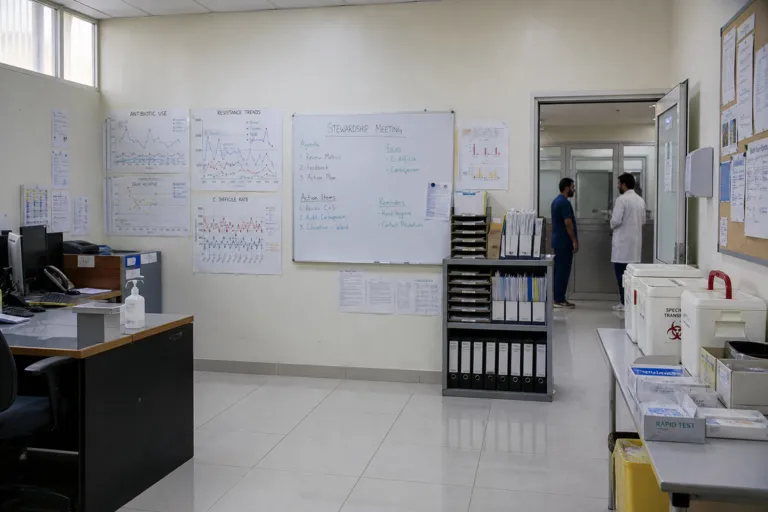
Hospitals are also testing what “mature” stewardship looks like in practice. A quality improvement report describes a restructured antimicrobial stewardship program at a 1,200-bed tertiary military medical center in Riyadh, designed to track stewardship and quality indicators such as antimicrobial consumption, prescribing appropriateness, emergency department blood-culture quality, and surgical antibiotic prophylaxis adherence. These types of operational metrics matter because they connect policy to daily decisions and allow leaders to see where rules and workflows actually change behavior. In parallel, industry analysis argues that stewardship programs launched by governments and organizations provide a foundation for market development, especially where infection control and rapid diagnostics are priorities.
Looking ahead, Saudi antimicrobial resistance efforts will likely be shaped by three converging forces: national policy, institutional execution, and innovation in diagnostics and therapeutics. Polaris Market Research highlights global interest in rapid diagnostics and notes AI’s role in areas like pathogen identification, susceptibility testing, and surveillance support, while also emphasizing that stringent government regulations can hinder market growth. For Saudi Arabia, those constraints can be a feature, not a flaw, if regulations drive better prescribing, better testing, and clearer reporting. The goal is not simply to grow a market; it is to create conditions where stewardship is routine and resistant infections are detected and managed earlier across the healthcare system.
What is Saudi Arabia doing to improve antimicrobial stewardship?
What do Saudi prescribing studies suggest about antibiotic overuse?
What resistance estimates have been reported for CRE in Saudi Arabia?
How big is the Saudi antibiotic resistance market, according to recent sources?
Why is Saudi antimicrobial resistance described as a systems challenge?