Saudi Arabia’s Vision 2030 healthcare transformation is not only about building clinics. It is also about changing how the Kingdom buys and produces critical technologies. The U.S. Department of Commerce notes that Saudi Arabia accounts for 60% of GCC healthcare expenditure, and healthcare is a top government priority. A planned US$13.8 billion investment in medical facilities by 2030 sits alongside major annual funding: in 2024, the government allocated SAR 214 billion (about US$57.1 billion) to healthcare, around 17% of the total budget. For manufacturers, these figures matter because procurement volume and policy direction create the conditions for “Made in Saudi” device programs to scale beyond small pilot lines.
Localization is also tied to how the market is structured and who controls purchasing. Trade.gov highlights NUPCO as the centralized government procurement entity for pharmaceuticals, medical equipment, and supplies supporting public healthcare facilities, while the SFDA monitors and controls imports and distribution of medical devices. In practical terms, this means local manufacturing strategies must be designed around tender requirements, lifecycle service expectations, and compliance systems, not just factory footprint. An IndexBox strategic study frames the decision-making logic of medical device technologies around care settings, workflows, regulatory pathways, service requirements, and replacement cycles. That framework supports a stepwise localization path: begin with categories that are easier to assemble and service locally, then expand into higher-complexity production as quality systems mature.
Where Localization Can Move Fastest: Connected Delivery, Monitoring, and Validation
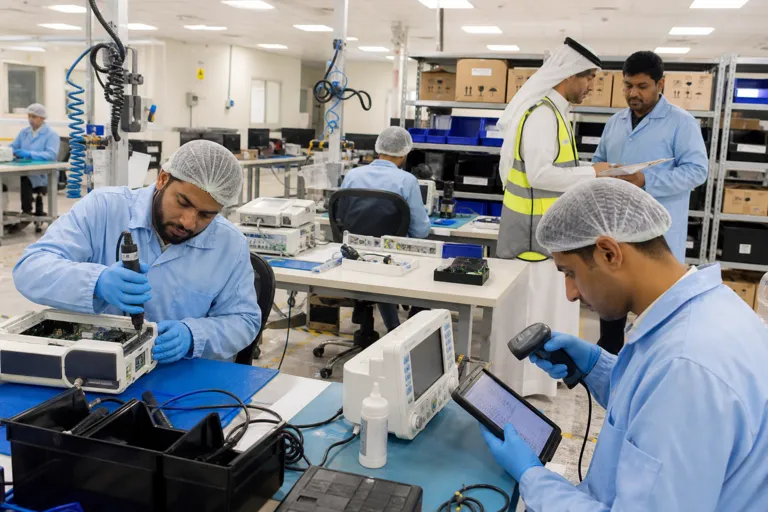
Some device segments show clear import dependence and defined bottlenecks, which makes them good candidates for targeted localization. IndexBox estimates the Saudi Arabia electronic drug delivery systems market at US$180–220 million in 2026, projecting 11–14% CAGR through 2035. In 2026, programmable and wearable infusion pumps plus connected autoinjectors account for about 60–65% of market value. Yet the market is structurally import-dependent, with over 85% of these devices sourced from manufacturers in the United States, Germany, and Switzerland; domestic capacity is described as nascent and focused on final assembly and labeling. This is exactly the kind of profile where local assembly, calibration, packaging, and after-sales support can be scaled first, while component localization is built over time.
However, localization must contend with regulatory and component realities. IndexBox reports that specialized electronic component bottlenecks, including micro-batteries and MEMS dosing mechanisms, can create lead-time variability of 12–18 weeks. It also notes that SFDA approval timelines for drug-device combination products can extend 18–24 months, which can delay launches of connected devices compared to conventional systems. Procurement preferences are moving toward connectivity too: an estimated 40–45% of new tenders in 2025–2026 specify Bluetooth or cellular data transmission for real-time adherence monitoring and clinical data collection. When performance-linked purchasing is introduced, price sensitivity becomes visible: smart autoinjectors are cited at US$80–150 per unit versus US$15–30 for conventional disposable devices, forcing local programs to balance cost, outcomes, and tender acceptance.
In higher-end AI medtech, the localization opportunity is different. IndexBox states there is minimal local manufacturing of high-end medical devices or AI chipsets, and that Saudi Arabia’s emerging role is therefore not in hardware manufacturing but in clinical validation and localization, acting as a gateway for regional expansion. That aligns with a partnership model where manufacturers co-develop and validate with leading providers rather than relying only on distributors, because local clinical data and workflow integration become essential. Across categories, Nexdigm notes that as of 2023 the Saudi government aims to reduce dependence on imports by encouraging domestic manufacturing of medical devices, including health monitoring technologies. Put together, Saudi medical device localization is best executed as a portfolio: local assembly and service for import-heavy connected devices, plus validation and workflow deployment capability for advanced AI solutions.
How does Vision 2030 funding support local medical device manufacturing?
Which Saudi entities most shape medical device procurement and compliance?
What does the electronic drug delivery segment reveal about import dependence in Saudi Arabia?
What constraints slow down local scaling for connected drug-device products?
What is the most practical approach to Saudi Arabia’s medical device localization strategy?