
Across the Middle East, the direction of women’s healthcare is changing. Sources describe demand that still centers on maternal health, contraception, and basic gynecological care, while gradually expanding into chronic and menopause-related treatments. In this context, Saudi Arabia is identified as a key growth market in the region, supported by healthcare system modernization and national transformation initiatives. At the same time, persistent access gaps remain a reality in lower-income regions globally, and private healthcare growth supports premium services in urban markets. This combination—system transformation, private-sector expansion, and a push for more complete lifecycle care—sets the backdrop for how the Saudi women’s health market is evolving.
Maternal care is also framed by the scale of preventable harm worldwide. In March 2024, the World Health Organization (WHO) reported that more than 800 women died every day from preventable causes related to pregnancy and childbirth globally. The same WHO update said approximately 95% of all maternal deaths occurred in low- and lower-middle-income countries, underscoring how uneven access to essential services remains. While these figures are global rather than Saudi-specific, they help explain why maternal health infrastructure and earlier, preventive care pathways are increasingly prioritized. Sources also note that health awareness campaigns, broader access, and more use of digital platforms and wearable devices are encouraging early diagnosis and preventive care.
FemTech Shifts from Apps to Integrated, Personalized Care
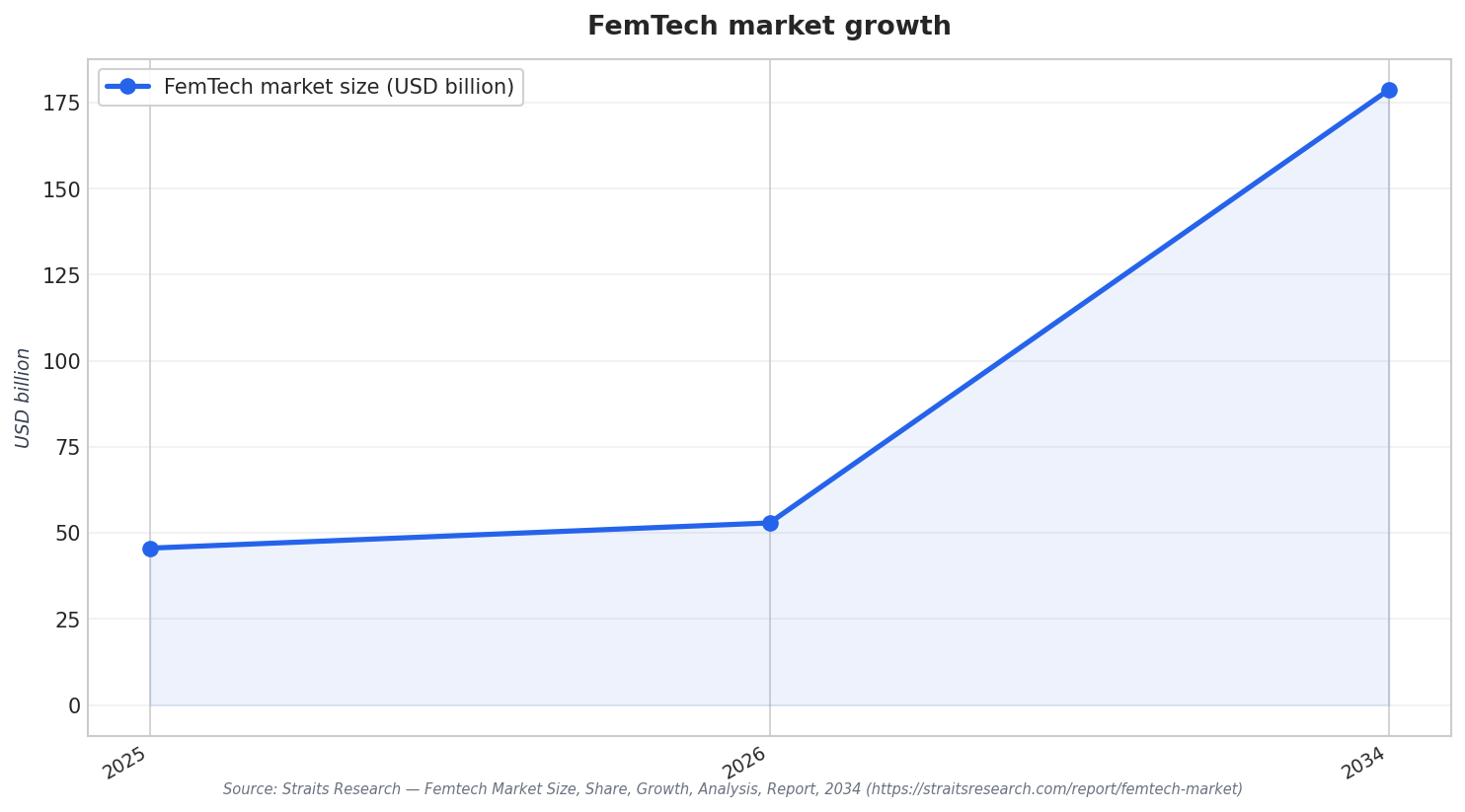
FemTech is repeatedly positioned as a growth lever for women’s healthcare delivery, especially as it moves beyond generic wellness tools toward precision and personalization. One market estimate puts the global femtech market at USD 66.2 billion in 2025, with expected growth at a 14.9% CAGR from 2026 to 2035. Another report values the global market at USD 45.58 billion in 2025 and projects growth from USD 52.90 billion in 2026 to USD 178.76 billion by 2034, at a CAGR of 16.44% during 2026–2034. In that same dataset, pregnancy and nursing care led by application with a 20.45% revenue share in 2025, and direct-to-consumer led end use with a 35.66% share. These global splits map closely to what many health systems are trying to improve: pregnancy pathways, ongoing monitoring, and easier access outside traditional clinic schedules.
For Saudi Arabia specifically, sources point to growing women’s health awareness initiatives, with an emphasis on preventive care and early treatment for menopause, maternal health concerns, and fertility-related issues. Another report notes that the UAE and Saudi Arabia have invested in women’s health infrastructure as part of national healthcare transformation programmes, while also highlighting that cultural sensitivity around reproductive and sexual health can create both differentiation opportunities for privacy-first platforms and barriers for apps marketed with explicit messaging. On the product side, leading femtech companies are described as building AI-driven health analytics, app-based symptom tracking, wearable integration, cloud-enabled storage, and real-time monitoring across reproductive, maternal, and hormonal use cases. This is part of a broader lifecycle approach that extends beyond reproductive care into fertility, menopause management, and gender-specific diagnostics.
Investment patterns in adjacent markets show how quickly femtech can scale once employer and health-system demand aligns. One source reports that Midi Health raised USD 65.0 million in 2024 to scale a virtual menopause care service, reflecting employer recognition of menopause-related productivity loss and healthcare utilization as a workforce management cost. Another notes a USD 100 million federal commitment tied to the White House Initiative on Women’s Health Research, announced in 2023 and released in February 2024, directing agencies to prioritize research into conditions that uniquely or disproportionately affect women, including menopause and maternal mortality. While these examples are from outside Saudi Arabia, they illustrate how research funding and scaled service models can accelerate evidence generation and adoption—signals that matter as Saudi Arabia’s women’s health ecosystem continues to integrate digital care and more preventive maternal pathways.
What is driving growth in Saudi Arabia’s women’s health landscape?
How large is the global FemTech market, according to the sources?
Which FemTech application area leads globally in revenue share?
What do WHO figures say about preventable maternal deaths worldwide?
What opportunities and barriers are noted for FemTech adoption in Saudi Arabia?