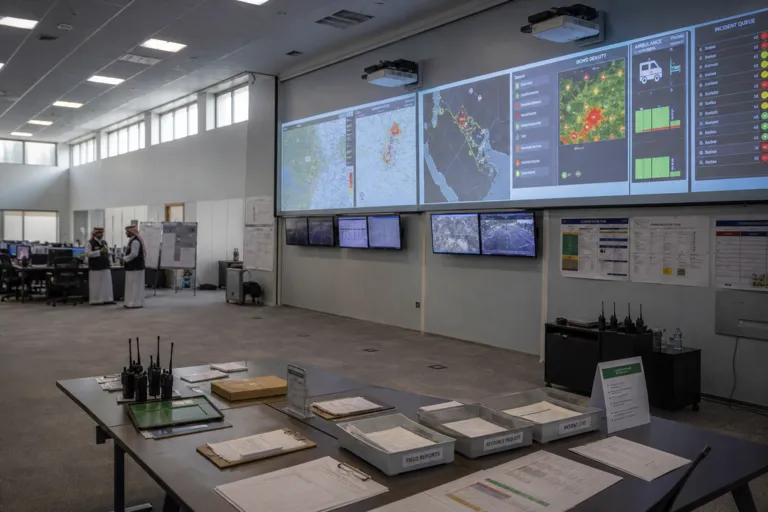
Match-day medicine is not just an emergency-room problem. It is a whole system challenge that starts long before kick-off. For Saudi Arabia, that planning window is defined by two non-negotiable milestones inside Vision 2030: Expo 2030 Riyadh and the FIFA World Cup 2034. Sources describing the investment stack note that the two events now sit at the top of national priorities, driven by fixed delivery deadlines that accelerate work across stadiums, transport, airports, hotels, utilities, and urban development. This matters for healthcare operations because every new venue and mobility upgrade changes crowd flows, response routes, and surge demand patterns that medical leaders must model early.
Public health preparedness is already being framed as central to upcoming FIFA mass gatherings in 2026, 2030, and 2034. A Journal of Travel Medicine article highlights that, for host-country planning, Saudi Arabia’s historic and demonstrated stewardship in annual and year-around implementation of Hajj medical services can serve as a model. The same source stresses how the 2034 tournament will be the first time FIFA is hosted in a country that hosts other mass gatherings, naming Umrah and Hajj. That overlap is a unique planning context. It pushes readiness beyond stadium clinics and into systems for monitoring, triage, patient transport, and coordinated response across a country that already operates large-scale pilgrimage healthcare services.
Turning Fixed Deadlines Into Field-Tested Health Systems
Expo 2030 Riyadh can function as a proving ground for match-day medical operations at scale. An analysis source states the event was awarded to Riyadh in November 2023 with an official budget of approximately USD 7.8 billion. The same analysis describes Expo 2030 as a global showcase four years before the World Cup, positioned as a proof-of-concept for the larger tournament. In practical healthcare terms, that sequencing supports a build-test-improve cycle. Planners can use Expo’s operational tempo to validate medical command structures, patient routing assumptions, and cross-agency coordination, then carry the lessons into 2034 planning when demand will be distributed across multiple host cities and stadium sites.
The World Cup footprint itself creates clear parameters for match-day medical coverage. FIFA confirmed Saudi Arabia as the 2034 host through an Extraordinary FIFA Congress where all 211 FIFA Member Associations convened virtually. One market report states the tournament is planned across five cities and 15 stadiums, while another report lists host-city locations as Riyadh, Jeddah, Al Khobar, Abha, and NEOM. A stadium profile example includes the 92,000-seat King Salman International Stadium. For healthcare readiness, those facts underscore the need for consistent standards across venues and a networked approach to medical staffing, ambulance staging, and referral pathways that can function across distinct urban geographies.
Healthcare planning should also track the broader build-out that mega-events pull into place. A construction pipeline report describes Expo 2030 and the FIFA World Cup 2034 as a combined pipeline exceeding USD 100 billion, spanning infrastructure, stadiums, hospitality, and transport. The same report says Saudi Arabia’s non-oil economy contributed 53.2% of GDP in Q1 2025, framing these programmes as part of wider economic diversification. Another source notes PIF construction spending declined from around USD 71.0 billion in 2024 to below USD 30.0 billion in 2025, describing a reallocation of capital rather than a broad withdrawal from infrastructure development. In this context, saudi world cup 2034 healthcare readiness should be designed to plug into fast-moving, event-led construction schedules, so medical capacity, access roads, and emergency workflows are aligned with what is actually delivered, when it is delivered.
How does Saudi Arabia’s World Cup 2034 healthcare readiness connect to Expo 2030 Riyadh?
Why do public health experts see Saudi Arabia as having a model for FIFA mass gatherings?
How many cities and stadiums are referenced for the FIFA World Cup 2034 in Saudi Arabia?
What is one stadium capacity figure mentioned for World Cup planning?
What investment signals show how fixed deadlines shape preparations for Expo 2030 and the World Cup?