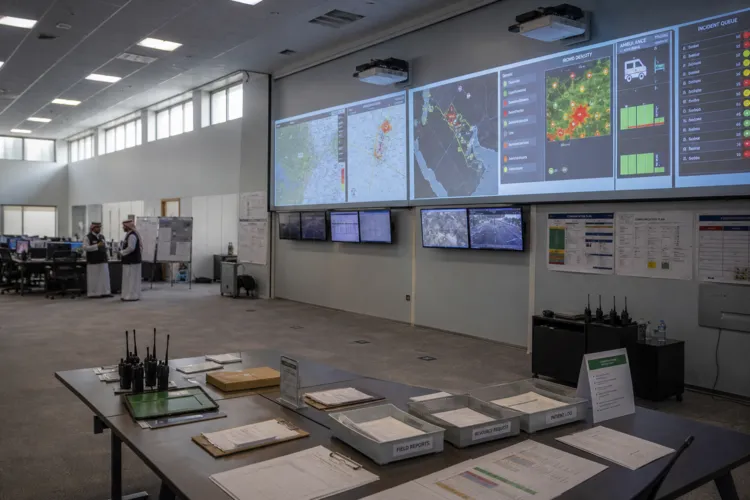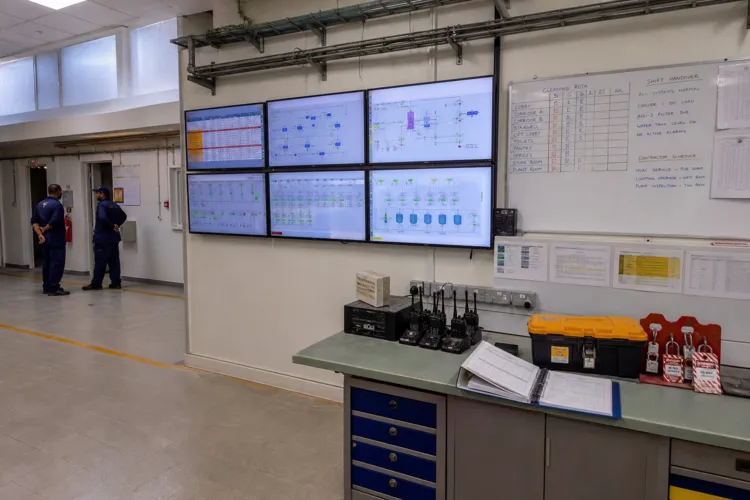
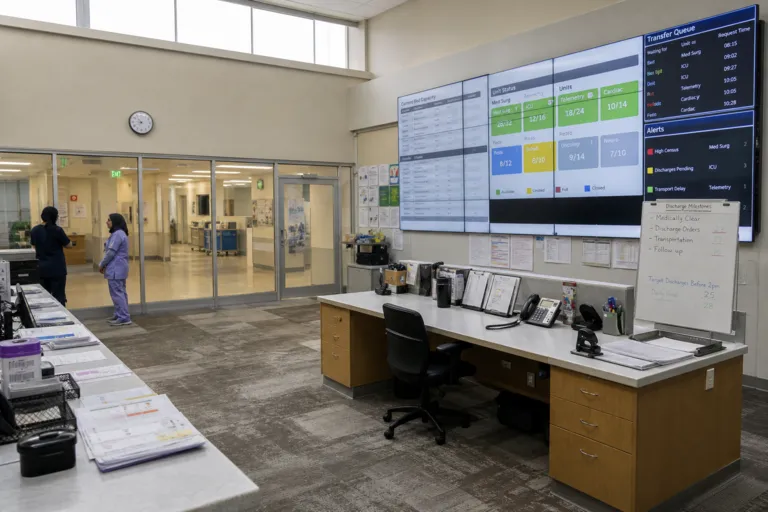
A command center model—often compared to NASA’s Mission Control—has become a practical way to manage patient flow when demand is high and resources are limited. In the sources, hospital command centers are described as centralized analytics hubs that monitor capacity, inventory, and patient flow, with the goal of supporting patient safety and quality of care. These hubs are positioned as a “single source of truth” that integrates real-time data across the hospital or across multiple hospitals. For leaders thinking about a Saudi hospital command center, the core idea is operational visibility: instead of departments acting as silos, a cross-functional team can see bottlenecks forming and coordinate actions such as patient placement, staffing adjustments, or discharge prioritization.
The operational case for command centers is illustrated most clearly through results reported by U.S. health systems, which should be read as international context rather than local Saudi performance. AdventHealth opened its “Mission Control” center in 2019 to orchestrate care across nine campuses. Between its debut and fall 2022, AdventHealth reported three measurable changes: emergency room admission-to-bed placement time fell by more than 23 minutes, the phone call abandonment rate for the AdventHealth Transfer Center decreased from 8% to 3%, and transport times for interhospital transfers dropped by more than 15 minutes. These are the kinds of end-to-end metrics a command center can track and improve when it has a live view of demand, beds, and transport constraints.
What “Unlocking Capacity” Looks Like in Practice
Capacity gains do not always require building new beds; they can come from removing process friction that keeps existing beds unusable. A Sutter Health case study offers a concrete example of this logic. Sutter Health, an integrated not-for-profit health system with 27 hospitals, launched a centralized command center in January 2025 after facing imbalance across facilities, with some sites having unoccupied beds while others were overcrowded. During the 2025 calendar year, Sutter reported that three pilot hospitals accelerated emergency department arrival-to-departure time by 8%, increased transfers and direct admissions by 29%, increased discharges by 4%, and reduced net days above Geometric Mean Length of Stay by 27%—which it described as the equivalent of adding 12 beds per day. In planning terms, this is “capacity unlocking” via throughput.
Several sources emphasize that the command center approach is not only a dashboard. It is an operating model that breaks down barriers between the emergency department, surgical units, and inpatient floors, so staff can coordinate around shared constraints. One article describes how command centers can help teams see how many patients are waiting in the ER, which surgical cases are running behind schedule, and where beds are about to become available, enabling proactive interventions. Another source highlights that patient flow and capacity management accounts for the largest share of the hospital command centers market, driven by emphasis on improving throughput, reducing emergency department congestion, optimizing resource utilization, and enhancing patient care coordination. In that same context, market participants are building AI-powered platforms, predictive analytics, centralized dashboards, and digital twin-based simulation tools.
Execution often comes down to standard work and milestone management. In the Sutter example, one tactic was standardizing processes across the health system because each hospital previously had different admission, transfer, and discharge order sets and workflows. Separately, another source describes how discharge is a chain of coordinated steps across physicians, nurses, pharmacy, therapy, and transport, and that command center software can track discharge milestones in real time and alert staff when tasks stall. For Saudi health leaders evaluating a Saudi Arabia command center, these sources suggest a practical blueprint: define the mission (capacity, patient safety, and quality), build a shared view of system-wide constraints, and then hardwire standardized transitions of care so the “mission control” room can continuously convert visibility into action.
What is a hospital command center designed to do?
What measurable results have mission-control style centers reported in U.S. health systems?
How can a Saudi hospital command center help unlock capacity without new construction?
Why do command centers focus so heavily on discharges?