Saudi hospitals are moving faster toward minimally invasive care, and robotic platforms are becoming a visible part of that shift. Ken Research values the Saudi Arabia Laparoscopic Robotic Assisted Procedures Market at USD 38 million based on a five-year historical analysis, while a separate Ken Research view values the Saudi Arabia Surgical Robot Procedures Market at approximately USD 50 million. These figures cover different scopes, but together they show sustained commercial focus on robot-assisted procedure ecosystems. In practice, the dominant users are described as tertiary hospitals and medical cities, because they can handle complex cases and have the infrastructure to support advanced workflows.
Policy and demand signals are also aligning behind this change. Ken Research cites the Saudi Ministry of Health expectation that around 65% of surgeries in Saudi Arabia are expected to be minimally invasive in the future. It also cites a World Health Organization estimate that approximately 8 million adults in Saudi Arabia are living with diabetes “as of now,” a burden that can increase the need for advanced interventions. At the facility level, Ken Research notes that ambulatory surgical centers are gaining traction as preference rises for outpatient surgeries, while specialty clinics focus on specific surgical areas. Hospitals still lead, due to the concentration of complex cases and access to advanced platforms.
What’s Changing Inside the Operating Room
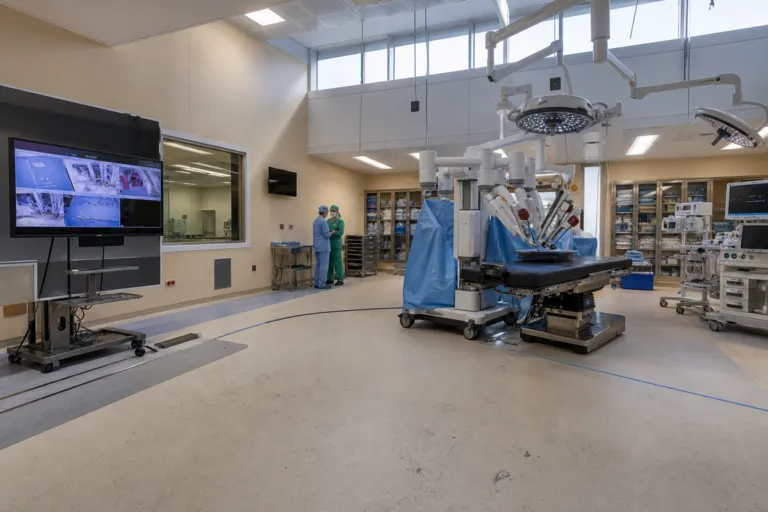
Several sources describe why adoption rises when hospitals modernize equipment and standardize supporting services. Ken Research says the introduction of new robotic platforms, like the da Vinci Xi, has led to a 25% increase in robotic-assisted surgeries in major hospitals. But the technology is only one layer. Ken Research segments the Saudi market into robotic surgical systems, instruments and accessories, and services such as maintenance and training. IndexBox similarly frames surgical robot procedures as an integrated ecosystem of capital equipment, disposable and reusable instruments, software, and services enabling robot-assisted minimally invasive surgery.
Procurement and operating costs also shape how programs scale. IndexBox describes Saudi Arabia’s role in robotic surgical system disposables as a high-value, tender-driven import market rather than a manufacturing or supply-chain hub for these devices. It defines disposables as single-use, procedure-specific instruments, accessories, and consumables. Global context helps explain why this matters: GM Insights reports instruments and accessories held a 68% market share in 2024, driven by recurring use in every procedure and continuous product upgrades. The same report notes the robot systems segment generated USD 2.6 billion in revenue in 2024, with projections indicating 16% CAGR from 2025 to 2034.
Capacity is not only about equipment; it also depends on trained teams and care settings. Ken Research states that, as of now, only about 250 surgeons in Saudi Arabia are certified to operate robotic systems, which can limit wider implementation. Meanwhile, government modernization efforts are part of the backdrop: Ken Research notes that in 2023 the Saudi Arabian government implemented the Health Sector Transformation Program, aimed at enhancing healthcare services through advanced technologies including surgical robots. It also states that over 350 new hospitals are planned in the near future, which could expand access points for programs that can staff and sustain safe robotic workflows—an important consideration for anyone tracking saudi robotic surgery as it scales.
What do market estimates say about robot-assisted procedures in Saudi Arabia?
How much of Saudi Arabia’s surgical care is expected to become minimally invasive?
What changed in major hospitals after new robotic platforms were introduced?
What is one workforce constraint affecting Saudi robotic surgery programs?
How do disposables and accessories affect robotic surgery economics?