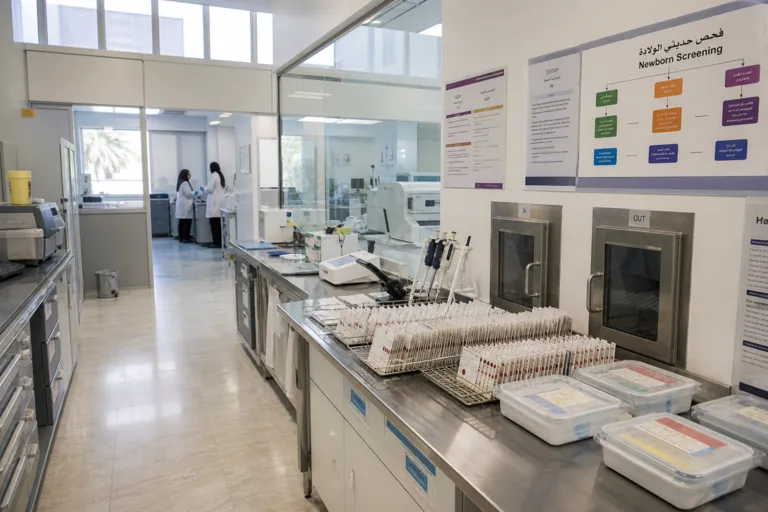
Saudi Arabia’s rare-disease and orphan-drug opportunity sits at the intersection of unmet need and system-level investment. Industry analysis links the country’s market expansion to increasing prevalence of genetic disorders, rising investments in healthcare infrastructure, and government-led rare-disease programs under Vision 2030. The same source notes active upgrades to diagnostic capabilities and the establishment of specialized treatment centers, both of which increase demand for orphan drugs and advanced therapies. In regional context, Saudi Arabia is expected to experience substantial growth within the Middle East and Africa market in 2025, as rare-disease infrastructure and treatment pathways continue to mature.
Local evidence underscores why diagnostics and long-term datasets matter for planning. A 2026 systematic review defines a rare disease as a condition affecting fewer than 1 in 2,000 individuals, consistent with the European Medicines Agency and Orphanet criteria. It also reports that the incidence of neurometabolic disorders in Saudi Arabia (1:635) exceeds world averages, and that exome sequencing has identified numerous autosomal recessive variants. At the same time, the review notes that most research focuses on Riyadh, Jeddah, and the Eastern Province, and that very few large-scale prospective studies have been conducted—leaving gaps that can affect screening, referral patterns, and payer-ready evidence.
What “Access” Really Means: SFDA Signals, Evidence Discipline, and Tender Reality
For companies evaluating the Saudi rare disease market, access strategy has to be built for local decision-making, not imported as a generic global template. A 2026 briefing on rare disease and orphan-drug access in Saudi Arabia stresses evidence discipline—separating regulatory facts from commercial forecasts—and highlights that Gulf uptake depends on rules and mechanics across NUPCO, MOHAP, and private insurers more than on global headline market size. The same briefing points to practical execution issues, including aligning sampling, payer interviews, and dossier modules to local formulary and tender mechanics, while ensuring Arabic labeling and pharmacovigilance plans are ready when modules are reused from FDA or EU submissions.
Global market signals help frame why orphan drugs remain strategically important even when patient pools are small. Mordor Intelligence estimates the rare disease treatment market will grow from USD 242.5 billion in 2025 to USD 271.07 billion in 2026 and reach USD 472.89 billion by 2031, at an 11.8% CAGR over 2026–2031. In that same report, oncological rare diseases held 41.89% market share in 2025, while biologics and monoclonal antibodies accounted for 50.74%. MarketResearchFuture projects the orphan drugs market will rise from USD 278.35 billion in 2025 to USD 663.94 billion by 2035 at a 9.08% CAGR, while noting the Middle East and Africa region as an untapped market with a 2024 market size of 7.18 million.
Opportunity in Saudi Arabia will be shaped by how fast diagnosis, centers of excellence, and payer processes translate into real-world access. GlobalMi Insights attributes Saudi growth to infrastructure investment, diagnostic upgrades, and specialized centers, while also pointing to the role of precision medicine and supportive regulatory frameworks such as orphan-drug designations. It adds that more than 50% of new drug approvals are found to be orphan drugs, reflecting a growing focus on rare-disease therapies. Yet the Saudi evidence base still needs broader, prospective studies, as highlighted by the 2026 systematic review. The most durable winners will pair local research generation with tender-ready value stories that match what Saudi committees and payers can evaluate.
What is driving growth in Saudi Arabia’s rare-disease and orphan-drug space?
How is a rare disease defined in the Saudi evidence review?
What does the literature say about neurometabolic disorders in Saudi Arabia?
How should teams approach access planning for the Saudi rare disease market?
What global market context matters for orphan drugs and rare-disease treatments?