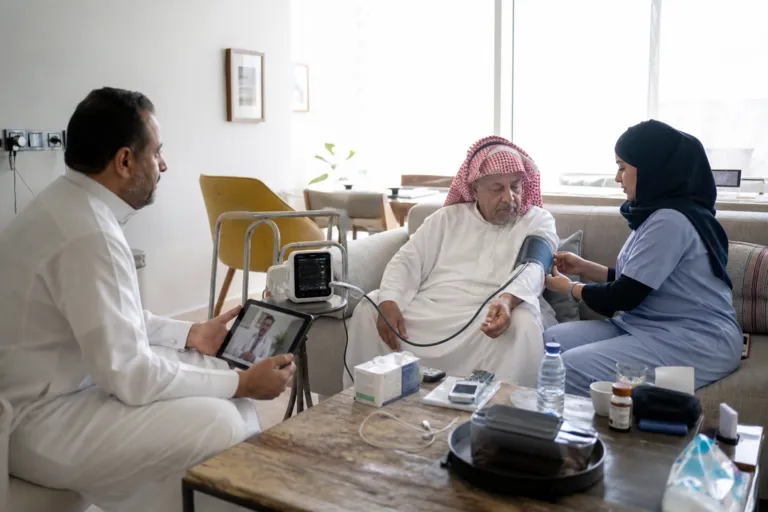
Care delivery in Saudi Arabia is shifting closer to patients, and the saudi home healthcare market is increasingly defined by at-home treatment, monitoring, and support. Grand View Research estimates the country generated USD 1,525.2 million in revenue in 2024 and is expected to reach USD 2,297.0 million by 2030, with a 7.1% CAGR expected from 2025 to 2030. Within Middle East & Africa, the same source projects Saudi Arabia will lead the regional market in revenue in 2030, while Oman is projected to reach USD 220.7 million by 2030. This momentum aligns with a broader push toward remote and home monitoring and a preference for care models that reduce friction for patients and families.
How the market organizes itself matters as much as top-line growth. Ken Research segments Saudi Arabia’s home health care by service type, highlighting skilled nursing care, rehabilitation therapy (including physical, occupational, and speech therapy), hospice and palliative care, and unskilled home care for personal assistance. It also cites other service lines such as respiratory therapy, maternal care, and companion care, describing them as increasingly in demand due to a growing elderly population. On the product side, Ken Research groups demand into therapeutic products, testing and monitoring products for remote tracking, mobility care products, and wound and continence care products. Across these categories, remote monitoring and at-home clinical management are positioned as central to how providers differentiate and scale care outside hospitals.
What Is Driving Demand: Elderly Care, Equipment, and Telehealth
Ken Research also frames the market by type, including Medical Equipment, Home Health Aides, Telehealth Services, Home Modifications, and Others, and states that Medical Equipment is the leading subsegment. In its end-user view, it lists Elderly Patients, Patients with Disabilities, Post-Surgical Patients, and Others, and says the Elderly Patients segment dominates due to an increasing aging population in Saudi Arabia. This structure helps explain why monitoring systems, mobility support, and therapy pathways are so prominent in at-home programs. It also underscores why workforce capacity and service design are key, because elderly-focused home care typically requires repeat visits, continuity, and coordinated clinical oversight across services and equipment.
Multiple sources describe a fast-evolving competitive landscape. Ken Research lists a mix of regional and international participants active in home-based services and enabling technologies, including Saudi Home Healthcare Company, Dr. Sulaiman Al Habib Medical Group – Home Care Services, Saudi German Health – Home Care Services, and several major hospital programs and government-linked services such as the Ministry of Health Home Care Program. Enablers include companies like Philips Healthcare Saudi Arabia for remote monitoring solutions and ResMed Saudi Arabia for home respiratory and sleep therapy solutions. MarketDataForecast adds a regional perspective, stating Saudi Arabia led the Middle East & Africa home healthcare market with a 33.5% share in 2024, and it links the Kingdom’s dominance to Vision 2030-driven healthcare transformation that prioritizes home-based care, including skilled nursing, infusion therapy, and telemonitoring.
At the same time, the expansion comes with constraints and open opportunities. MarketDataForecast points to the scarcity of trained home healthcare professionals as a major restraint in the Middle East & Africa market, noting the World Health Organization’s estimate that Africa faces a deficit of 2.4 million health workers, and adding that Saudi Arabia reported a notable vacancy rate in home care nursing positions within the Ministry of Health’s home services division. On the opportunity side, Ken Research (via MarketResearch.com) says telehealth consultations in Saudi Arabia are expected to increase to over 6 million in the future, creating room for home healthcare providers to integrate telehealth for monitoring and care coordination. Together, these factors suggest growth will reward providers that can build staffing pipelines while using telehealth and remote monitoring to extend clinical reach.
How fast is Saudi Arabia’s home healthcare revenue expected to grow through 2030?
Which segments are emphasized in Saudi Arabia’s home-based care offerings?
What is the leading type segment in the Saudi home healthcare market?
How does Saudi Arabia compare to the wider Middle East & Africa home healthcare market?
What is one major opportunity and one major challenge for expansion at home?