Saudi Arabia’s push to modernize healthcare is helping AI move from research pilots into everyday drug development work. Market commentary links the shift to growing demand for AI-driven, personalized discovery as disease profiles become more complex and diagnostics improve. Hospitals, research institutions, and pharmaceutical companies are under pressure to accelerate development timelines, which is pushing adoption of AI strategies aimed at improving efficiency and outcomes. In the same context, government efforts to digitize healthcare, promote innovation in pharmaceutical research, and strengthen regulatory frameworks are repeatedly cited as adoption drivers across both public and private health sectors.
Forecasts quantify this momentum in different ways, underscoring how model-dependent the space can be. One report values the Saudi Arabia AI in drug discovery market at USD 1.2 billion, based on a five-year historical analysis, and ties growth to AI integration in healthcare, government support, and demand for more efficient drug processes in major cities. It also points to Riyadh, Jeddah, and Dammam as dominant hubs due to healthcare infrastructure, the presence of leading pharmaceutical companies, and initiatives designed to foster innovation. A separate Saudi outlook estimates USD 4.2 million in revenue in 2025, rising to USD 24.9 million by 2033, with a stated CAGR of 25.1% from 2026 to 2033.
What Changes When Discovery Becomes a Data Loop
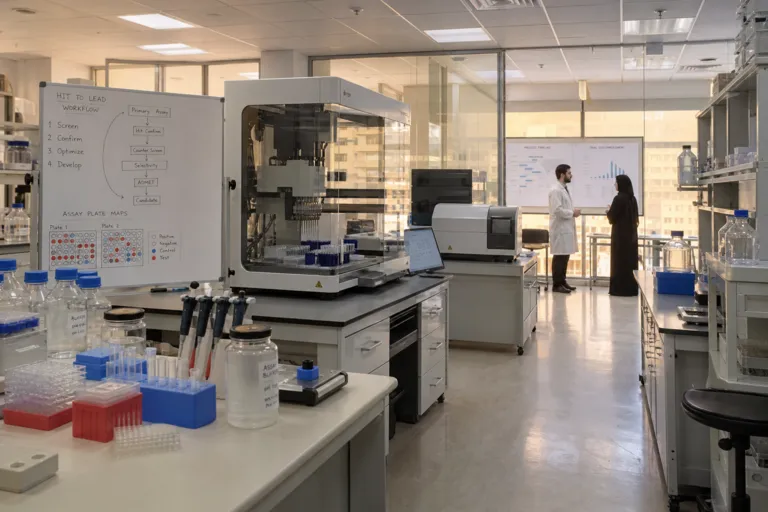
The workflow change described in Saudi-focused analysis is a shift from linear lab cycles toward data-driven loops that prioritize prediction, screening, and faster iteration. Methods cited include deep learning models, natural language processing, predictive analytics, and generative algorithms. Use cases span target identification, lead optimization, drug repurposing, de novo drug designing, and preclinical testing. In Saudi market segmentation, commonly referenced technology types include predictive analytics, machine learning models, natural language processing, and computer vision. On the application side, drug discovery leads, while clinical trials, patient stratification, and drug repurposing are also highlighted as practical points where AI can support more personalized medicine and more efficient pipelines.
Clinical trials are expected to be one of the most visible adoption zones. A Saudi-focused forecast states that, by the future, 25% of clinical trials in Saudi Arabia will incorporate AI technologies to streamline patient recruitment and data analysis, positioning AI as a lever to reduce timelines and improve result accuracy. At the regulatory interface, the CEO of the Saudi Food and Drug Authority (SFDA), Dr. Hisham Al-Jadhey, has said that AI shortens stages of drug development and discovery. Together, these signals suggest that Saudi AI drug discovery will increasingly be judged on execution in trial operations, not only on model performance in early research stages.
Saudi growth is also framed in the context of research partnerships and wider global momentum. Grand View Research notes that the region is driven by government-led initiatives to modernize healthcare systems and adopt AI-driven solutions, adding that countries such as Saudi Arabia and the UAE are actively investing in digital health and precision medicine, including AI-based drug repurposing research. One concrete example cited for Saudi Arabia is an October 2020 partnership in which the University of Oxford entered into a collaboration with King Abdulaziz University (KAU) to discover novel treatments for rare genetic conditions and common diseases. In parallel, global context shows scale: Polaris Market Research values the worldwide AI in drug discovery market at USD 2.29 billion in 2025, with North America holding 38.0% share that year and the Asia Pacific region expected to post a 27.40% CAGR during 2026–2034.
What do current forecasts say about Saudi Arabia’s AI in drug discovery market size?
Which Saudi cities are described as hubs for AI-enabled drug discovery activity?
How is AI expected to show up in clinical trials in Saudi Arabia?
What is a cited example of an international partnership supporting Saudi research momentum?
How is Saudi AI-driven drug discovery positioned versus global market context?