Saudi Arabia is entering a new phase of drug-spend discipline. Multiple sources forecast strong market expansion, which raises the stakes for how payers and providers manage prescriptions, coverage rules, and dispensing channels. One outlook values the Saudi Arabia pharmaceutical market at USD 11.0 billion in 2025 and estimates USD 11.7 billion in 2026, projecting USD 21.6 billion by 2036 with a 6.3% CAGR from 2026 to 2036. Another forecast frames the Saudi Arabia pharmaceutical drugs market at USD 15.73 billion in 2026, crossing USD 26.61 billion by 2033 at a 7.8% CAGR. As volumes and budgets grow, the question becomes whether Saudi pharmacy benefit management models can scale beyond procurement into day-to-day utilization control.
Procurement reform is already a major lever. In December 2025, Saudi Arabia announced that NUPCO’s 2026 tenders would reject foreign bids where an SFDA-approved local alternative is available, reinforcing a preference within public purchasing. The same source states that government procurement accounts for approximately 54% of the country’s SAR 30 billion pharmaceutical market, indicating how much spending sits inside centralized buying. Manufacturing capacity also signals a push toward local supply: Sudair Industrial City expanded to 421 facilities after 12% growth in 2024. These steps can reduce acquisition costs, but they do not automatically solve benefit design, claims controls, or consistent formulary enforcement across payers and providers.
Where PBM Tools Fit: Formulary, Claims, and Economic Value
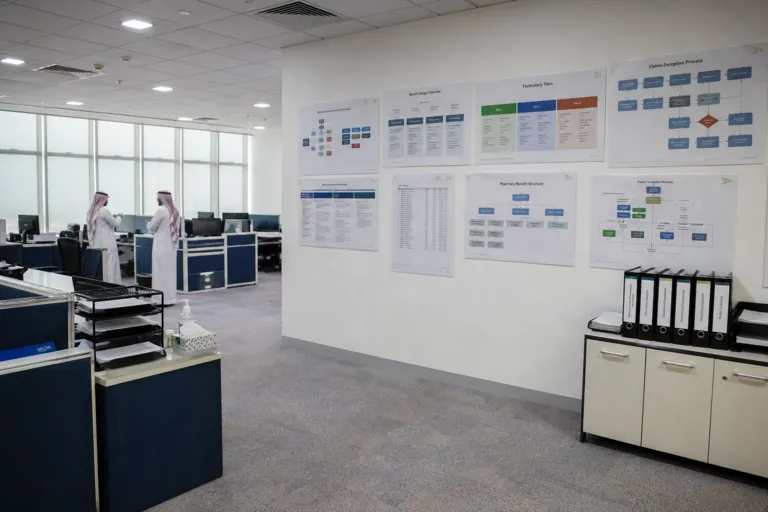
Pharmacy benefit management, as defined in global market reports, focuses on optimizing prescription drug programs through services such as benefit plan design, pharmacy claims processing, and formulary management. Globally, the PBM market is large: one report values it at USD 593.30 billion in 2025 and projects 5.5% CAGR from 2026 to 2034, while another estimates USD 651.82 billion in 2025 and expects growth to around USD 1,076.41 billion by 2035 at a 5.1% CAGR. These global splits also highlight what tends to matter operationally: pharmacy claims processing held 25.6% of global revenue share in 2025 in one report, and specialty pharmacy services held 33.4% share in 2025 in another. In Saudi Arabia, a key enabling step is already in place: SFDA implemented version 1.1 of its pharmacoeconomic evaluation guideline on July 1, 2025, making full economic evaluations mandatory for pharmaceutical assessments.
Adoption dynamics will also be shaped by how care is delivered and where medicines are dispensed. One forecast says hospital pharmacies are expected to hold 48.6% share of Saudi distribution channel demand in 2026, reflecting the importance of institutional dispensing and supervised therapy. Another projection says prescription products hold 61.6% of the product-type segment in 2026. On the commercial mix, branded drugs are projected to hold approximately 51.6% of the Saudi Arabia pharmaceutical drugs market during the forecast period. This context matters for PBM-style approaches because the biggest savings opportunities often come from aligning formularies, prior authorization, and substitution rules with what providers actually prescribe and where patients pick up medicines. It also means any PBM operating model must integrate with hospital workflows, not only retail networks.
International comparisons show both opportunity and caution. A PBM market report notes that, in 2022, healthcare expenditure of the GCC countries crossed the USD 50 billion mark and that drug benefits were becoming a salient feature in insurance policies; it highlights Saudi Arabia’s NUPCO unifying pharmaceutical purchases to realize savings. However, most detailed PBM performance figures in the available sources are from outside the Kingdom. For example, one report cites U.S. specialty drug expenditures reaching USD 485.4 billion in 2025, representing 53.0% of total prescription expenditures, and another references U.S. Medicare Part D activity including 50.8 million utilizing beneficiaries and 1.6 billion prescription drug events in 2023. For Saudi Arabia, the practical path is to pair centralized purchasing and mandatory pharmacoeconomic review with PBM capabilities in claims processing, formulary governance, and specialty-drug pathways, while ensuring transparency amid the regulatory scrutiny that global PBM reports flag as a constraint.
What recent Saudi policy changes could support PBM-style cost controls?
How large is Saudi Arabia’s pharmaceutical market in the near term, according to the sources?
Where are medicines most often dispensed in Saudi Arabia, based on the forecasts cited?
What is the case for Saudi pharmacy benefit management as drug budgets grow?