Precision imaging and targeted radionuclide therapy are reshaping how hospitals and imaging centers approach oncology care. In the Saudi Arabia and Middle East radioisotope market, demand is being linked to growing use of nuclear medicine diagnostics and treatment across healthcare facilities, as well as the broader adoption of precision oncology. Coherent Market Insights valued the Saudi Arabia and Middle East radioisotope market at US$ 772.6 Mn in 2026 and expects it to reach US$ 1,655.3 Mn by 2033, reflecting a CAGR of 11.5% from 2026 to 2033. The same source notes a persistent constraint: limited local production, with the region still relying on imports to meet most demand.
Within that regional picture, Saudi Arabia is described as the dominant leader, accounting for over half of the total market share in the Saudi Arabia and Middle East radioisotope market. The cited drivers include strong government support for healthcare development, significant public and private investment to boost manufacturing infrastructure, and efforts to facilitate access to advanced medical facilities. Coherent Market Insights also highlights Saudi Arabia’s strategic location and trade relationships as advantages for serving nearby international markets, with isotope exports described as a key revenue source for companies based in the country. This combination ties the Saudi radiopharmaceuticals nuclear medicine opportunity to both local clinical growth and regional supply-chain positioning.
Theranostics Momentum Is Pulling Diagnostics and Therapy Together
Across the broader market, theranostics is increasingly framed as the bridge between imaging and treatment by pairing diagnostic and therapeutic radiopharmaceuticals in a single clinical pathway. Grand View Research describes market growth being supported by PET and SPECT imaging and by theranostic techniques that integrate diagnosis and treatment. Business Research Insights adds that over 60% of new nuclear medicine developments combine diagnostic and therapeutic capabilities. On the diagnostics side, Grand View Research estimates diagnostic radiopharmaceuticals held 75.5% of global market share in 2025, while therapeutic radiopharmaceuticals are anticipated to grow at the fastest CAGR during the forecast period. This reinforces why stakeholders focus on end-to-end pathways rather than isolated products.
Growth signals also show up in procedure and market forecasts, but the geography must be kept explicit. Business Research Insights states that in the Middle East and Africa, nuclear imaging procedures have increased by 30% over the past decade, and that the Middle East accounts for nearly 70% of regional demand led by Saudi Arabia and the UAE. For the GCC specifically, Dimension Market Research forecasts radiopharmaceuticals growth from $218.4 Mn in 2026 to $682.6 Mn by 2035 at a 13.5% CAGR, and notes diagnostics at 68.9% with Saudi Arabia leading. Globally, Grand View Research values the radiopharmaceuticals market at USD 10.3 billion in 2025, projecting USD 11.0 billion in 2026 and USD 33.4 billion by 2040 (8.2% CAGR).
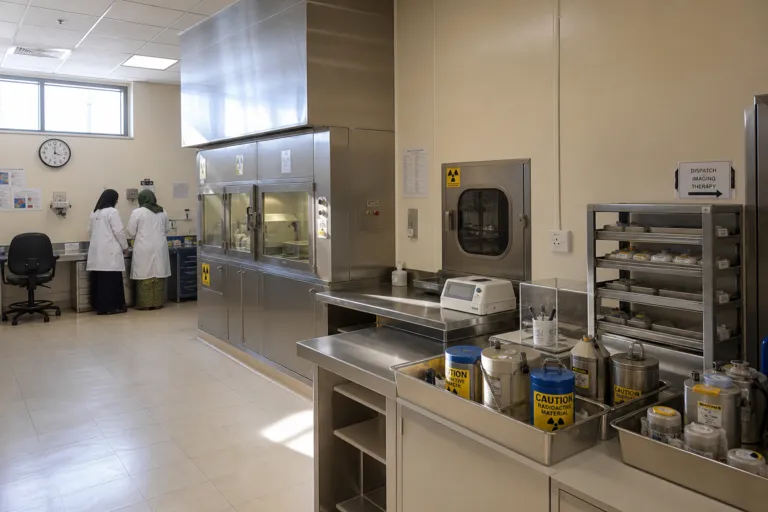
Execution risk sits beside the opportunity. Grand View Research highlights supply constraints for short-lived and emerging radioisotopes, alongside the need for specialized production facilities, trained personnel, radiation-safe handling, and time-sensitive transportation. That operational reality aligns with Coherent Market Insights’ observation that limited local production and reliance on imports remain challenges in the Saudi Arabia and Middle East radioisotope market. At the same time, multiple sources describe sustained momentum in precision diagnostics and targeted therapies: Grand View Research values the global nuclear medicine market at $21.3 billion in 2025 and projects $24.1 billion in 2026 to $38.2 billion by 2033 (6.8% CAGR). The commercial case strengthens when infrastructure, logistics, and clinical pathways are planned together.
What is the Saudi Arabia and Middle East radioisotope market forecast?
Why does Saudi Arabia stand out in the regional radioisotope market?
How big is the GCC radiopharmaceuticals opportunity, and what dominates it?
What is pushing precision imaging and targeted therapy to converge through theranostics?
What are key constraints for Saudi radiopharmaceuticals and nuclear medicine growth?