

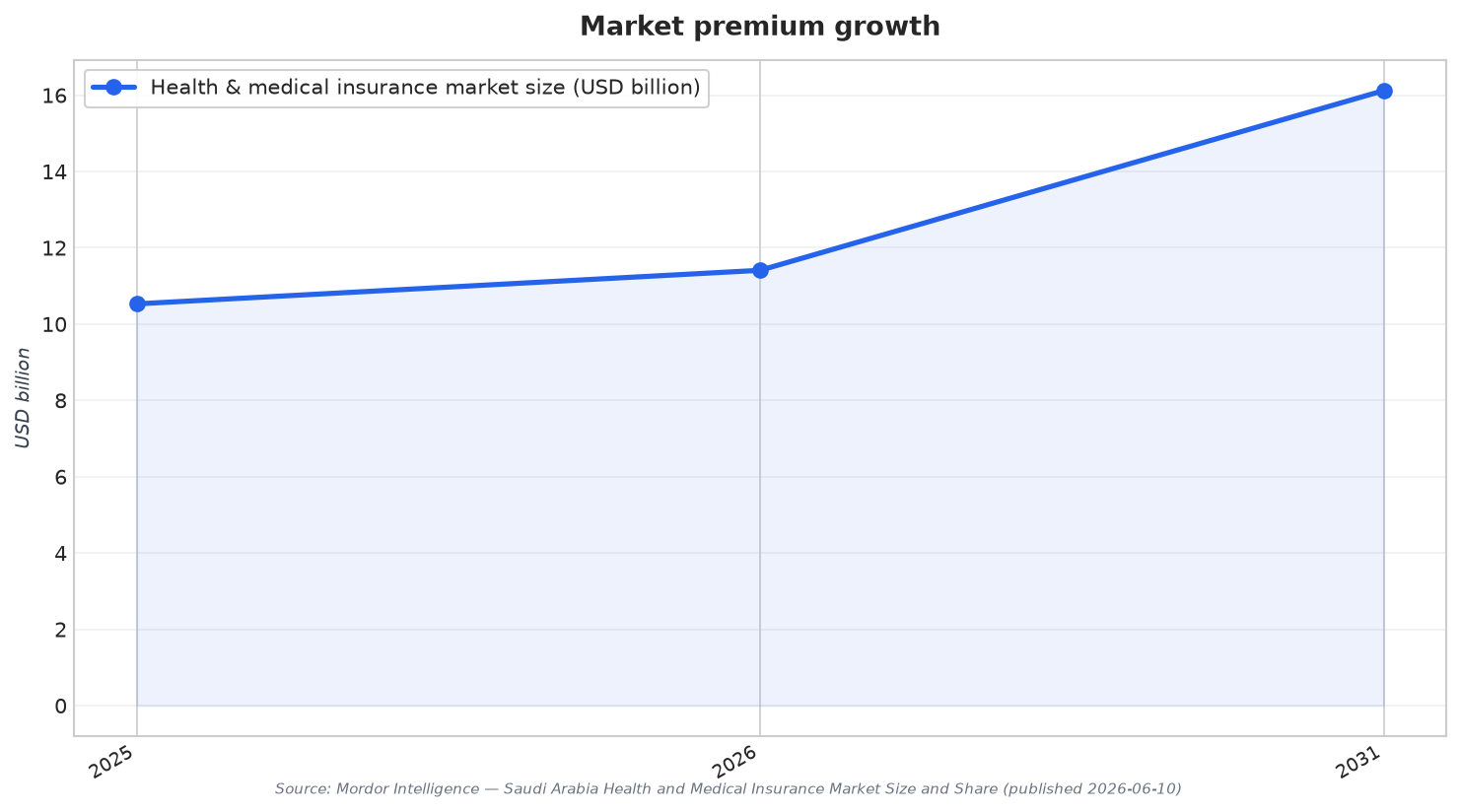
“One nation, one payer” is a powerful framing for what many people want from healthcare: fewer seams between eligibility, billing, and care access. In Saudi Arabia, the discussion is unfolding alongside market growth, digital claims modernization, and regulatory consolidation. Mordor Intelligence valued the Saudi Arabia health and medical insurance market (premium value) at USD 10.53 billion in 2025, estimating growth from USD 11.41 billion in 2026 to USD 16.12 billion by 2031 at a CAGR of 7.16% (2026–2031). In this environment, the idea of a more unified health insurance experience is increasingly tied to standardization, real-time processing, and centralized oversight rather than a single number or slogan.
The operational core of this shift is claims and identity infrastructure. Mordor Intelligence points to real-time e-claims through the NPHIES platform as improving settlement speeds, lowering denial rates, and reducing working-capital pressures for healthcare providers. Consumer behavior also supports this direction. The Sehhaty mobile health application is described as a key part of the digital healthcare ecosystem, with over 24 million users—around 68.5% of the population—using it for appointment scheduling, teleconsultations, prescription management, and health tracking. In parallel context, an IMARC Group press release on openPR cites virtual consultations reaching 1,008,228 across home-based and hospital-based settings, and notes insurer interest in unified digital health IDs and interoperable EHR platforms for real-time access to patient history.
What “Unified” Means in Practice: Oversight, Enrollment, and Standard Benefits
Regulation is another lever pushing the market toward more unified rules and fewer gaps. Mordor Intelligence cites a March 2024 consolidation in which health insurance powers were transferred to the Insurance Authority, described as streamlining approval cycles and centralizing oversight. Market structure also shows where standardization pressure concentrates. In 2025, group health led with 71.33% share, while inpatient cover accounted for 67.44% share, according to Mordor Intelligence. It also reports silver plans at 45.44% share, with Bronze plans forecast to grow at a 15.67% CAGR through 2031. MarkWide Research notes that the Council of Health Insurance enforces mandatory participation and minimum benefits, and that it is tightening mandatory participation rules for SMEs, compressing enrollment timelines and pushing carriers to reconfigure group policy administration systems.
The economics of a unified experience also show up in who holds purchasing power and how coverage is distributed. MarkWide Research describes consolidation among large employer sponsors, repositioning purchasing power toward corporate brokers and third-party administrators. It also highlights how compulsory coverage rules shape demand, including expatriate coverage mandated by the Council of Health Insurance. On distribution and product mix, Mordor Intelligence reports that brokers led distribution with a 54.42% market share (Saudi Arabia health and medical insurance) in 2025, and that co-operative Takaful accounted for 85.39% share in 2025. These are not just structural details. They influence how quickly digital claims requirements propagate across networks and how consistently benefit minimums can be administered across employers and regions.
Looking ahead, multiple sources describe growth, but with different baselines and forecasts that should not be blended. Grand View Research states the Saudi Arabia healthcare insurance market generated USD 12,936.4 million in 2025 and is expected to reach US$ 19,709.7 million by 2033, with a CAGR of 5.3% from 2026 to 2033; it also notes public as the largest segment with 76.66% revenue share in 2025 and Saudi Arabia at 0.4% of the global healthcare insurance market in 2025. Separately, Economy Middle East reports gross written premiums (GWP) for Saudi Arabia’s insurance sector rising from SAR 75.9 billion in 2024 to more than SAR 129 billion by 2030, and says health insurance represents 55% of the market. It also cites projections of health insurance premiums nearly doubling from SAR 42 billion to SAR 83 billion by 2030, and frames expanded mandatory coverage as a potential driver. Together, these signals frame the Saudi unified health insurance conversation as a push for tighter rules, faster claims, and broader compliance—implemented through platforms, regulators, and employer-led enrollment.
How is Saudi Arabia’s unified health insurance shift linked to digital claims?
What market size and growth figures are reported for Saudi Arabia’s health and medical insurance?
Which segments dominate coverage and enrollment today?
What changed with the transfer of health insurance powers to the Insurance Authority?
How do mobile health tools relate to a more unified insurance experience in Saudi Arabia?