
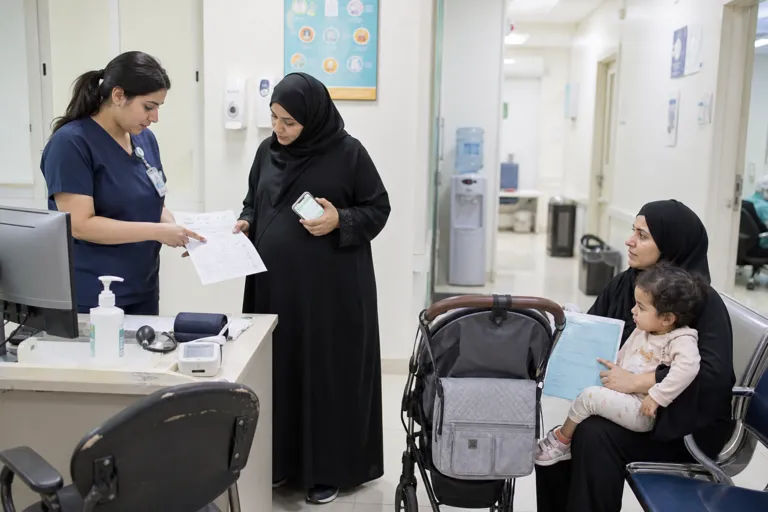
Saudi maternal health sits inside a wider women’s health investment story that is moving fast, but not always evenly. In Saudi Arabia, the direction of travel is clear: prevention and national-scale systems are being prioritized. The Saudi Model of Care is designed to deliver integrated, equitable, and high-quality care across the Kingdom’s 20 health clusters, and it is anchored around six pillars: Wellness, Planned Care, Chronic Care, Urgent Care, Safe Birth, and Palliative Care. Safe Birth is explicitly named, which matters for maternal outcomes. Yet a pillar is not the same thing as a fully funded, fully measured pathway that reaches every woman.
That is where the conversation about “beyond Sehhaty’s reach” begins. Digital-first access can reduce friction, but it cannot automatically close the investment gaps that sit underneath care delivery. Forbes has described Saudi Arabia as deploying state-backed investment into women’s sport, preventative health, and AI infrastructure, with the aim of moving “from pilot to scale.” This is a platform mindset, and it can help standardize prevention and follow-up. But maternal health is also shaped by what systems measure, what investors reward, and what clinical tools were trained to recognize.
Why Funding and Data Frameworks Still Miss the Full Need
Global investment patterns show why maternal care can be under-served even when “women’s health” looks like a hot sector. A Women’s Health Access Matters (WHAM) report cited in Forbes estimates a $360 billion global “ghost market” in conditions that affect women differently or disproportionately, reflecting demand and cost without matching targeted investment. Another Forbes analysis notes how the often-cited “only 5% of healthcare venture capital reaches women’s health” depends on using reproductive health as the denominator, meaning definitions can shrink the visible market and skew funding decisions. For Saudi maternal health, the risk is that capital follows narrow labels rather than end-to-end outcomes.
Measurement gaps also matter because the burden does not stay neatly inside reproductive care. McKinsey data cited by Forbes indicates that 43% of the total female health burden comes from conditions that do not affect women uniquely, differently, or disproportionately—conditions that standard “women’s health” investment frameworks do not track, measure, or fund. If a mother’s health needs span chronic care, urgent care, or wellness support, then a “maternal” lens alone can miss what actually drives risk and recovery. Saudi Arabia’s six-pillar model acknowledges this breadth, but investment narratives do not always keep up.
Underinvestment is reinforced by knowledge gaps. New Scientist reported that the Gates Foundation committed $2.5 billion to women’s health innovation, but argued it still is not enough, pointing to a “shocking gap in knowledge” across nearly every women’s health issue. Meanwhile, Forbes reported that women were excluded from most clinical trials until the early 1990s, leaving drugs, devices, and even modern AI systems trained on incomplete data. In a Saudi context that is scaling AI infrastructure, this history matters: scaling faster does not automatically fix what the underlying data failed to capture.
The opportunity, then, is to treat Saudi maternal health as a system investment challenge, not just an access challenge. The Health Holding Company’s work to accelerate nationwide adoption of the Saudi Model of Care, with Mass General Brigham advising, is described as targeting national capacity and stronger clinical governance. That is a structural lever. Separately, Saudi Arabia is also localizing manufacturing of cell-based seasonal and pandemic influenza vaccines through a deal involving CSL Seqirus and the Saudi Health Ministry, which signals a broader push for healthcare capability. Maternal and women’s health can benefit when capability building is paired with better definitions, better measurement, and investment that follows the full female health burden.
What does “beyond Sehhaty’s reach” mean for saudi maternal health?
How does the Saudi Model of Care connect to maternal outcomes?
Why can women’s health funding still miss key needs?
What is the “ghost market” mentioned in women’s health investment coverage?
Why does data history matter as Saudi Arabia scales AI infrastructure?