Saudi Arabia’s air ambulance market is described as a medically regulated dispatch and transport service that links trauma scenes, remote communities, pilgrimage zones, and tertiary hospitals. In 2024, it handled 18,400 missions while the Kingdom’s population reached 35.3 million, reinforcing the need for national emergency access. Commercial demand is framed as being driven less by routine transport and more by high-acuity urgency, referral distance, and clinical complexity. This is the operational backdrop for scaling Saudi aeromedical services: building reliable dispatch, matching aircraft type to clinical need, and integrating with hospital transfer pathways without relying solely on volume growth.
Scale also depends on where the network is densest. Geographic concentration is anchored by the Riyadh referral and aviation cluster, where care density, command functions, and air connectivity are strongest. In 2024, Riyadh Region had 115 hospitals, the highest in the Kingdom. Air infrastructure is similarly concentrated: Saudi airports handled 905,000 flights, and the four main airports in Riyadh, Jeddah, Dammam, and Madinah accounted for 82% of total air traffic. This concentration supports fleet utilization, transfer economics, and dispatch reliability, while still leaving a clear role for coverage into remote desert regions and event-driven surge demand.
Fleet Mix, Service Models, and the Shift Toward Higher-Acuity Transfers
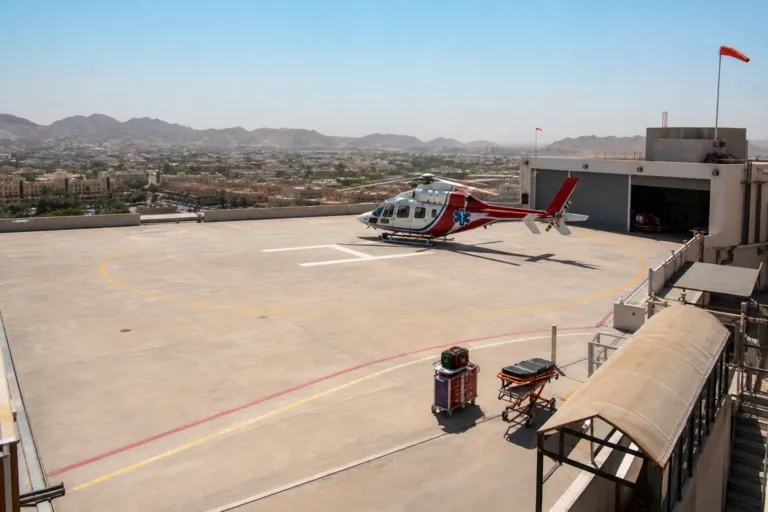
Across Saudi Arabia’s air ambulance services market, rotary-wing operations lead today, but fixed-wing platforms are positioned for faster growth. In 2025, rotary-wing held a 72% share and fixed-wing held 28% in one market breakdown, reflecting how helicopters can operate in emergency and remote locations while fixed-wing supports long-distance transport and patient comfort. Another 2025 view shows rotary-wing at 83.23% revenue share, while other analysis notes fixed-wing is set to register the highest growth over the forecast period. On the operating side, hospital-based services were reported at 56% share versus 44% for community-based models, aligning with the growing importance of integrated transfer pathways between remote points and advanced facilities.
Market outlooks also point to growth that is driven by specialization and structured movement rather than only more dispatches. One forecast projects expansion from USD 236.0 Mn in 2024 to USD 409.9 Mn by 2030, a 9.6% CAGR for 2025–2030. The same outlook expects mission volume to rise from 18,400 in 2024 to about 30,200 in 2030, while average revenue per mission is projected to increase from about USD 12,826 to roughly USD 13,573. This frames a shift from broad emergency-response orientation toward a balanced mix of public rescue, hospital-linked transfer, and cross-border evacuation, with revenue growth expected to outpace mission growth as specialization and contracting deepen.
Technology and coordination shape how these networks scale in practice. One source links the market’s tailwinds to Vision 2030’s USD 1.5 billion health information technology and telemedicine investment, alongside specialized Hajj pilgrimage medical services and expanding emergency response networks that cover urban centers and remote desert regions. Operators are described as coordinating with ground emergency services, hospitals, and event organizers to build integrated response networks, with seasonal surge capacity planning during peak pilgrimage periods. Separately, the Saudi Arabia air ambulance services market is estimated at USD 126.34 million in 2025 and is projected to reach nearly USD 259.18 million by 2035 at a 7.45% CAGR from 2026 to 2035, reflecting continued momentum tied to equipment, fleet specialization, and pre-hospital emergency care awareness.
How large is Saudi Arabia’s air ambulance market and how is it expected to grow?
What mission volume is projected for Saudi Arabia’s air ambulance network?
Which aircraft type dominates, and what is expected to grow faster?
How are service models split between hospital-based and community-based operators?
How are Saudi aeromedical services being supported by technology and coordination?