Saudi Arabia is building at scale, and the wider market signals why speed is now a competitive advantage. Mordor Intelligence values the Saudi Arabia construction market at USD 78.60 billion in 2025 and estimates growth from USD 82.80 billion in 2026 to USD 101.83 billion by 2031, at a CAGR of 4.22% for 2026–2031. In 2025, infrastructure led with 60.13% of revenue, while new construction accounted for 85.08% of value. Yet, conventional on-site work still represented 90.92% of 2025 value, even as modern construction methods are expanding at a 5.53% CAGR. That gap is the opening modular construction targets, including hospital delivery where timelines are compressed.
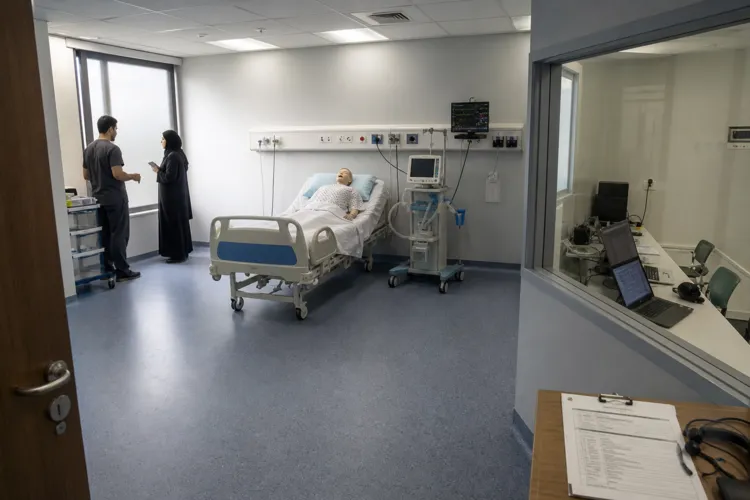
For healthcare clients, the value proposition is less about novelty and more about execution. A Saudi Arabia prefabricated buildings market commentary links the healthcare construction pipeline to Vision 2030’s goal of expanding hospital beds and primary care coverage, stating that this is generating sustained demand for modular medical facilities that can be commissioned and operational faster than any site-built equivalent. In that same framing, prefab can be delivered in modular batches, scaled incrementally as needs grow, and reconfigured if specifications change. That flexibility matters for clinical networks rolling out clinics and hospitals across multiple locations, where procurement and build sequencing can be as important as design.
Why Modular Fits the Kingdom’s Speed-and-sustainability Brief
“Greener” also has a measurable pathway in the sources. The same prefabricated buildings commentary states that factory-controlled manufacturing generates up to 52% less material waste compared to conventional site construction, attributing the improvement to precision that reduces rework and over-ordering. It also points to ROSHN’s Sedra project as a live demonstration that explicitly incorporates modular manufacturing to deliver affordable housing aligned with Vision 2030’s sustainability mandate. Separately, Emergen Research describes growth drivers across Saudi Arabia and the UAE as including government net-zero targets and rising adoption of modular techniques in healthcare, education, and hospitality, while also noting that COVID-19 accelerated adoption of prefabricated hospitals and testing facilities, with governments extending modular designs to additional building types afterward.
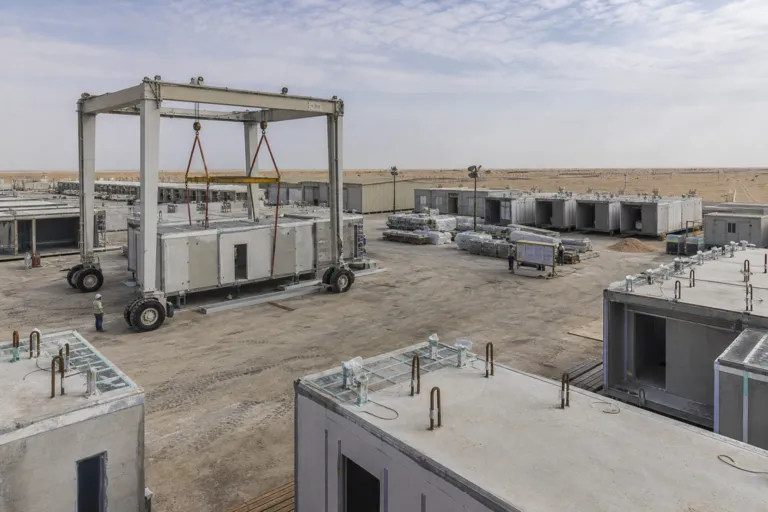
Under the hood, the market is also maturing from temporary to permanent applications. IndexBox describes Saudi Arabia’s modular buildings market as evolving from a niche solution for temporary facilities to a mainstream methodology aligned with Vision 2030, and defines the category as encompassing volumetric units or panelized systems transported and assembled on site. It explicitly includes permanent, multi-story structures for hospitals, hotels, schools, and residential complexes, and notes that permanent modular is gaining momentum as design capabilities and regulatory acceptance improve. Ken Research values the Saudi Arabia modular construction market at approximately USD 880 million and says key cities such as Riyadh, Jeddah, and Dammam dominate due to ongoing urban development and investments that include healthcare alongside housing and hospitality.
Globally, modular’s trajectory provides context for industrialization and technology adoption, but it should not be confused with local market sizing. Grand View Research values the global modular construction market at $111.1 B in 2025 and projects growth from $119.4 B in 2026 to $207.8 B by 2033, at a CAGR of 8.2%. It adds that new players entering the modular construction industry in Saudi Arabia are focusing on advanced technology to improve speed and quality, and cites digital tooling such as extended 3D analysis of building systems (ETABS) and Revit/3D Max as part of the broader technology backdrop. Put together, these signals explain why Saudi modular hospital construction is increasingly framed as a practical delivery tool: it fits compressed timelines, aligns with sustainability benchmarks, and benefits from an off-site manufacturing model that can be repeated across a national pipeline.
How large is Saudi Arabia’s construction market, and why does it matter for healthcare delivery?
What does the source say about waste reduction from prefabrication?
How is modular construction shifting in Saudi Arabia: temporary units or permanent buildings?
What is the cited value of the Saudi modular construction market?
What should decision-makers know about Saudi modular hospital construction from these sources?