

In healthcare, getting paid is a clinical-quality issue as much as a finance issue. Revenue cycle management (RCM) links scheduling, eligibility checks, medical coding, billing, payments, and denials into one operational chain. Grand View Research notes that Saudi Arabia’s hospital RCM market is expected to grow significantly, citing ongoing healthcare sector reforms and digital transformation initiatives. The same source points to forces that make modernization urgent, including stricter regulatory requirements, a move toward value-based care models, and technology advances that let providers streamline workflows, reduce errors, and prioritize patient care.
AI is now being positioned as the practical toolset for this modernization. Techsslaash describes how AI-based coding systems use Natural Language Processing (NLP) and Machine Learning to analyze clinical documents and suggest the correct codes. The goal is simple: accurate codes help providers receive appropriate payment while complying with healthcare rules and regulations. On the claims side, the same article explains that machine learning algorithms can flag incomplete claims, detect missing documentation, and predict whether a claim is likely to be denied before submission, so teams can correct issues proactively instead of reacting after the payer response arrives.
From Denials to Cash Acceleration: Where AI Changes the RCM Game
Denials are a key pressure point, and they show why AI-driven workflows matter. EY (US) reports that providers saying 10% or more of their claims are denied rose from 30% in 2022 to 38% in 2024 and 41% in 2025. EY frames AI as reshaping the revenue cycle by predicting denials, resolving issues upfront, and accelerating cash flow. That same viewpoint connects operational efficiency with resilience: reducing workflow friction, cutting unnecessary administrative complexity, and improving contract management can help stabilize cash flow when margins shrink and care models change.
Saudi Arabia’s broader digital health momentum provides the runway for AI-enabled RCM. A Vocal Media Futurism article states that the Sehhaty app reached 31 million active users and conducted 51 million virtual consultations, described as 88% population penetration. In the same piece, Vision 2030’s Health Sector Transformation Program is described as attracting over USD 66 billion in health and social development spending, with SAR 214 billion allocated for healthcare infrastructure. As patient access expands across digital channels, RCM teams face more encounters, more documentation, and more billing events—making automation and analytics more valuable for keeping the financial back end aligned with the front door.
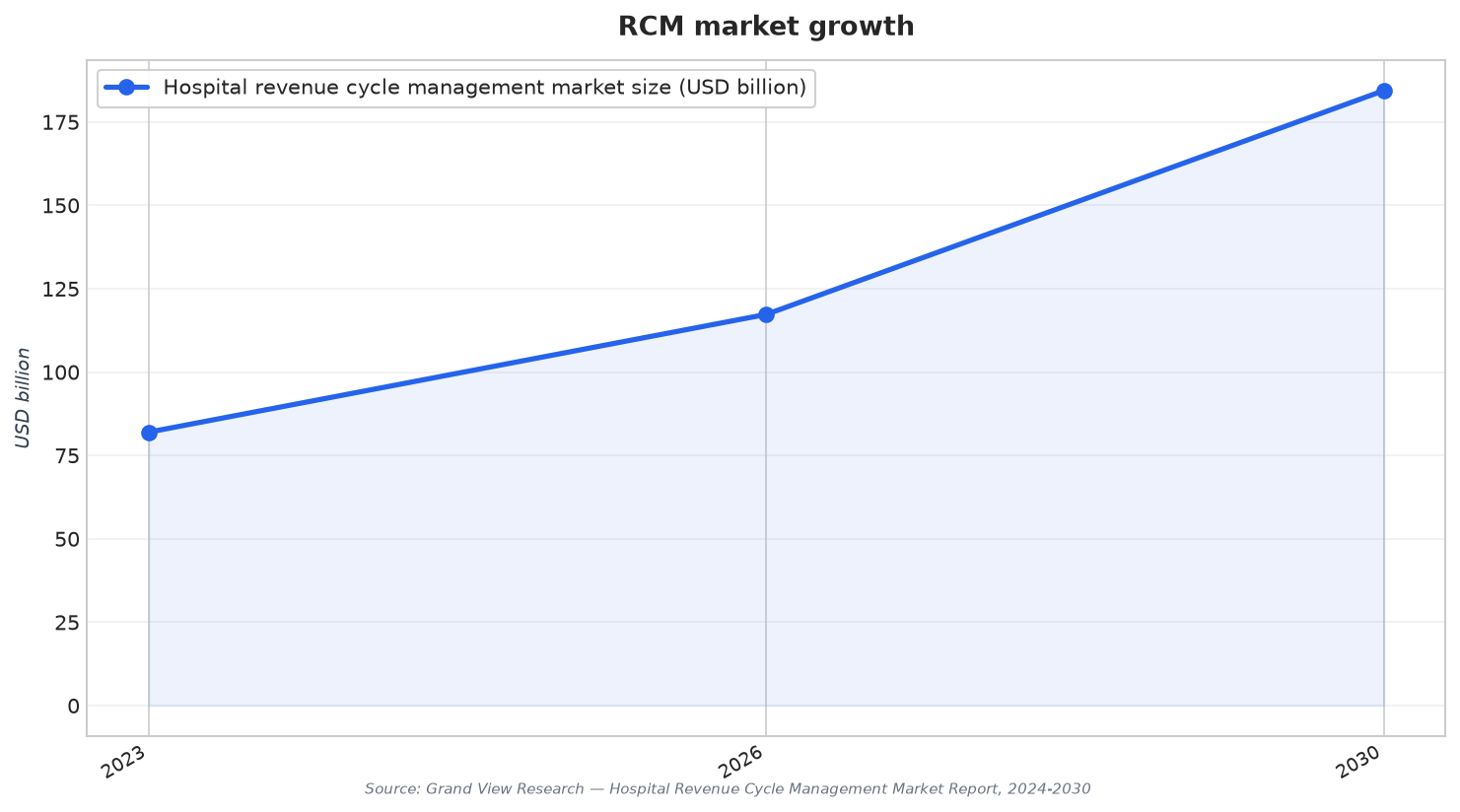
This shift is also part of a larger global market story, which offers context rather than a Saudi-specific figure. Grand View Research values the global hospital RCM market at USD 82.0B in 2023 and projects growth from USD 117.3B in 2026 to USD 184.4B by 2030, at a 12.2% CAGR. The report adds that AI, automation, and cloud computing are transforming RCM systems, and that players are strengthening platforms by integrating AI, electronic health record systems, and data analytics to reduce administrative burden and streamline workflows. It also cites examples such as NXGN Management, LLC and Luma Health expanding an alliance in August 2023 for AI-enhanced patient communication, and Iodine Software launching AwareUM in February 2024 to streamline utilization management and strengthen revenue management.
What does revenue cycle management cover in healthcare?
How can AI reduce denials in the revenue cycle?
What denial trend is EY reporting for providers?
How does Saudi Arabia’s digital health scale support modern RCM?
How is Saudi healthcare revenue cycle management changing with AI?