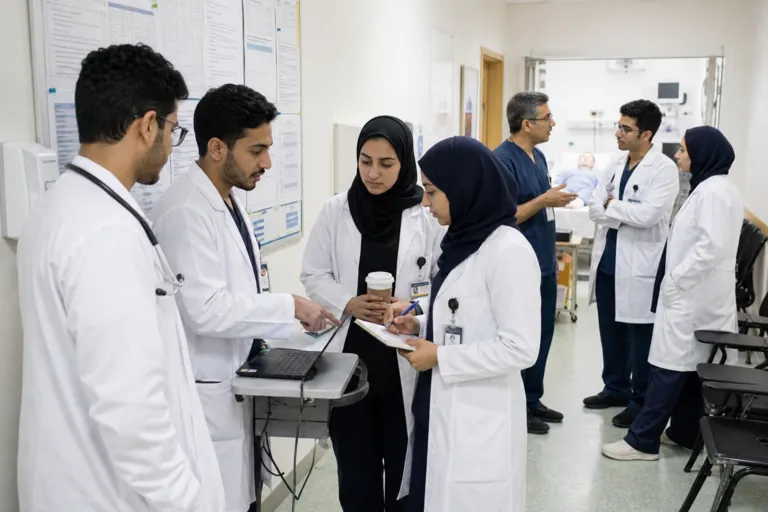
Any conversation about saudi physician licensing lands in a bigger story than a single exam or a single regulator. The sources describe a national direction that emphasizes capacity building, stronger clinical governance, and a “world-class, patient-centered” system aligned to Saudi Vision 2030. In that environment, the role of bodies like the Saudi Commission for Health Specialties (SCFHS) and high-stakes assessments such as the SMLE is easier to frame. They are not just gatekeeping steps. They sit within a transformation agenda that links training, leadership, accreditation, and system-wide standards into a coherent pipeline for the next generation of Saudi physicians.
Recent collaboration milestones show how that pipeline can be reinforced by structured programs and operational improvements. A partnership established via a Memorandum of Understanding (MOU) in 2023 focuses on accelerating nationwide adoption of the Saudi Model of Care, building national capacity, and strengthening clinical governance in support of Vision 2030 goals. In AlUla, the same collaboration helped transform emergency care services, where Prince Abdul Mohsen Hospital’s Emergency Department earned its first national accreditation. The source also notes the initiative significantly reduced patient wait times while maintaining high standards of care and safety.
Where Licensing Meets Leadership and Workforce Readiness
Licensing is only as durable as the workforce ecosystem around it. Leadership development is one example of how readiness gets built upstream of clinical practice. The sources describe a Leadership Essentials Program launched with the Institute for Excellence in Health Leadership (IEDLI) and positioned as the first program of its kind in the Middle East. Its inaugural session took place in AlUla in December 2024 and aimed to train a new generation of Saudi healthcare leaders. This matters for saudi physician licensing because clinical standards are implemented through teams, supervision, and governance, not only through individual credentials.
Skills-based development is also highlighted at a national level. The Red Sea Development and Training Forum in Jeddah gathered more than 250 officials, experts, and academics under the theme “Building People, Empowering Capabilities, and Creating Impact.” Discussions highlighted Saudization as a key driver reshaping the training ecosystem. The forum also pointed to the expanding role of the training sector, supported by the Human Capability Development Program under Vision 2030. For physician pathways, this context supports the idea that licensing milestones should align with practical capability building and role readiness.
Technology can compress timelines and reduce friction in credentialing workflows, which can affect how quickly licensed clinicians enter the system. One source reports that AI-based credentialing platforms can cut processing time down to around two weeks. It also cites reported outcomes for hospitals that use AI tools: a reduction of around 60% in processing time and 80% fewer manual errors. The same article describes real-time updates where training modules, clinical hours, or workshops can be integrated and verified instantly. While this is not specific to SMLE or SCFHS in the sources, it shows a practical direction that can support saudi physician licensing operations.
Finally, the broader health system infrastructure described in the sources points toward standardized, scalable delivery environments for newly licensed physicians. A strategic partnership aims to deploy deep clinical AI across 20 Saudi Health Clusters, framed as building infrastructure for country-wide AI-enabled care aligned to Vision 2030. Separately, a quote from Mass General Brigham International describes a commitment to “knowledge exchange, innovation, and sustainable impact — all in support of realizing Vision 2030.” Put together, these signals reinforce a central idea: saudi physician licensing is most effective when it is paired with governance, leadership, training capacity, and modern operational systems.
How does saudi physician licensing connect to Vision 2030 in these sources?
What concrete capacity-building activities are mentioned alongside healthcare transformation?
What operational outcomes were linked to emergency care improvement in AlUla?
What does the source say AI can change in medical credentialing timelines and quality?
What scale of AI-enabled healthcare deployment is mentioned in Saudi Arabia?