Renal care in Saudi Arabia is being reshaped by two forces that can move in opposite directions. Demand is expected to rise as diabetes and hypertension are repeatedly cited as contributors to chronic kidney disease (CKD), while late diagnosis is also described as common in the Kingdom. At the same time, the ability to treat patients depends on provider capacity, trained workforce availability, and how services are reimbursed. A Global Market Insights summary that cites the International Society of Nephrology Global Kidney Health Atlas says Saudi Arabia accounted for 25.0% of Middle East & Africa dialysis revenue in 2025 and is projected to grow at a 5.8% CAGR from 2026 to 2035. That same framing highlights that utilization trends and provider capacity deployment are central to the market’s path.
Market sizing snapshots in Saudi Arabia differ because they measure different slices of dialysis. NextMSC values the Saudi Arabia dialysis market at USD 0.14 billion in 2023 and expects USD 0.19 billion by 2030, a CAGR of 4.4% from 2024 to 2030, spanning hemodialysis and peritoneal dialysis equipment, consumables, and associated pharmaceuticals. Ken Research, in a separate view focused on SNF-based dialysis, values that market at USD 1.2 billion based on a five-year historical analysis. The same consulting-style source also states there are approximately 1,200 new CKD cases diagnosed daily in Saudi Arabia, and separately describes approximately 1.2 million people affected by CKD. Read together, these figures underline why capacity planning and service scaling are recurring themes, especially in major hubs such as Riyadh, Jeddah, and Dammam.
Capacity Expansion Meets Policy and Quality Controls
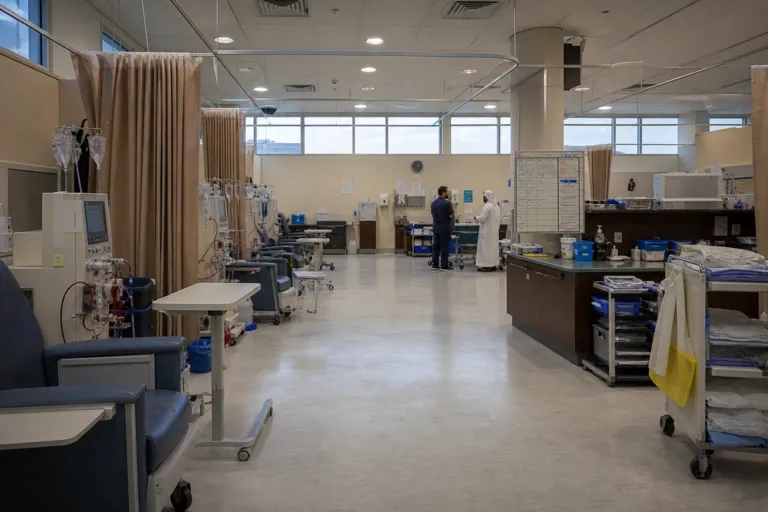
Capacity is not just about opening chairs. It also depends on standards, staffing, and operating discipline. Ken Research notes that in 2023 the Saudi government implemented a regulation requiring all dialysis centers to adhere to strict quality control standards and provide comprehensive training for healthcare professionals. Industry commentary also points to constraints that can slow expansion even as demand grows. Vocal Media describes high treatment costs and workforce shortages as persisting challenges, even while government-led initiatives and private participation have established modern centers and improved access in urban and semi-urban areas. In the Middle East & Africa context, the Global Market Insights summary emphasizes the importance of reimbursement depth and local service capacity in determining commercial development.
Technology is repeatedly positioned as a lever to extend care without relying solely on in-center growth. NextMSC describes modern dialysis machines as having improved filtration mechanisms, enhanced portability, and user-friendly interfaces, with smart connectivity features that enable remote monitoring and data management. Multiple sources also connect growth to a shift toward home-based care. IMARC Group notes that the need for individualized care is driving the growing popularity of home hemodialysis, alongside investments in dialysis facilities with cutting-edge equipment. Vocal Media similarly points to a shift toward home-based care as part of reforms under Vision 2030. These changes matter because, as Global Market Insights frames it, home modalities can change the care mix while established in-center networks remain commercially significant for clinically complex patients.
Competition and procurement dynamics also shape the Saudi dialysis market as it grows. Ken Research characterizes the SNF-based segment as a mix of regional and international players and lists participants such as Fresenius Medical Care, DaVita Inc., Baxter International Inc., Nipro Corporation, B. Braun Melsungen AG, and others. For broader context, Global Market Insights notes that B. Braun Melsungen AG held approximately 4.5% of the global dialysis market in 2025, reflecting how multinational supply relationships can influence local availability of machines and consumables. Across sources, the practical takeaway is consistent: growth expectations depend on matching epidemiological need with reimbursement coverage, trained workforce capacity, and infrastructure that can support both clinic-based services and monitored home modalities.
What is the current outlook for the Saudi dialysis market through 2030?
How important is Saudi Arabia within Middle East & Africa dialysis revenues?
What regulation affected dialysis providers in Saudi Arabia in 2023?
Which factors are repeatedly linked to rising dialysis demand in Saudi Arabia?
What technology trends are shaping dialysis delivery models in the Kingdom?