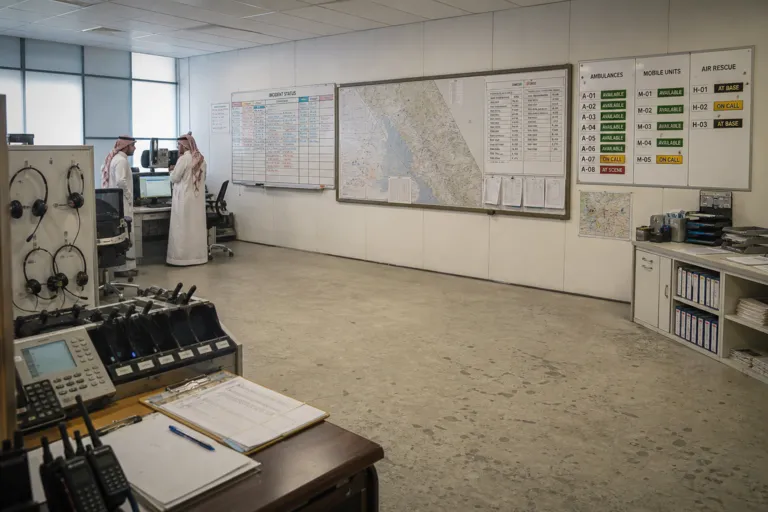
Seconds define outcomes in emergency care. That is why the Saudi emergency medical services market is increasingly framed as an ecosystem, not a single vehicle. A May 2026 Ken Research release stated that Saudi Arabia’s Emergency Medical Services market reached USD 1.5 billion. In the same release, the report’s focus goes beyond market sizing by mapping service models, regulatory priorities, technology adoption, and competitive dynamics across the Kingdom’s emergency medical services ecosystem. It also highlights segmentation that extends beyond ground transport, including ground ambulance services, air ambulance services, emergency medical dispatch services, mobile health units, and others. The signal is clear: growth discussions are shifting from “more ambulances” to “better coverage and coordination.”
Global ambulance-market benchmarks help clarify what “beyond the ambulance” can mean operationally, without assuming those figures apply locally. Grand View Research valued the global ambulance services market at USD 51.2 billion in 2025, estimating USD 56.1 billion in 2026 and projecting USD 111.7 billion by 2033, with a CAGR of 10.3% from 2026 to 2033. In that same global view, ground ambulances held 73.1% share in 2025, emergency services held 61.8%, and advanced life support (ALS) services held 69.3%. These shares suggest that markets tend to concentrate demand in urgent, higher-acuity responses, which elevates the importance of triage, routing, and clinical capability alongside transport.
Scaling Beyond Transport: Dispatch, Mobile Units, and Air Rescue
Scaling response capacity starts before a vehicle moves. Ken Research explicitly lists emergency medical dispatch services and mobile health units as core segments in Saudi Arabia’s EMS landscape, pointing to a broader set of levers than fleet expansion alone. Dispatch and scheduling systems can shape time-to-care by improving call handling and resource allocation. In Saudi Arabia’s air-rescue context, a Vocal Media Futurism article describes advances in scheduling systems and dispatch algorithms that maximize air ambulance resource utilization for immediate responses. The same source positions air ambulances as critical for reaching remote areas where ground transportation is challenging or time-prohibitive, underscoring why dispatch and coverage design are central to scaling outcomes across both urban and remote environments.
Air ambulance is also presented as a practical coverage layer, not just a premium add-on. The Futurism article notes that in September 2023, Saudi aviation services provider The Helicopter Company (THC) highlighted a partnership with the Saudi Red Crescent Authority (SRCA) to deliver helicopter emergency medical services (HEMS) at the Saudi Emergency Medical Services (SEMS) conference. It also describes a rescue of a camel herder injured in a remote desert region near the Al-Bu’itha mine, illustrating how air assets can extend emergency medical coverage beyond urban centers into vast desert regions. In this framing, air ambulances provide rapid patient transport with intensive care unit-level capabilities for time-sensitive emergencies, strengthening the system’s ability to respond where ground routes add delay.
Finally, “beyond the ambulance” also means “beyond transport-only economics,” with care pathways anchored in hospitals and trauma centers. Market Research Future reports that, globally, the hospitals and trauma centers segment held the majority share in 2021, contributing around ~60–63% of emergency medical services market revenue. The same source values the global Emergency Medical Services market at USD 46.50 billion in 2024 and projects USD 78.87 billion by 2035, at a CAGR of 4.92% from 2025 to 2035, citing drivers such as rising trauma injuries, advancements in healthcare facilities, and increased demand for emergency care. For Saudi decision-makers, these global patterns reinforce a practical message: scaling the EMS market requires linking dispatch, mobile units, ground fleets, and air rescue into hospital-ready care, because seconds saved must translate into clinical handoff and treatment.
How large is Saudi Arabia’s emergency medical services market?
What services sit beyond ambulances in Saudi Arabia’s EMS ecosystem?
How does air rescue support coverage in remote parts of Saudi Arabia?
What do global market shares suggest about where EMS demand concentrates?
What role do hospitals and trauma centers play in EMS market revenue globally?