

“Pay over time” is no longer just a retail concept. It is increasingly part of the conversation about care access in Saudi Arabia. The broader payment and coverage system is growing in ways that make installment-based healthcare financing easier to offer and easier to manage. Healthcare payer services are one sign of this shift. Grand View Research reports the Saudi Arabia healthcare payer services market generated USD 422.0 million in revenue in 2023 and is expected to reach USD 560.9 million by 2030. Ken Research separately describes the Saudi Arabia Healthcare Payer Services Market as valued at USD 420 million, linking growth to rising demand, population growth, and Vision 2030 privatization initiatives.
Insurance scale also matters, because it determines how much of a bill is pooled versus left to households. Mordor Intelligence estimates the Saudi Arabia health and medical insurance market at USD 11.41 billion in 2026, with a projection to reach USD 16.12 billion by 2031 at a 7.16% CAGR. The same source notes SMEs are the fastest-growing end-user cohort at 19.73%, while individual policies rise with the dependent enrollment mandate. For employers and families, this creates more structured coverage for inpatient and outpatient care. But it also increases the importance of payment flexibility around deductibles, co-payments, out-of-network choices, and services that fall outside plan terms.
Why “Pay Over Time” Is Accelerating Now
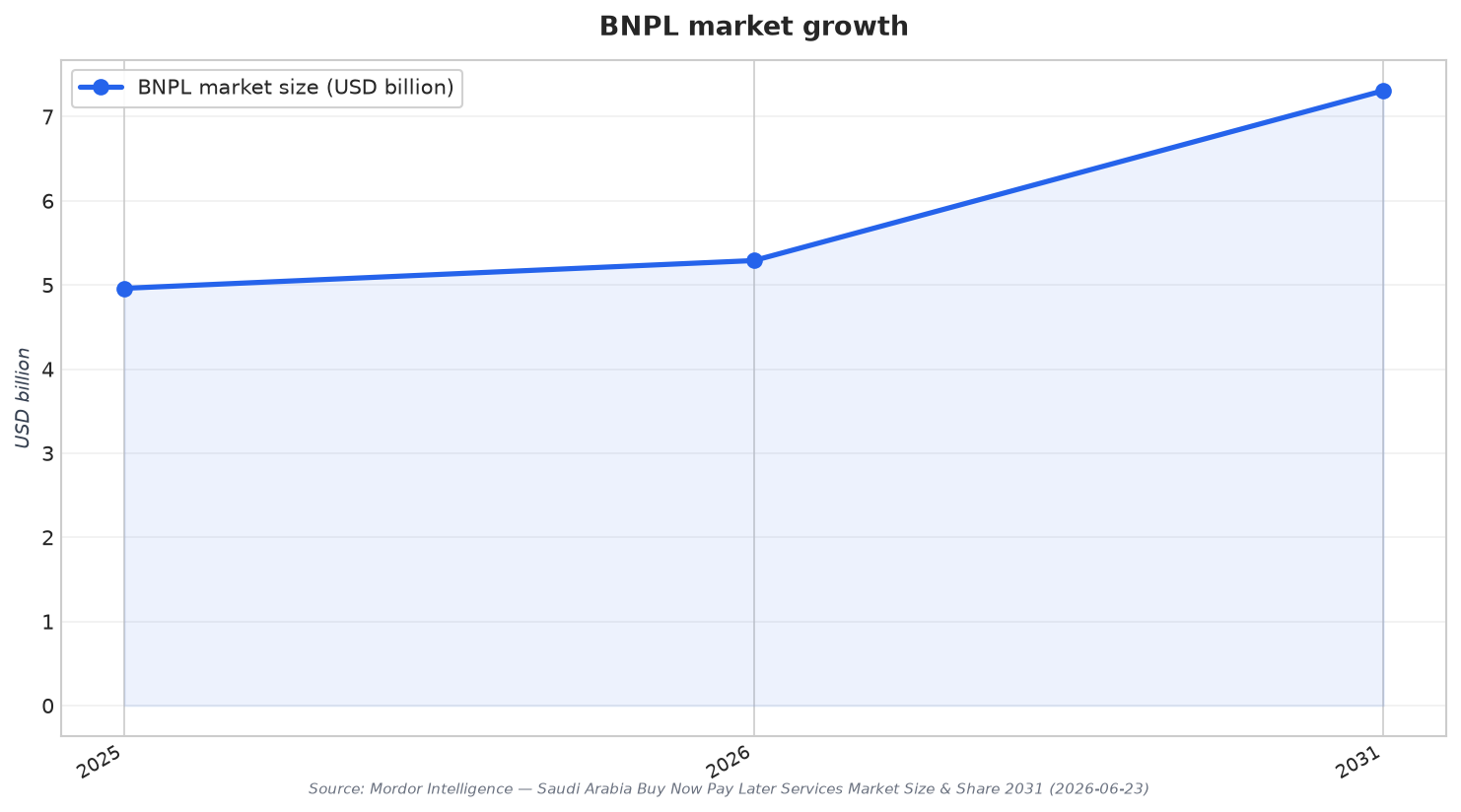
Regulated consumer finance rails are expanding quickly, which supports installment payments for many categories, including healthcare. Mordor Intelligence estimates the Saudi Arabia buy now pay later (BNPL) services market at USD 5.29 billion in 2026, up from USD 4.96 billion in 2025, with projections reaching USD 7.31 billion by 2031 at a 6.66% CAGR. It also states that SAMA’s 2023 licensing framework governs 67 finance companies. As cashless behavior grows, BNPL becomes easier to adopt where it is integrated into merchant and provider workflows. Mordor Intelligence adds that electronic payments accounted for 79% of all transactions in 2024 and that online platforms held 60.74% of BNPL market share in 2025.
Within that BNPL ecosystem, healthcare financing is forecast to expand at a 33.97% CAGR to 2031, according to Mordor Intelligence. That does not describe the full Saudi patient financing market by itself, but it signals momentum for installment-style payment models around medical spending. At the same time, reimbursement mechanics shape provider cash flow and patient experience. Ken Research values the Saudi Arabia Healthcare Reimbursement Market at approximately USD 49.4 billion. The same source cites a survey finding that over 60% of healthcare professionals reported insufficient training on reimbursement protocols, a gap that can contribute to billing errors and delayed payments. In that environment, patient financing and medical loans can act as a practical buffer when timing and documentation slow down reimbursement.
Policy and market structure are pushing in the same direction. Ken Research notes a Health Insurance Law issued by the Council of Ministers in 2023, overseen by the Insurance Authority, mandating employer-provided health insurance for employees and dependents with minimum benefit requirements. As coverage participation broadens, more claims move through payer and reimbursement channels, and more patients encounter structured cost-sharing. This is where well-governed installment plans can support continuity of care, especially when providers want predictable collections and patients want to avoid delaying treatment due to upfront costs. In practice, the expansion of payer services, insurance premiums, and regulated financing options is steadily widening the playbook for pay-over-time healthcare access in Saudi Arabia.
What is driving pay-over-time healthcare options in Saudi Arabia?
How fast is healthcare-related BNPL expected to grow in Saudi Arabia?
How large is Saudi Arabia’s healthcare reimbursement market in the sources?
What does the 2023 employer insurance mandate change for care access?
How does the Saudi patient financing market connect to payer and insurance growth?