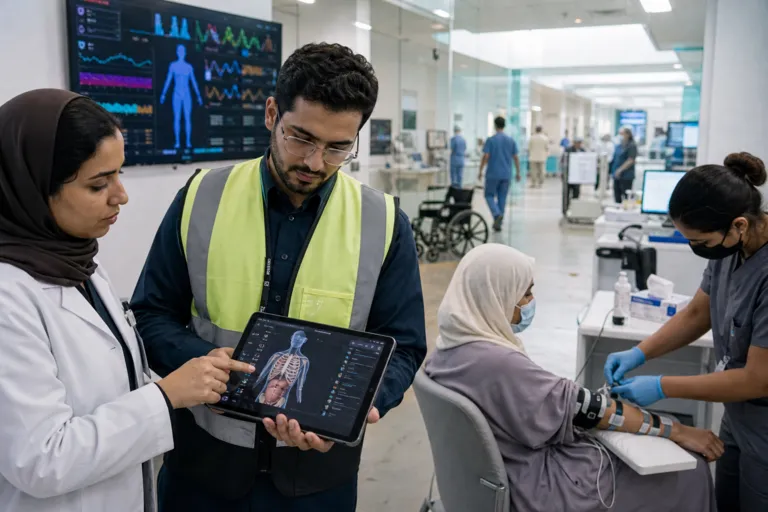
In 2026, the idea of the hospital of the future is less about a single new device and more about how care is modelled, validated, and delivered across settings. For saudi neom healthcare, the most relevant building block in the sources is the rise of “digital twins”, also called digital patient twins or virtual human twins. These are patient-specific computational models derived from multimodal health data. In oncology-focused reporting, they are framed as a way to simulate organ behaviour and disease progression, and to predict responses to treatments using integrated clinical, genomic, imaging, and histopathological information.
Digital twins are also described as a simulation methodology that mirrors physical entities in real time, with roots in manufacturing and later expansion into other industries. When moved into healthcare, the sources point to two connected uses. One use is personalised medicine, where a calibrated computational model helps identify personalised treatment approaches. Another use is workflow and resource optimisation, where modelling can simulate complex hospital processes and patient flows. However, the sources also stress that there are fewer applications for workflow optimisation in healthcare, partly due to difficulties demonstrating discrete events in dynamic, complex departments.
From Digital Patient Twins to Genomic Avatars
Genomic avatars fit naturally into the same multimodal frame described for digital patient twins. In uro-oncology, digital twins are explicitly positioned to integrate molecular data alongside imaging and clinical inputs, with the goal of targeted simulations that improve risk stratification, treatment planning, and dynamic monitoring across the cancer care pathway. A broader life sciences outlook in the sources also emphasizes genomic insights, digital biomarkers, and longitudinal health data as enablers of precision medicine that can shift care away from episodic interactions toward more continuous health management.
Yet the sources repeatedly signal that translation into routine practice is not automatic. For uro-oncology, progress is still limited by challenges in robust data integration, privacy, and real-world clinical validation. A separate viewpoint on healthcare digital transformation reinforces the same dependency: AI is not enough without a robust data layer and strong governance. In parallel, 2026 commentary from the Asia-Pacific region describes an evolution from exploratory AI toward clinically governed, regulator-ready AI that integrates into real workflows rather than staying as standalone pilots.
Another defining “hospital of the future” thread in the sources is decentralised care. One 2026 perspective argues that one of the biggest shifts is happening outside hospitals and clinics, at home, as digital health supports people to remain independent. That decentralisation only works when technology is designed around individuals, not systems, and when platforms allow more personalised and flexible care. For saudi neom healthcare, that combination implies a future model where digital twins and genomic avatars do not only sit inside tertiary centres, but connect to longitudinal data streams and governance processes that can support decision-making across the full pathway.
Finally, the sources underscore why digital twins are attractive but demanding. The “powerful surge” in AI is described as a primary factor accelerating twin adoption, but data remains the fundamental component for building and validating models, whether AI-driven or physics-based. In clinical contexts, digital twins are framed as tools that can help clinicians and patients make better decisions and can even support the design of more-efficient clinical trials. Taken together, the hospital of the future in 2026 looks like a system that simulates, validates, and learns continuously, while acknowledging the hard constraints of integration, governance, privacy, and proof in real-world care.
What does “saudi neom healthcare” mean in the context of digital twins?
What is a digital patient twin?
How do digital twins relate to hospital workflows?
What blocks digital twins from routine clinical use?
Why does decentralised care matter for the hospital of the future?