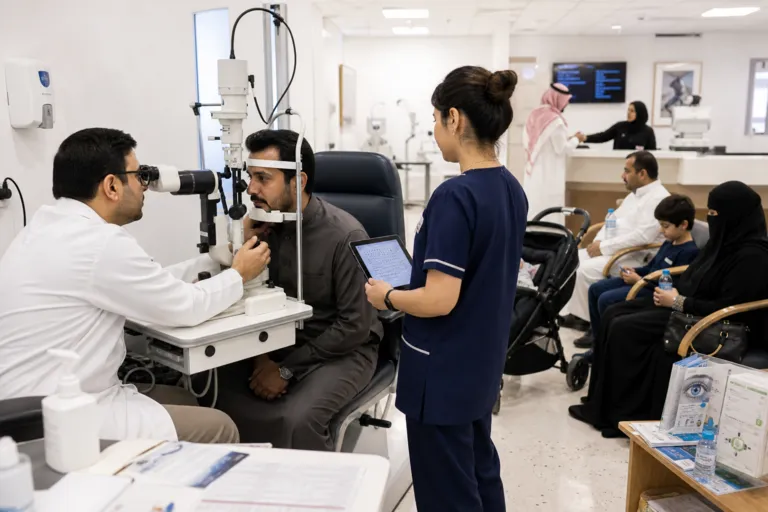
The saudi ophthalmology market is influenced by the Kingdom’s broader investment and modernization agenda. Vision 2030-linked initiatives have supported strong capital flows into industrial infrastructure, and investments in the pharmaceutical sector alone have exceeded SR7 billion. For vision care providers, that wider momentum matters because it signals a system that is actively building capacity, improving supply resilience, and creating conditions where specialized healthcare services can scale. At the same time, Saudi Arabia’s non-oil economy is expanding at a pace of more than 4%, supported by heavy public investment under the Vision 2030 programme.
Specialty clinic expansion depends on dependable inputs and quality-aligned supply. In that context, the growth of contract development and manufacturing capacity is a relevant adjacent signal. Industry reports cited in the sources expect the Saudi pharmaceutical CDMO market to rise from USD $1.62 billion in 2024 to USD $2.24 billion by 2030, at a CAGR of 5.45%. The Saudi pharmaceutical market as a whole is expected at USD $12.4 billion in 2025 and projected to reach USD $18.1 billion by 2030, at a nearly 8% CAGR. These figures are not ophthalmology-specific, but they indicate a scaling healthcare and life-sciences ecosystem.
Why Clinics Are Expanding: Regulation, Capital, and Digital Execution
Clinic growth also relies on the practical ease of building and operating. Saudi Arabia has undertaken a comprehensive modernization of its regulatory and legislative environment, resulting in clearer governance structures and faster licensing processes. The same source describes improved coordination among relevant authorities, which reduces development timelines and mitigates regulatory risk. For specialty eye-care clinics, these conditions can support expansion planning, multi-site rollouts, and service-line additions, because investor confidence and predictability improve when approvals and governance are clearer.
Digital transformation can shape how specialty clinics handle patient journeys and compliance. Saudi Arabia is becoming an increasingly important market for SAP, with expansion in cloud, data, and AI capabilities. Organizations are leveraging SAP technologies to transform operations, integrate enterprise data, reduce costs, enhance patient experiences, and accelerate digital maturity, while remaining compliant with Saudi regulatory frameworks. In healthcare delivery, a concrete example in the sources is Baraya Extended Care upgrading its technology foundation with SAP to enhance its patient experience. While this is not ophthalmology-specific, it illustrates the direction of operational modernization that specialty clinics can mirror.
Broader health and wellness positioning also supports demand visibility for specialty services. The sources note investment opportunities in medical and wellness tourism aligned with Vision 2030 objectives, and they link this to infrastructure development and improved investment appeal. Separately, macro indicators show progress on the reform agenda: inflation dropped by 1.6% by the end of 2023 from 3.1% in 2022, and unemployment decreased from 8% in 2022 to 7.7% in 2023. Together, these conditions frame a market environment where specialty clinics can focus on service quality, operational scale, and patient experience without treating expansion as a purely speculative bet.
For the saudi ophthalmology market, the practical takeaway is that demand-side momentum and supply-side readiness often move together. The Kingdom is investing in infrastructure and enabling faster licensing, while enterprise technology adoption supports compliant, data-driven operations. Meanwhile, investment in life sciences continues to rise, with a shift from import-dependent supply toward manufacturing-focused growth strategies. For eye-care providers, that combination can translate into smoother expansion execution, stronger procurement options, and more consistent patient experience delivery as specialty clinic networks grow.
What is shaping the saudi ophthalmology market right now?
Which policy framework is referenced as enabling investment momentum?
What evidence in the sources suggests life-sciences capacity is expanding?
How does digital transformation relate to specialty clinic operations?