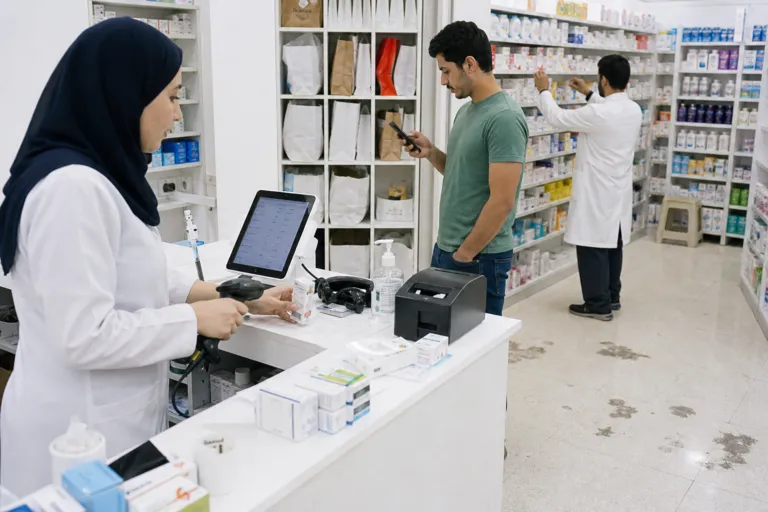
The story around saudi retail pharmacy is increasingly tied to scale, efficiency, and digital execution. Consolidation talk often centers on big chains such as Nahdi and Dawaa, but the sources provided do not include store counts, market shares, or transaction details for either brand. What the sources do show is a market backdrop where demand is rising and operational discipline matters. The Saudi pharmaceutical market as a whole was expected to reach USD $12.4 billion in 2025 and is projected at USD $18.1 billion by 2030, reflecting continued expansion that supports downstream retail and omnichannel fulfillment needs.
Profitability signals in the listed pharma segment also point to momentum in the broader health economy that retail pharmacies depend on. Maaal reported that Saudi-listed pharmaceutical companies achieved a 36.8% increase in net profits. In a separate Maaal report, Saudi listed pharmaceutical manufacturers posted a 30% surge in net profit in 2025. These results are not retail-pharmacy-specific, but they matter for retail supply availability and pricing discipline. As manufacturers and distributors invest in capacity and compliance, pharmacy chains can improve assortment stability, which is essential when shifting customers across stores, apps, and delivery partners.
Operational Excellence Is Becoming the Omnichannel Differentiator
The omnichannel pivot is also shaped by fast delivery expectations. Consultancy-me highlighted that the next chapter for the Saudi retail market will be about operational excellence, where on-time delivery and accurately filled orders build trust for consumers who value time. That logic maps directly onto pharmacy baskets, where accuracy and reliability define loyalty. The same source noted that to win over the remaining 66% of the population who do not yet use quick commerce, providers must address the perception of cost. For retail pharmacies, this reinforces the need to balance speed, service quality, and sustainable unit economics.
Supply chain modernization is also being formalized at the policy level. Saudi Arabia’s Ministry of Health signed a Memorandum of Understanding with Efficio to jointly advance supply chain, procurement, and local content excellence in the healthcare sector. The MoU was signed on the sidelines of the eighth edition of the Global Health Exhibition 2025 and is linked to the Health Sector Transformation Program under Vision 2030. For omnichannel pharmacy leaders, this kind of procurement and supply-chain push can translate into tighter standards, better availability planning, and stronger coordination with suppliers and logistics networks.
Company disclosures in adjacent healthcare segments illustrate how mix and execution can move results. SPIMACO’s CFO told Argaam that private sector sales, its largest contributor, posted growth of around 25%. Contract manufacturing rose about 16%, supporting profitability alongside better operating efficiency and tighter discount controls. SPIMACO reported private-sector sales of SAR 239.5 million in Q4 2025 versus SAR 51.9 million from government sales. These figures are for a manufacturer, not a pharmacy chain, but they underscore the commercial gravity of private demand that retail pharmacies ultimately serve through prescription and front-of-store purchasing journeys.
Consolidation logic is also visible in broader Saudi retail. Arab News reported BinDawood Holding agreed to acquire a 51% stake in Vaza Food Co. for SR217.9 million, citing procurement and logistics efficiencies and consolidation of support functions as potential benefits over the medium to long term. BinDawood’s 2025 net profit was SR269.93 million, down 0.8% year on year. While this is grocery, not pharmacy, the operational playbook resembles what large pharmacy chains pursue in omnichannel: integrate capabilities, streamline support functions, and improve procurement leverage, while competing on service reliability.
What is driving change in saudi retail pharmacy?
Do the sources confirm a consolidation deal involving Nahdi or Dawaa?
What does the quick commerce data imply for omnichannel pharmacy strategies?
How is Saudi policy influencing healthcare supply chains?
What adjacent retail example shows consolidation benefits?