
Saudi nutraceutical brands are scaling in a market where growth forecasts and category definitions can differ by source. One market lens values the Saudi Arabia nutritional supplements market at USD 6.80 billion in 2023, while a separate estimate places Saudi Arabia’s nutraceuticals market size at USD 2.01 billion in 2023, showing how boundaries shift depending on what is counted. Demand is linked to rising health and wellness awareness, higher disposable income, and higher healthcare expenditures, with a post-pandemic lift for products positioned around immunity and general health. Health context also matters: the Saudi Ministry of Health reports that over 60% of Saudi adults are either overweight or obese, a backdrop frequently associated with higher consumption of vitamins, minerals, and other dietary supplements.
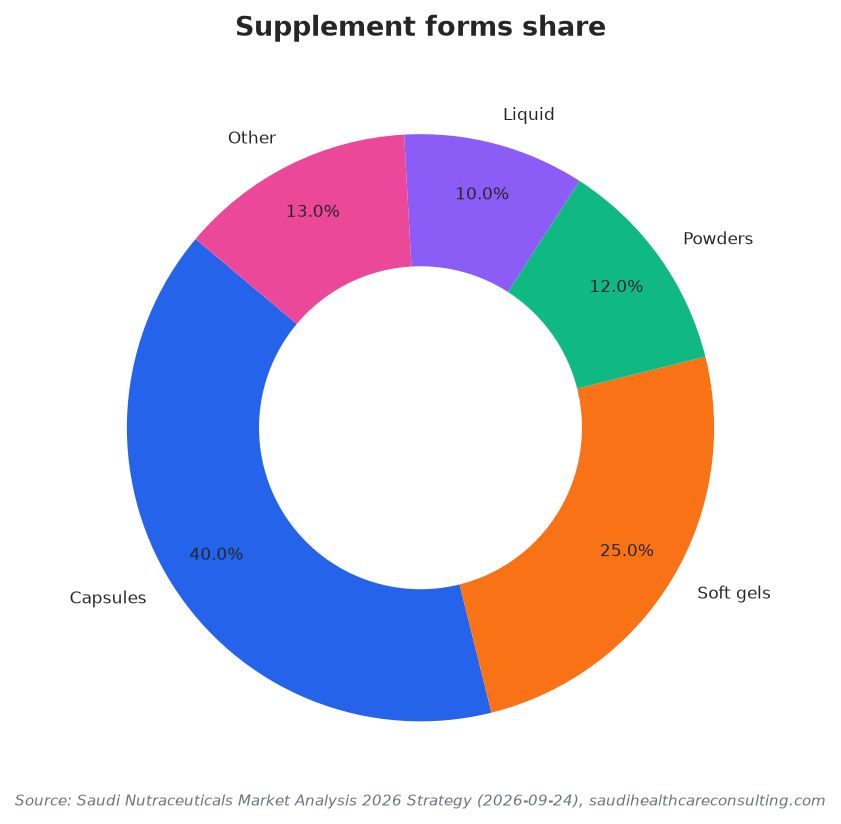
To plan registration and compliance work, it helps to see what product structures dominate shelves. In 2025, single-ingredient products were reported to lead with a 58% share, compared with 42% for multiple-ingredient blends. By form, capsules were described as dominant at 40% share, followed by soft gels at 25%, powders at 12%, and liquid at 10%. Ingredient shares in 2025 showed vitamins at 30%, minerals at 15%, proteins and amino acids at 13%, and botanicals at 12%. These patterns affect dossier and label preparation because different forms and ingredient classes often require different evidence packets, consistent naming, and careful claims discipline across pharmacy, online, and fitness-oriented channels.
Registration Reality Check: What Compliance Must Align With
Saudi nutraceuticals regulation is evolving alongside localization priorities. Market Research Future notes that the Saudi Food and Drug Authority (February 2025) updated health supplement registration requirements and added localisation incentives aligned with Vision 2030 procurement goals. In practice, that pushes brands to think beyond a one-time approval and toward an operating model that supports documentation control, stable sourcing, and consistent product identity over time. It also means compliance teams should watch how procurement-linked incentives can influence formulation and packaging decisions, especially for companies balancing imported inputs with local partnerships. For cross-border teams, it is a reminder that requirements can diverge by geography even when the product concept is the same.
Consumer trust mechanics make compliance visible, not just procedural. In a nationwide Saudi survey (672 nutraceutical users analyzed out of 1,169 responses), vitamins and minerals were the most common products (82.4%), followed by probiotics (73.2%) and botanicals (67.3%). Buying was frequent, with 37.5% purchasing more than once per month. Discovery is also digital: 60.7% reported social media as a common route, and 56.2% said they trusted influencer content more when it referenced evidence or long-term use. At the same time, offline validation still mattered. Halal, clinical, or regulatory marks enhanced confidence for 59.7% of respondents, and frequent purchasers were more likely to still value pharmacist advice (OR 3.02, 95% CI 1.65–5.56).
Market forecasts underline why getting registration and compliance right can be a strategic advantage. Grand View Research estimates the Saudi Arabia dietary supplements market size at USD 1,081.9 million in 2025 and projects USD 2,373.1 million by 2033, with a CAGR of 10.4% from 2026 to 2033. IMARC also reports growth in Saudi Arabia’s nutritional supplements market from USD 4.6 billion in 2025 to USD 4.9 billion in 2026, expecting USD 8.0 billion by 2034 at a 6.33% CAGR during 2026–2034. With shoppers moving across pharmacies, fitness centers, and online platforms, compliance-ready labeling and clear quality markers can support trust at each touchpoint while brands scale portfolios across dominant forms and ingredient categories.
What changed in Saudi Arabia’s supplement registration expectations in 2025?
What do Saudi consumers buy most often in nutraceutical categories?
How often do nutraceutical users in Saudi Arabia purchase these products?
Which trust signals matter when navigating Saudi nutraceuticals regulation?
What are the main product formats and ingredient shares reported for Saudi supplements?