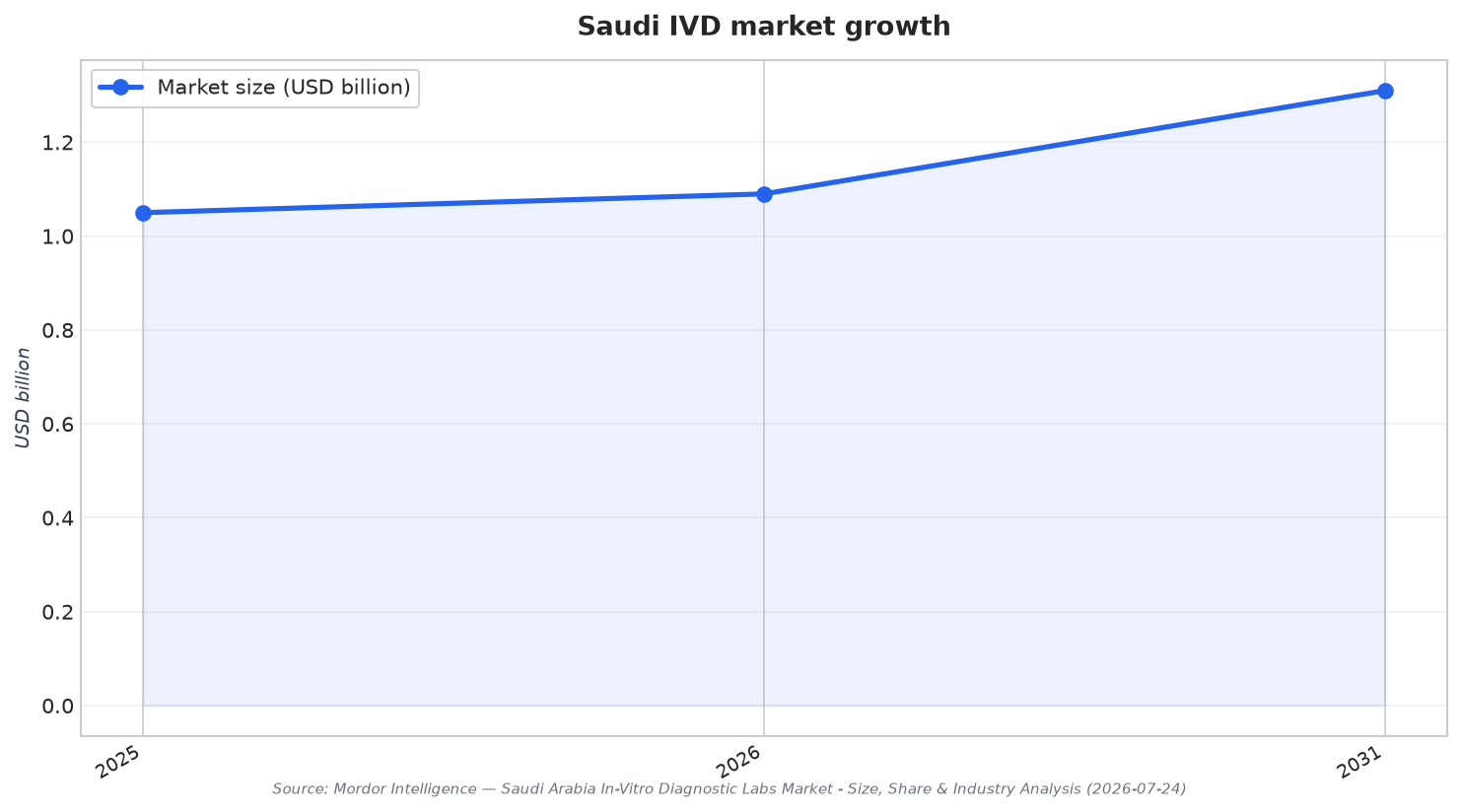
Testing the market in Saudi Arabia now means tracking two forces at once: steady volume growth in routine lab work and faster expansion in advanced testing. Mordor Intelligence estimates the Saudi IVD market will grow from USD 1.05 billion in 2025 to USD 1.09 billion in 2026, and reach USD 1.31 billion by 2031, at a 3.81% CAGR over 2026–2031. Within that mix, clinical chemistry remained the largest test type by share at 35.1% in 2025. At the same time, molecular diagnostics is projected to be the fastest-rising test category in that dataset, with a projected 5.33% CAGR through 2031.
Localization shows up in how Saudi Arabia is funding infrastructure and in how suppliers are embedding capabilities locally. Mordor Intelligence links lab-automation upgrades to budget allocations of SAR 214 billion (USD 57.1 billion) in 2024 and a projected SAR 260 billion (USD 69.3 billion) in 2026. On the demand side, mandatory newborn, premarital, and cancer screening mandates are cited as drivers that push testing volumes beyond historical infectious-disease baselines. Product mix also reflects scale and standardization: reagents and kits represented 68.12% of market size in 2025, while instruments are expected to expand at a 5.66% CAGR from 2026 to 2031, aligned with digital pathology and total lab automation investment cycles.
Where Growth Concentrates: Screening, Oncology, and Data-Driven Workflows
In applications, Mordor Intelligence reports infectious disease held a 42.65% revenue share in 2025, but oncology testing is advancing at a 6.12% CAGR to 2031. Chronic disease pressure also shapes the routine baseline: the same source notes Saudi Arabia’s diabetic population is projected to increase from 2.69 million in 2020 to 4.21 million by 2030, supporting demand for glucose-related and lipid testing. MarketResearch.com’s Mordor summary adds that molecular diagnostics is propelled by the Saudi Genome Program’s 100,000 whole-genome sequences and forecasts a 7.95% CAGR to 2031 for molecular diagnostics in that report context. It also cites next-generation sequencer investment at King Faisal Specialist Hospital, and points to AI-enabled workflows and localized variant databases improving diagnostic accuracy for Saudi populations.
Go-to-market decisions also depend on where testing happens and how products are used. Mordor Intelligence estimates diagnostic laboratories captured 47.87% of revenue in 2025, while home-care and point-of-care settings are set to grow at a 6.54% CAGR over 2026–2031. Usability data in the same report shows disposable IVD devices accounted for 71.32% of market size in 2025, while re-usable devices are poised to expand at a 5.87% CAGR between 2026 and 2031. Together, those shares and growth rates indicate a system that still runs on high-throughput centralized labs, but is actively building a second lane for decentralized access, especially as worksite wellness programs and other settings broaden point-of-care demand.
Quality assurance is becoming its own commercialization pathway as labs modernize and regulators tighten expectations. MarketsandMarkets values Saudi Arabia’s IVD quality control market at USD 12.58 million in 2025, projecting growth to USD 15.52 million by 2030 at a 4.3% CAGR. Grand View Research provides an adjacent set of figures, estimating USD 13.6 million in 2023 revenue and a rise to USD 17.4 million by 2030, at a 3.6% CAGR from 2024 to 2030, and noting controls as the largest revenue product in 2023 while calibrators are the fastest-growing. In practice, these quality-control trends matter for any saudi in vitro diagnostics market entry plan because they connect localization, compliance, and speed of deployment across public and private labs.
How fast is Saudi Arabia’s IVD market projected to grow through 2031?
Which testing segments lead today, and which are growing fastest?
What is the role of localization and genomics in Saudi Arabia’s diagnostics growth story?
How large is the IVD quality control market in Saudi Arabia, and what is the outlook to 2030?
What does “testing the market” mean for companies targeting Saudi Arabia’s in vitro diagnostics sector?