Saudi Arabia’s diabetes care buildout is being shaped by two forces that reinforce each other: rising disease burden and a faster shift toward connected, device-enabled care. One market report cites the International Diabetes Federation (IDF) estimate that more than four million individuals had diabetes in 2021, with that figure expected to reach 7.53 million in the next twenty four years. Another source describes approximately 5.3 million adults currently living with diabetes in Saudi Arabia, representing 23.1% of the adult population. Against this backdrop, the country’s infrastructure push is increasingly defined by tools that help patients and clinicians track glucose trends, improve treatment decisions, and reduce dependence on frequent in-person checks.
On the devices side, reported market sizing points to a system expanding its monitoring and delivery capacity. One analysis values the Saudi Arabia diabetes care devices market at USD 438 million in 2025 and projects USD 683 million by 2033, at a 5.7% CAGR from 2026–2033. A separate market sizing source for diabetes devices calculates USD 199.65 million in 2025, forecast to reach around USD 441.11 million by 2035, at an 8.25% CAGR from 2026–2035. Even across differing scopes, both narratives stress demand linked to ongoing monitoring needs and evolving technology such as insulin delivery devices and continuous glucose monitoring capabilities integrated with smartphone apps and cloud-based platforms.
CGM and Home-Based Monitoring Reshape Care Pathways
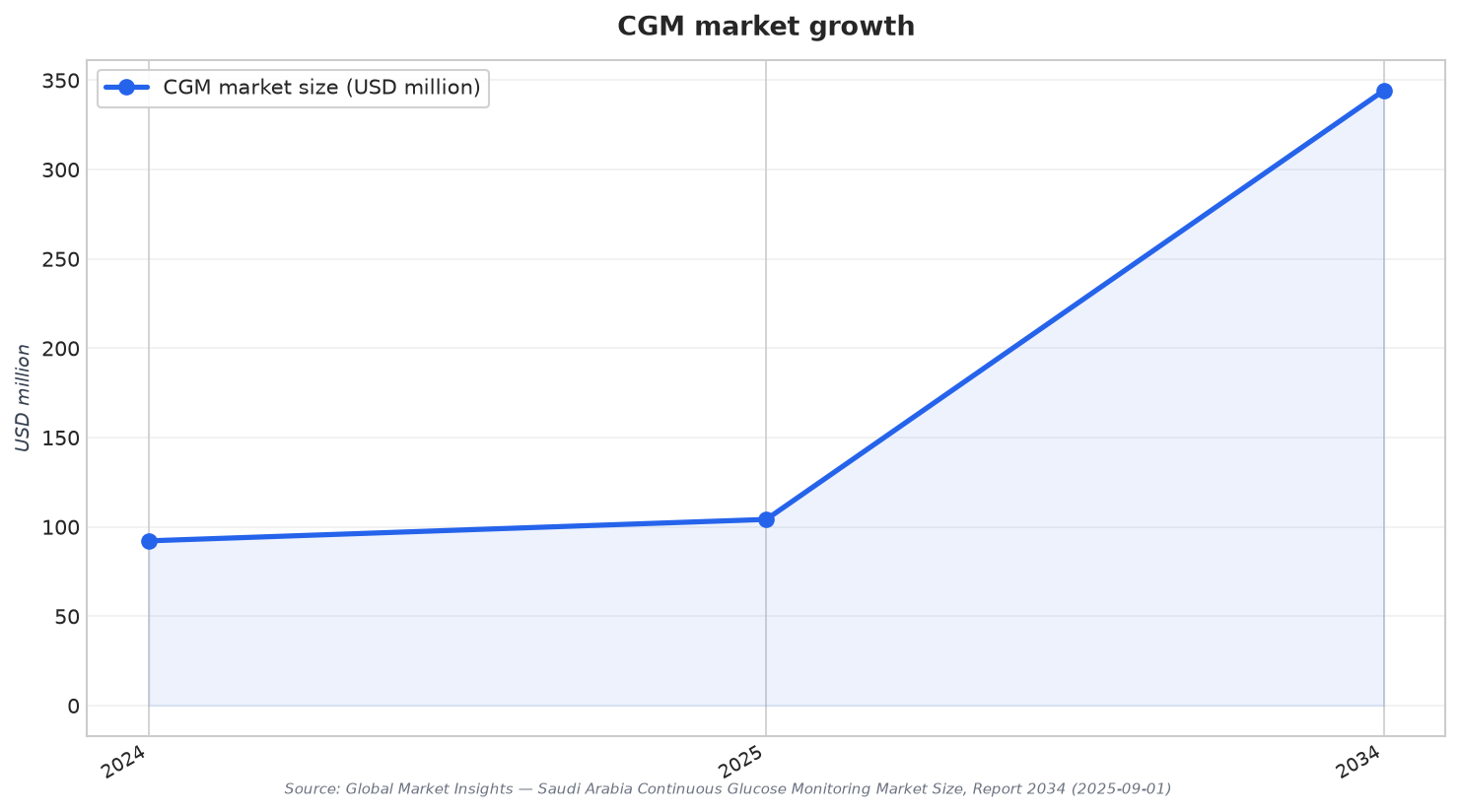
Continuous glucose monitoring (CGM) stands out as a practical lever for shifting daily management closer to patients, while still feeding actionable data back into clinical decision-making. The Saudi Arabia CGM market was valued at USD 92.2 million in 2024, with a projection from USD 104.2 million in 2025 to USD 344.2 million in 2034, at a 16.1% CAGR from 2025–2034. End-use details show how care settings are changing: home care settings generated USD 74.4 million in 2024 and represented 80.8% revenue share. The same source emphasizes that CGMs provide continuous, real-time data without healthcare worker intervention, supporting adherence and enabling people to manage diabetes more independently.
Digital diabetes management adds another layer to the infrastructure push by combining monitoring, education, and treatment support across mobile applications, wearables, telemedicine platforms, and electronic health records. One dataset estimates this market at USD 136.17 million in 2025 and projects nearly USD 322.36 billion by 2035, expanding at a CAGR of 9% from 2026–2035. Product shares in 2025 place continuous glucose monitoring systems at 39%, followed by smart glucose meters at 18%, smart insulin pumps/closed loop systems at 17%, and smart insulin pens at 14%. By type, wearable devices lead with a 58% share, and by end use, home settings dominate with 65% versus hospitals at 28%, underscoring the strategic shift toward self-management at scale.
At the same time, the infrastructure story is not “home versus hospital,” but an expanding continuum of care. In one diabetes care devices segmentation view, hospitals dominated market revenue share in 2024, while another devices market breakdown attributes about 44% share to homecare and about 41% to hospitals, with diagnostic centers at 15%. Government-backed modernization is frequently cited as an accelerant. One source links Vision 2030 to digital health scale-up, citing an investment of USD 66.6 billion in health and social development, the addition of 26,000 to 43,000 hospital beds, and a target to digitize 70% of patient activities by 2030. In that context, the Saudi diabetes care market is increasingly defined by how devices, data, and clinical pathways connect—so monitoring, intervention, and complication screening can happen earlier and more consistently.
What is driving Saudi Arabia’s diabetes care infrastructure push?
How large is the Saudi Arabia continuous glucose monitoring market, and how is it used?
Which products lead Saudi Arabia’s digital diabetes management tools?
How is care split between home settings and hospitals in diabetes device use?
What do recent reports suggest about the direction of the Saudi diabetes care market?