
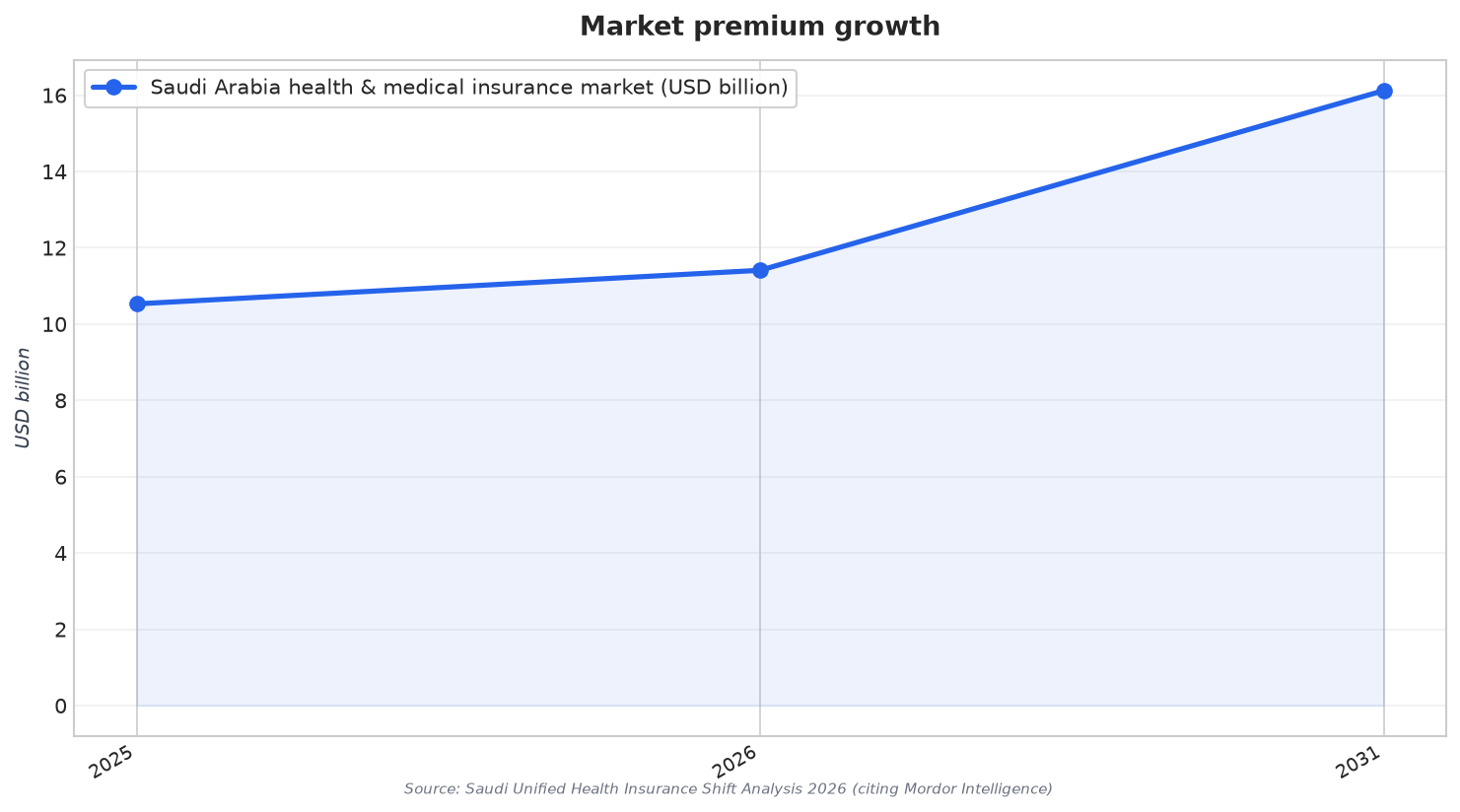
Claims administration is becoming the operational center of Saudi Arabia’s push for a more seamless health insurance experience. A Saudi market analysis referencing Mordor Intelligence values the Saudi Arabia health and medical insurance market (premium value) at USD 10.53 billion in 2025, with estimates rising from USD 11.41 billion in 2026 to USD 16.12 billion by 2031 at a CAGR of 7.16% (2026–2031). As premium volumes grow, the pressure increases to standardize eligibility, billing, and claims decisions across large employer groups and regulated benefit baselines. In this environment, third-party administrators are positioned to help insurers and providers execute consistent processes at scale while keeping service performance measurable.
Digitization is a key driver of this shift, with identity and e-claims infrastructure shaping day-to-day settlement. Mordor Intelligence highlights real-time e-claims via the NPHIES platform as improving settlement speeds, lowering denial rates, and reducing working-capital pressures for healthcare providers. Consumer-facing adoption supports the broader ecosystem: the Sehhaty mobile health application is described as having over 24 million users, around 68.5% of the population, using it for appointments, teleconsultations, prescriptions, and health tracking. In parallel context, an IMARC Group press release cited in the same analysis references virtual consultations reaching 1,008,228 across home-based and hospital-based settings, reinforcing why insurers want unified digital health IDs and interoperable EHR access for real-time patient history.
Regulation and Standardization Are Redefining the Middle Layer
TPAs do not operate in a vacuum. Regulation is tightening the rules of engagement and clarifying oversight pathways. Mordor Intelligence cites a March 2024 consolidation in which health insurance powers were transferred to the Insurance Authority, described as streamlining approval cycles and centralizing oversight. Separately, Mordor Intelligence notes that, in Saudi Arabia, the Insurance Authority says health-insurance qualification requests should be directed to it from March 4, 2024. Market structure adds more pressure for consistent administration: in 2025, group health led with a 71.33% share, while inpatient cover accounted for 67.44% share; silver plans held 45.44% share, and Bronze plans are forecast to grow at a 15.67% CAGR through 2031.
Employer purchasing dynamics also strengthen the case for outsourced administration in Saudi Arabia. MarkWide Research states that consolidation among large employer sponsors is repositioning purchasing power toward corporate brokers and third-party administrators. It also describes the Council of Health Insurance enforcing mandatory participation and benefit minimums that shape product design, while tightening mandatory participation rules for SMEs, compressing enrollment timelines and forcing carriers to reconfigure group policy administration systems. Expatriate coverage mandates create additional administrative volume because the Council of Health Insurance enforces compulsory health coverage for all foreign workers. For TPAs, these conditions elevate the importance of enrollment accuracy, pre-authorization discipline, and consistent claims rules across networks and policy tiers.
Regionally, TPA growth and technology trends provide context for the Saudi health insurance TPA market’s direction. NextMSC values the Middle East Insurance TPA Market at USD 2.36 billion in 2023, predicting USD 4.70 billion by 2030 at a 9.2% CAGR (2024–2030), and frames TPAs as intermediaries providing claims processing, customer support, and policy management. It also highlights TPAs enabling digital transformation with tools such as AI-powered claims automation, cloud-based infrastructure, chatbots, and mobile-enabled policyholder tools. Mordor Intelligence adds that cloud-based platforms were the largest technology segment globally, accounting for 47.69% of revenue in 2026, reinforcing why modern claims operations increasingly depend on platform-led administration rather than manual workflows.
What is pushing Saudi Arabia toward more unified, digital health insurance claims?
How does regulation change claims administration and TPA workflows in Saudi Arabia?
Why do TPAs matter more as employer plans dominate Saudi health coverage?
What does the regional market say about demand for TPAs and claims technology?
What is the outlook for the Saudi health insurance TPA market as claims digitize?