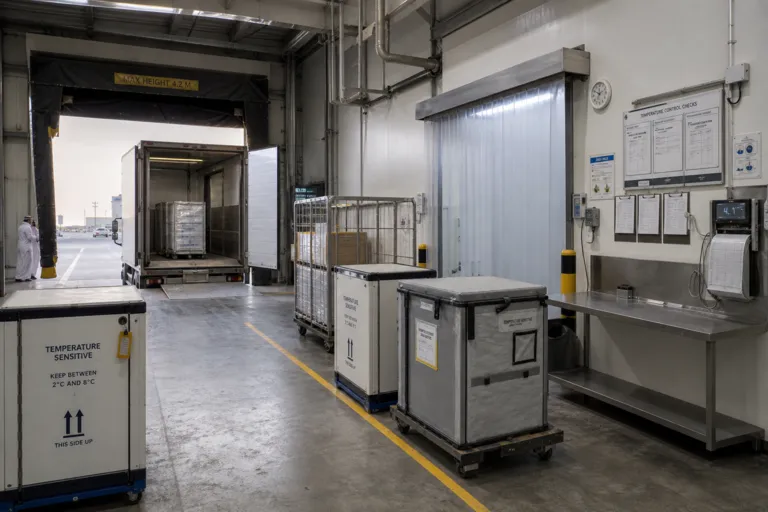
Temperature-controlled logistics is a trust system. In Saudi Arabia, it matters because small temperature shifts can ruin a vaccine, insulin, or other high-value medicines. The cold chain spans storage, transport, and handling under controlled conditions, with typical ranges that include chilled 0–5°C, frozen at -18°C and below, and ultra-low at -70°C for certain biologics and vaccines. In the GCC, summer temperatures often exceed 45°C, so temperature control becomes a daily operational requirement. During the COVID-19 pandemic, millions of mRNA doses required an unbroken chain of freezers, GPS-monitored vans, and temperature sensors, turning cold chain execution into a visible measure of healthcare reliability.
Market signals show why operators are scaling capacity and controls. IMARC Group values the Saudi Arabia cold chain market at USD 3.5 billion in 2025 and projects USD 15.9 billion by 2034. Mordor Intelligence sizes the Saudi Arabia Cold Chain Logistics Market at USD 2.26 billion in 2026, growing to USD 2.76 billion by 2031 at a CAGR of greater than 4.12%. Within healthcare-specific services, IMARC Group reports the Saudi Arabia healthcare cold chain logistics market reached USD 166.7 million in 2025 and is expected to reach USD 205.2 million by 2034, at a 2.34% CAGR during 2026–2034. These figures frame a network that must expand while staying compliant and auditable across more lanes and delivery points.
What “Trust” Looks Like in Operations: Compliance, Mix, and Monitoring
Execution is shaped by regulation and by what moves through the network. The Saudi Food and Drug Authority (SFDA) and the Ministry of Health mandate specific storage and handling conditions for food and pharma products, which pushes providers toward tighter monitoring and standardized processes. On the product side, vaccines are central: IMARC Group notes vaccines account for 46.8% of the Saudi Arabia cold chain pharmaceutical logistics market in 2025, and transportation is the leading service segment at 56.4% share (2025). Those shares reflect a distribution-led reality, where maintaining temperature control in motion is as critical as warehousing. Technology is positioned as a lever, with one estimate indicating AI-powered IoT sensors can cut product spoilage by up to 40% and reduce cooling energy use by 20% through real-time monitoring and optimization.
Infrastructure build-out is happening alongside cost and access constraints. Cold chain operational costs are estimated at around SAR 3 billion annually, and access remains uneven, with about 30% of Saudi Arabia’s population living in remote areas with inadequate cold chain infrastructure. Projects and partnerships aim to close gaps. Mordor Intelligence reports that in June 2026 LogiPoint started construction of a new 12,000 square meter temperature-controlled logistics facility in Jeddah 1st Industrial City, scheduled for completion by December 31, 2026, adding multi-temperature warehousing closer to key consumption zones. In April 2026, Saudia Cargo and SFDA launched an initiative to support pharmaceutical supply chains with enhanced cold chain capabilities and up to a 50% reduction in shipping costs.
Strategy also depends on how the wider pharma ecosystem evolves. Vision 2030 is linked to a cited target of 75% localisation of pharmaceutical manufacturing by 2030, which increases the need for reliable domestic storage, tracking, and distribution. At the same time, Mordor Intelligence states Saudi Arabia relies on imports for 70% to 80% of its pharmaceutical supply, keeping inbound temperature-controlled lanes critical. SFDA projects the Kingdom’s pharmaceutical market will reach SAR 50 billion by 2026, growing at a CAGR of 5.5%, which raises the bar for end-to-end integrity. In practice, Saudi healthcare cold chain logistics becomes a coordinated network problem: multi-temperature capacity, compliant transport, monitoring, and last-mile resilience working together under heat, distance, and audit pressure.
What temperature ranges define Saudi Arabia’s cold chain for healthcare products?
How large is Saudi Arabia’s healthcare cold chain logistics market?
Why are vaccines so important in the Kingdom’s cold chain pharmaceutical logistics?
What are key constraints affecting delivery reliability across Saudi Arabia?
What does “Saudi healthcare cold chain logistics” need to scale next?