Saudi Arabia’s insurance growth story is increasingly a health story, and that has direct implications for Saudi health insurance premium pricing. The Insurance Authority’s 2025 results show more than 14 million health insurance beneficiaries. In the same year, gross written premiums across the overall insurance market reached SAR 84.3 billion, up 10.7% on 2024. Health alone contributed roughly 68% of that premium growth, and health and motor together accounted for nearly 89%. The practical message is that premium growth is concentrated in compulsory lines, and health pricing is becoming one of the main levers that determines how the entire sector performs.
But the same 2025 results also show why more premium does not automatically mean more profit. Claims paid rose 10% year on year to SAR 53 billion, signaling a market that is growing while its cost base grows almost as fast. A listed-insurers read of 2025 results reported the sector loss ratio rising to 89.3% from 86.7%, while the net profit ratio contracted to 3.1% from 5.7%. Another market view of the same year notes net income around SAR 1.9 billion, down notably from 2024, and an average solvency margin slipping from 165.7% to 156.7%. Those indicators frame why renewal cycles can feel tense: cost pressure shows up quickly in margins.
Medical Inflation Is the Variable Insurers Cannot Ignore
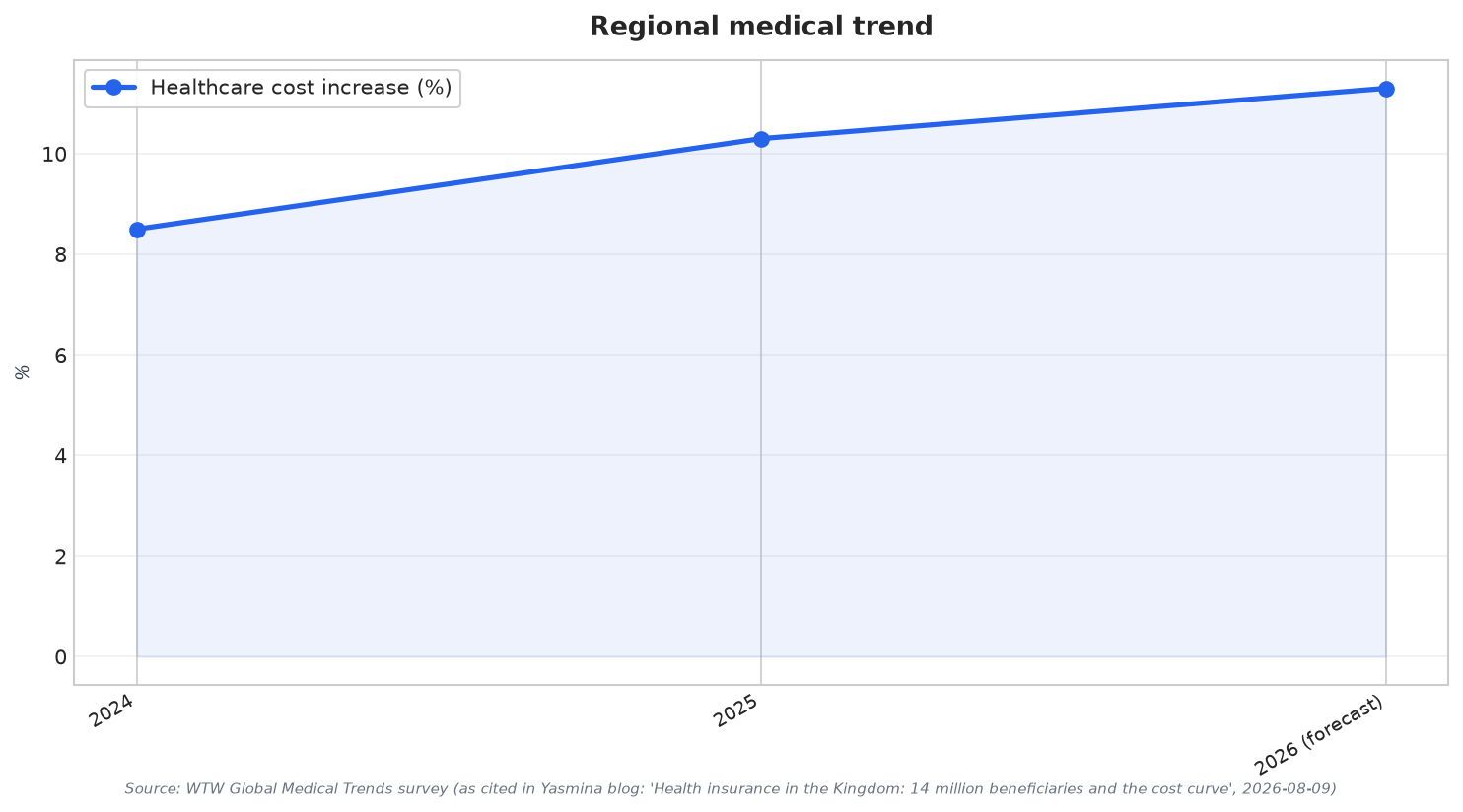
Medical inflation is repeatedly identified as the watch item beneath headline growth. A regional comparator from WTW’s Global Medical Trends survey puts Middle East healthcare cost increases at 8.5% in 2024 and 10.3% in 2025, with a forecast of 11.3% for 2026. This is not a Saudi-specific time series, but it is used as a directional indicator for the region, and the direction is clear. L.E.K. Consulting adds that claims have grown faster than premiums since 2016, with medical cost inflation persistently elevating loss ratios. In that same view, fraud, waste, and abuse can account for up to 10%-12% of overall claims, based on ANB Capital’s 2025 Saudi insurance sector report.
Scale and structure also shape how pricing debates play out. Mordor Intelligence values the Saudi health and medical insurance market at USD 10.53 billion in 2025, estimating USD 11.41 billion in 2026 and USD 16.12 billion by 2031, at a 7.16% CAGR for 2026-2031. Group health led with a 71.33% market share in 2025, and brokers led distribution with 54.42% share, while digital aggregators are forecast to grow at a 22.38% CAGR through 2031. Those mix details matter because group business is typically re-tendered annually and pricing is negotiated, while distribution economics influence how much premium is available to absorb rising claims and regulatory compliance costs.
Looking ahead, projections underline why the pricing question stays front and center. Ken Research projects the Saudi Arabia health insurance market could reach USD 27,247 million by 2032, representing an 11.91% CAGR from the 2025 base, and explicitly links value growth to medical-cost repricing alongside enrollment changes. That same outlook illustrates margin tension with an example: Bupa Arabia’s 2025 GWP rose 11.40% while its insurance-service result declined 13.67%. Meanwhile, a sector overview notes that competitive pricing pressure, medical inflation exceeding premium growth, and compliance costs can create margin pressure, with several smaller insurers reporting consecutive years of underwriting losses. The common thread is that premium increases raise questions because they are often responding to a cost curve insurers say they do not control.
What is driving Saudi health insurance premium pricing higher at renewal?
How big is the insured population in Saudi health insurance today?
Are insurers’ profitability metrics improving as premiums grow?
How concentrated is premium growth in Saudi Arabia’s insurance market?
What role do fraud, waste, and abuse play in claims pressure?