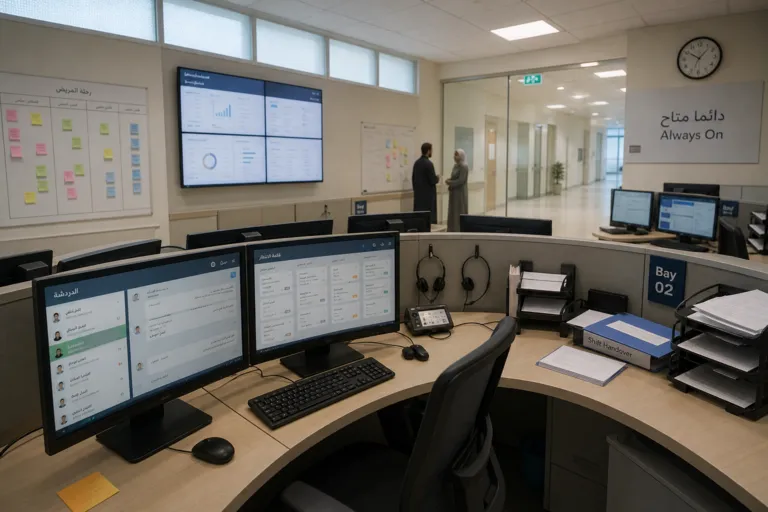
An always-on front door in a hospital is about access. It gives patients a place to start at any hour, even when the clinic is closed. In Saudi Arabia, this front door is increasingly digital, supported by national emphasis on healthcare digitalization under Saudi Vision 2030. Patient-provider communication platforms in the Kingdom are described as being driven by rising smartphone penetration, government healthcare initiatives, and a growing focus on patient-centered care. Cities such as Riyadh, Jeddah, and Dammam are highlighted as key to adoption, with Riyadh described as an economic hub that helps drive uptake of digital health solutions and Jeddah fostering expansion through its large population and healthcare expenditure.
Chatbots sit naturally at the entry point because they can handle high-volume, repetitive requests across multiple touchpoints. In Saudi Arabia, the healthcare chatbot market generated USD 45.7 million in 2024 and is expected to reach US$ 132.0 million by 2030, with a projected 19.2% CAGR from 2025 to 2030. Saudi Arabia represented 3.8% of the global healthcare chatbot market in 2024 and is projected to lead the Middle East & Africa regional market in terms of revenue in 2030. Software was the largest segment by revenue share at 73.96% in 2024, signaling that hospitals may prioritize deployable chatbot platforms as the core layer of the digital front door.
Where Chatbots Meet CRM: From First Message to Follow-Up
For Saudi hospitals, the always-on experience improves when chatbot conversations connect to a CRM record that tracks patient context and next steps. IMARC notes that the healthcare CRM market is anticipated to reach USD 405.5 million by 2033, linking demand to goals such as enhancing operational efficiency and providing high-quality care as providers aim to improve outcomes and experiences. Market activity also reflects momentum. In June 2025, Doctorna announced expansion into Saudi Arabia, launching healthcare CRM and telehealth services and positioning the move as supporting Vision 2030 with AI-powered, compliant solutions intended to improve patient care and clinic efficiency across the Kingdom.
Communication platforms supply the “doorbell,” and secure messaging is a major part of that. Nexdigm describes the KSA patient-provider communication platforms market as segmented into video conferencing, secure messaging, and integrated communication systems, with secure messaging seeing rapid growth. The cited reasons include real-time secure communication and confidentiality aligned to regulatory requirements such as HIPAA, plus immediate response capabilities that reduce wait times and improve patient satisfaction. Hospitals are described as dominating end-user adoption because of large-scale infrastructure needs and complex multi-department workflows, and because these platforms help streamline patient management while supporting compliance requirements.
“Always-on” also extends beyond messaging into ongoing monitoring and long-term care workflows. A Saudi-focused estimate values the Kingdom’s remote patient monitoring market at USD 274.4 million in 2026 and projects USD 457.0 million by 2031, reflecting a 10.7% CAGR through 2031. The same outlook links growth to the Vision 2030 digitalization agenda and a focus on preventive care, patient engagement, and reducing hospital readmissions through connected monitoring technologies. It also notes that, in Saudi Arabia’s next generation patient monitoring devices market, an estimated 40–50% of new hospital tenders in 2025–2026 specify real-time data integration with EHRs, reinforcing why chatbots and CRM need to connect cleanly into clinical systems.
How big is Saudi Arabia’s healthcare chatbot market expected to become?
What role do Saudi patient engagement chatbots play in an always-on front door?
Why are secure messaging platforms growing in KSA patient-provider communication?
What is the outlook for healthcare CRM in Saudi Arabia’s healthcare sector?
What figures signal momentum for always-on care via remote monitoring in Saudi Arabia?