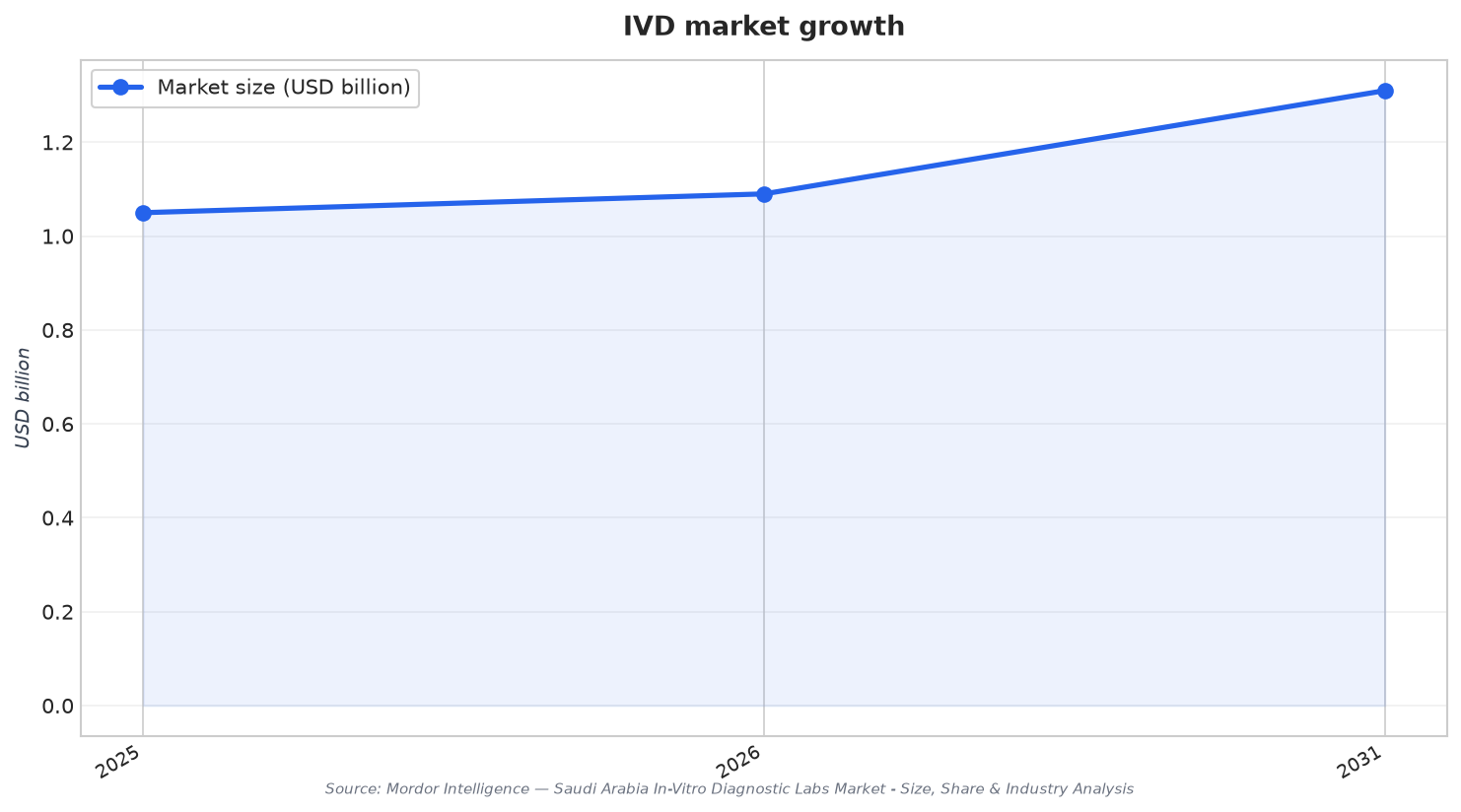
Saudi Arabia’s in-vitro diagnostics (IVD) market is moving beyond routine lab work into a more automated, data-driven era. Mordor Intelligence expects the market to grow from USD 1.05 billion in 2025 to USD 1.09 billion in 2026 and reach USD 1.31 billion by 2031, at a 3.81% CAGR over 2026–2031. Multiple reports tie this momentum to Vision 2030 healthcare modernization, including upgrades to diagnostic capabilities and laboratory facilities. This growth is also being reinforced by mandated screening programs, with Mordor citing newborn, premarital, and cancer screening mandates as drivers that push test volumes beyond older infectious-disease baselines.
Under the hood, the Saudi IVD mix is changing by test type, application, and where testing happens. Mordor reports clinical chemistry led with 35.1% market share in 2025, keeping its role as a volume backbone, while molecular diagnostics is projected to grow fastest at a 5.33% CAGR through 2031. On the demand side, infectious disease held a 42.65% revenue share in 2025, yet oncology testing is forecast to advance at a 6.12% CAGR to 2031. By end user, diagnostic laboratories captured 47.87% of 2025 revenue, but home-care and point-of-care settings are projected to grow at a 6.54% CAGR over 2026–2031, pointing to a broader shift in access and delivery.
Why Consumables Lead, While Automation Spending Accelerates
Consumables still anchor spending, but capital equipment is building momentum. Mordor estimates reagents and kits accounted for 68.12% of the market in 2025, and a separate Mordor dataset reports 68.00% of 2025 revenue for the same segment, supported by recurring purchases for chronic disease monitoring. Instruments, however, are entering a stronger upgrade cycle. One Mordor view puts instruments at a 5.66% CAGR between 2026–2031, while another states instruments are projected to deliver a 9.40% CAGR through 2031, linked to capital equipment demand across new hospital builds. In parallel, Mordor notes disposable IVD devices represented 71.32% of 2025 size, while re-usable devices are poised to expand at a 5.87% CAGR over 2026–2031.
Policy and funding context matters because it shapes procurement timelines and where advanced testing concentrates. Mordor describes budget allocations of SAR 214 billion (USD 57.1 billion) in 2024 and a projected SAR 260 billion (USD 69.3 billion) in 2026 as underwriting lab-automation upgrades and enabling private sector participation in precision-medicine demand. Another Mordor report adds that Vision 2030 aims to transition 290 hospitals and 2,300 primary centers into private management, changing revenue models toward fee-for-service diagnostics and prompting procurement of high-throughput analyzers. It also flags friction: hospitals operating in fee-for-service models may hesitate to absorb uncovered expenses, which can slow the diffusion of oncology companion diagnostics and keep high-complexity testing concentrated in academic centers.
Rising chronic disease burden and quality requirements are also pushing the system toward more testing and tighter standardization. Mordor projects Saudi Arabia’s diabetic population will grow from 2.69 million in 2020 to 4.21 million by 2030, lifting demand for tests such as HbA1c and lipid panels. It also cites a 2024 launch at King Faisal Specialist Hospital of an AI-driven hematology lab that processes 9,000 flow tests annually, illustrating modernization in specialized workflows. Alongside market expansion, quality assurance is scaling too: MarketsandMarkets values the Saudi Arabia IVD Quality Control Market at USD 12.58 million in 2025 and projects USD 15.52 million by 2030 at a 4.3% CAGR, citing increasing regulatory requirements and alignment with international quality standards. Together, these forces are reshaping what the Saudi in-vitro diagnostics market looks like, from procurement to performance expectations.
How fast is Saudi Arabia’s in-vitro diagnostics market projected to grow?
Which test type leads today, and which is growing the fastest?
Why do reagents and kits dominate spending in Saudi Arabia’s IVD market?
What is happening in IVD quality control in Saudi Arabia?
What are the key drivers shaping the Saudi in-vitro diagnostics market?