Saudi Arabia’s health insurance market operates under strict rules that shape how insurers enroll members, design benefits, and process claims. Precedence Research notes that the market is managed by the Cooperative Health Insurance Council (CCHI), which requires coverage for all expatriates, private-sector employees, and their dependents. MarkWide Research adds that the Council of Health Insurance enforces mandatory participation and benefit minimums, and that regulators are pushing toward digital claims interoperability requirements and real-time adjudication systems. In this environment, fraud prevention is not just about stopping bad actors. It is also about keeping claims decisions consistent, auditable, and fast enough to meet the expectations created by digital service delivery.
AI and analytics fit naturally into the shift toward real-time and interoperable claims workflows. MarkWide Research describes “Digital Claims Platforms” and real-time adjudication systems as reducing processing friction and accelerating premium collection cycles across employer-sponsored plans. Precedence Research also frames machine learning-driven fraud detection as a way to keep insurers and honest customers safe from false claims, while AI-aided predictive analytics support more precise risk assessment. For Saudi health insurance fraud detection, that combination matters because tighter participation rules, including pressure on small and medium enterprises, can compress enrollment timelines and increase the operational load on group policy administration and claims teams.
From Rules to Predictive Models: What Changes in Practice
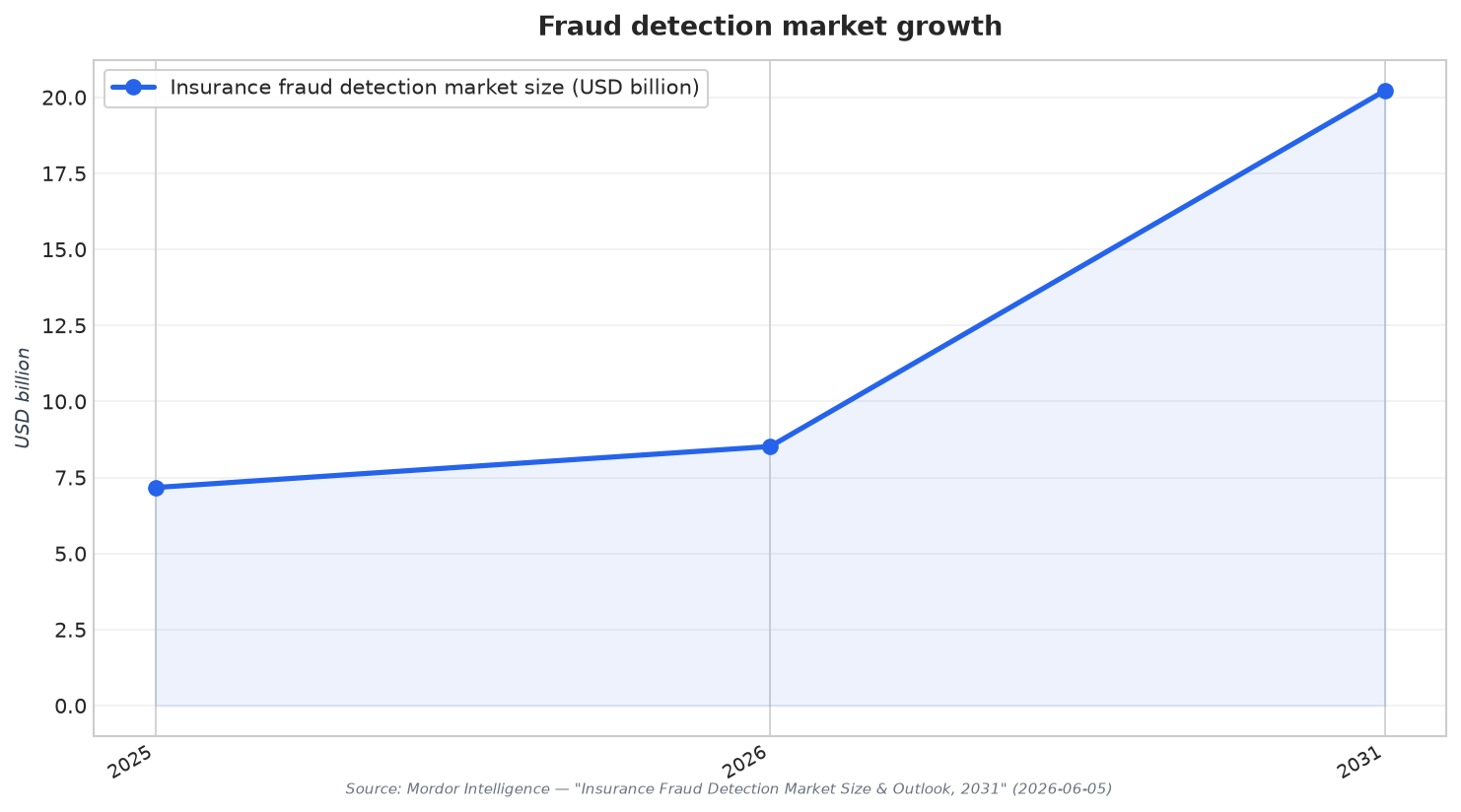
Market indicators suggest that fraud detection is becoming a larger, more technology-led discipline across insurance and financial services. Verified Market Research values the global Insurance Fraud Detection Market at $4.64 Bn in 2025 and projects it will reach $23.57 Bn by 2033, with 24.9% CAGR. Mordor Intelligence estimates the same market at USD 7.17 billion in 2025, USD 8.52 billion in 2026, and USD 20.22 billion by 2031, growing at 18.87% CAGR from 2026 to 2031. Mordor also reports that early adopters saw 30% fewer false positives after deploying multimodal analytics, helping investigators focus on higher-severity alerts rather than chasing noise.
Saudi Arabia’s broader fraud analytics ecosystem is also expanding, which creates spillover capabilities insurers can use for claims integrity and anomaly detection. Ken Research estimates the Saudi Arabia AI-Powered BFSI Fraud Detection Predictive Analytics Market at USD 400 million, based on a five-year historical analysis. It highlights transaction monitoring and identity verification as widely adopted, while behavioral analytics is gaining traction. Ken Research also points to SAMA’s 2020 “Rules for Regulating Financial Technology Experimental Environment,” which require robust AI-driven fraud detection and risk management systems for regulatory sandbox participants, setting expectations around data security and compliance reporting. These patterns support insurers investing in stronger analytics governance, case management, and reporting.
On the claims floor, Saudi insurers are already pointing to AI-led execution, not just strategy. An IMARC Group release published on openPR states that in January 2026, Walaa Insurance deployed Saudi Arabia’s first fully AI-powered health claims platform in partnership with CoverGo, delivering measurable reductions in administrative processing costs while improving claims accuracy and fraud detection capabilities. That type of platform aligns with the regulators’ direction toward real-time adjudication and interoperability, as described by MarkWide Research. As digital claims become the norm, stronger analytics can help insurers triage risk, reduce manual bottlenecks, and strengthen oversight without slowing legitimate payments.
What is pushing Saudi Arabia toward more advanced health insurance fraud detection?
What role do AI and predictive analytics play in claims and fraud controls?
Is there evidence of AI-powered claims platforms being deployed in Saudi health insurance?
How big is the fraud detection technology market, based on the sources?
How does the BFSI fraud analytics market in Saudi Arabia relate to insurance use cases?