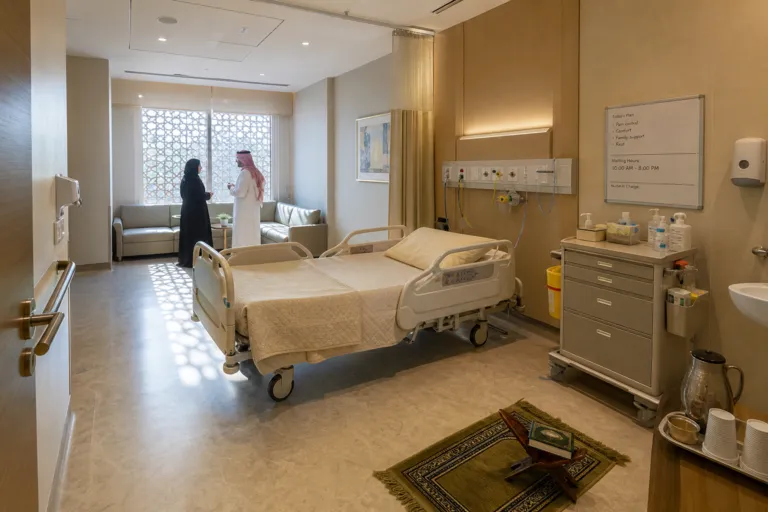
Comfort and dignity are becoming a clearer priority in Saudi healthcare. Recent market research estimates the Saudi palliative care market at USD 680 million, with growth linked to an aging population, rising chronic disease burden, and stronger awareness of palliative services among clinicians and patients. The same source points to government initiatives that improve healthcare infrastructure, expand access to specialized care, and integrate palliative care into national health strategies. This is not only a clinical shift. It is also a service design shift, as families and providers look for care that supports patients throughout serious illness, not only in the final days.
Saudi Arabia’s momentum is also visible in where services concentrate. Riyadh, Jeddah, and Dammam are highlighted as key cities shaping the local palliative care landscape due to advanced facilities, concentration of healthcare professionals, and continued hospital infrastructure investment. Riyadh is described as having the highest number of hospitals and specialized clinics. Jeddah is framed as a major hub for the western region. Dammam is positioned as an emerging center supported by a growing population and healthcare investments. For patients, this clustering can mean better access to multidisciplinary expertise, but it also underscores the need to extend consistent comfort-focused care beyond major urban healthcare hubs.
From Policy to Practice: Strategy, Settings, and Skills
A major inflection point cited in Saudi market coverage is the 2023 National Palliative Care Strategy, issued by the Ministry of Health. The strategy aims to enhance quality of life for patients with life-limiting illness. It includes establishing specialized palliative care units in hospitals, developing national guidelines, and rolling out training programs for healthcare professionals. Those practical elements matter because palliative care depends on consistent standards and skilled teams, not only beds. They also create a clearer foundation for hospice pathways and for care that aligns with patient values, symptom needs, and family support across the course of advanced disease.
Service mix is also changing, and the segmentation helps explain why. Saudi market segmentation lists inpatient care, outpatient care, home care, hospice care, and others. Inpatient care is identified as the leading segment, reflecting demand for intensive symptom management and access to multidisciplinary teams in hospital settings. Outpatient care is described as gaining traction because it supports ongoing treatment while people maintain daily routines. End users are similarly segmented, with hospitals described as dominant due to infrastructure and complex-case capability, while home healthcare agencies are noted as growing as more patients prefer care at home. Globally, hospice demand is also framed around home-based preference and chronic disease burden: one hospice market report estimates support for over 30 million patients in 2025, and notes that over 70% of hospice patients were aged 65 and above in 2025, while emphasizing limited awareness and late referrals as restraints.
International market context shows how quickly end-of-life services can scale once systems mature, but those figures should be treated as comparison rather than Saudi baselines. One global palliative care report values the market at USD 13.8 billion in 2025, projecting USD 14.2 billion in 2026 and USD 18.7 billion by 2036 at a 2.8% CAGR, while also forecasting hospital inpatient care at a 29.8% share in 2026 and palliative care centres at a 34.7% end-user share. Separate global hospice reporting estimates USD 89.04 billion in 2025 and USD 217.64 billion by 2035 at a 9.37% CAGR, while another source puts hospice care at $88.2 billion in 2025 and $150.3 billion by 2033 at an 8.7% CAGR. For Saudi Arabia, the near-term story is less about mirroring global scale and more about building capability: strategy-led standards, trained teams, stronger referral timing, and care settings that make dignity possible where patients actually live.
How big is Saudi Arabia’s palliative care market right now?
What changed with the Ministry of Health’s National Palliative Care Strategy?
Which Saudi cities are most associated with palliative care growth?
Which care settings lead, and which are expanding in Saudi Arabia?
What do global hospice figures suggest about demand, and what constraint is commonly cited?