
Market access is becoming a data discipline. Stakeholders want proof that a product or program delivers value in the settings where people actually use it. In Saudi Arabia, that push is reinforced by broader investment and reform signals that favor measurable outcomes. For example, the Public Investment Fund (PIF) is described as providing financing of at least USD 40 billion a year, a liquidity anchor that supports large, multi-year delivery. At the same time, execution risks are explicitly noted, including labor shortages and cost inflation, which makes performance tracking and operational evidence more important than assumptions.
Digital capability is also scaling, which changes what “acceptable evidence” looks like. Grand View Research reports that the Saudi Arabia data analytics market generated USD 2,227.4 million in revenue in 2024 and is expected to reach USD 5,723.4 million by 2030, with a projected CAGR of 16.1% from 2025 to 2030. This kind of growth supports more routine measurement, faster feedback loops, and better linkage between outcomes and resource use. When analytics capacity rises, decision-makers can ask for stronger real-world baselines, more frequent reporting, and clearer segmentation by patient or user groups.
What “New Rules” Look Like When Evidence Must Travel With the Product
In practice, the new rules of market access often mean that evidence needs to be both local and resilient to volatility. Fitch Solutions highlights that Saudi Arabia and the UAE will continue to present the most significant opportunities for digital health in the GCC, while noting governments will increasingly prioritise health data integration, AI, and population health management. Fitch also points to regional geopolitical tensions that can slow digital health investment and implementation. That combination matters: it pushes market access teams to plan for data integration early, but also to design evidence generation that can survive delays, procurement changes, and uneven rollout timelines.
Cost and supply disruption are another reason real-world measurement becomes central. Fitch Solutions describes a conflict-driven supply shock that has pushed construction input costs in Saudi Arabia sharply higher and links this to a forecasted contraction of construction activity in 2026. The same source also forecasts MENA inflation rising from a GDP-weighted 6.4% in 2025 to 7.0% in 2026, before easing to 5.1% in 2027. Even though these figures are regional, they provide context for why market access decisions may demand clearer proof of value under tightening conditions. Strong Saudi real-world evidence can reduce uncertainty when budgets and timelines are under pressure.
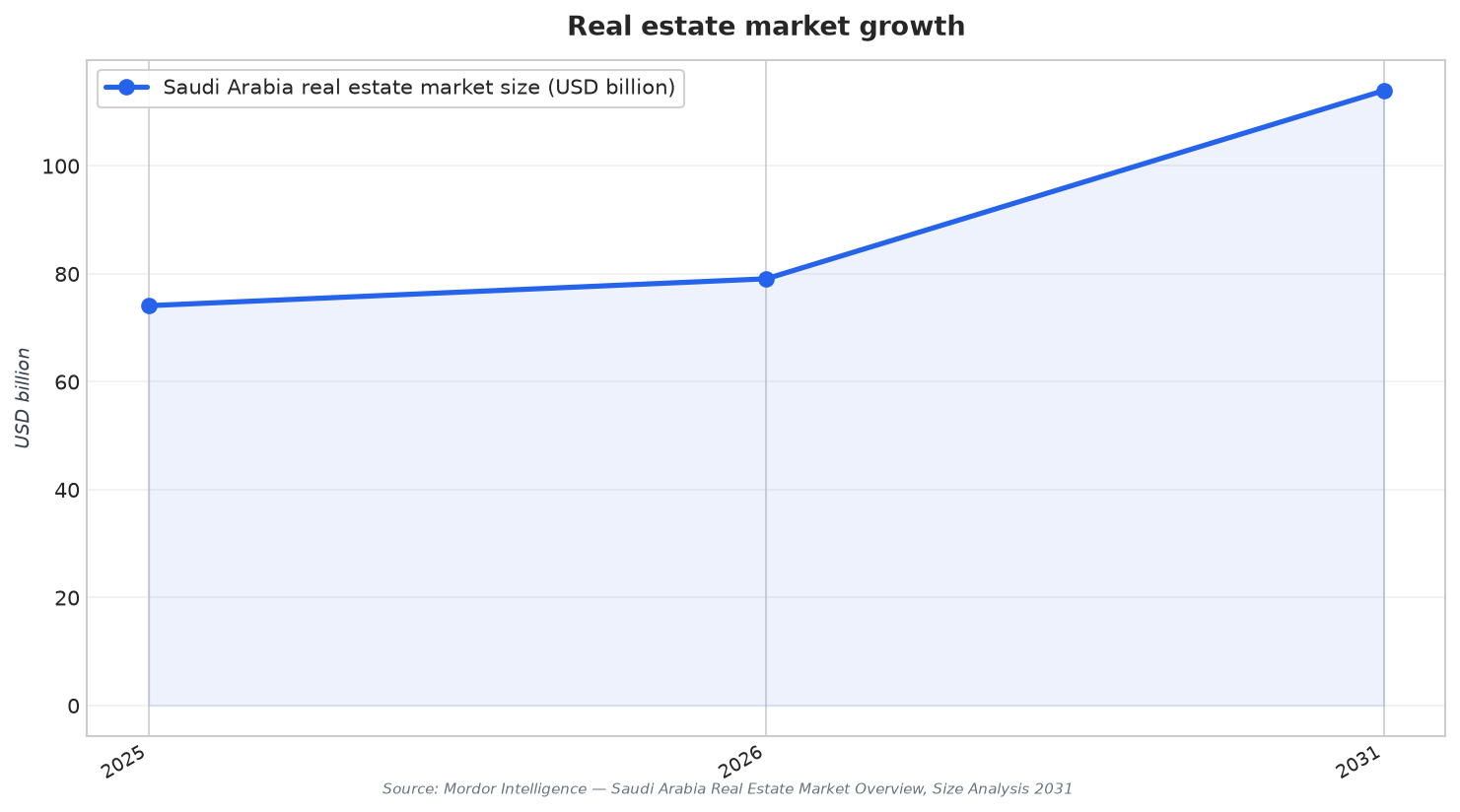
Saudi policy direction also favors data-backed accountability across sectors, which influences how evidence is interpreted. Mordor Intelligence ties market momentum to Vision 2030’s giga-project pipeline and reforms that broaden institutional participation, and it notes regulatory upgrades such as expanded REIT rules and premium residency permits. The same report states that Riyadh led with a 41.5% share of the real estate market in 2025, while the rental segment is set to grow at a 7.85% CAGR through 2031. These details are not health statistics, but they illustrate a governance environment where tracking, transparency, and investment-grade reporting are valued. In that environment, evidence that connects outcomes to real operating conditions becomes a practical route to access.
Why is real-world evidence becoming more important for market access in Saudi Arabia?
What do forecasts say about the Saudi Arabia data analytics market?
How are GCC digital health priorities shaping evidence expectations?
What regional economic pressures make value proof more urgent?
How should teams approach Saudi real-world evidence in a changing market access environment?