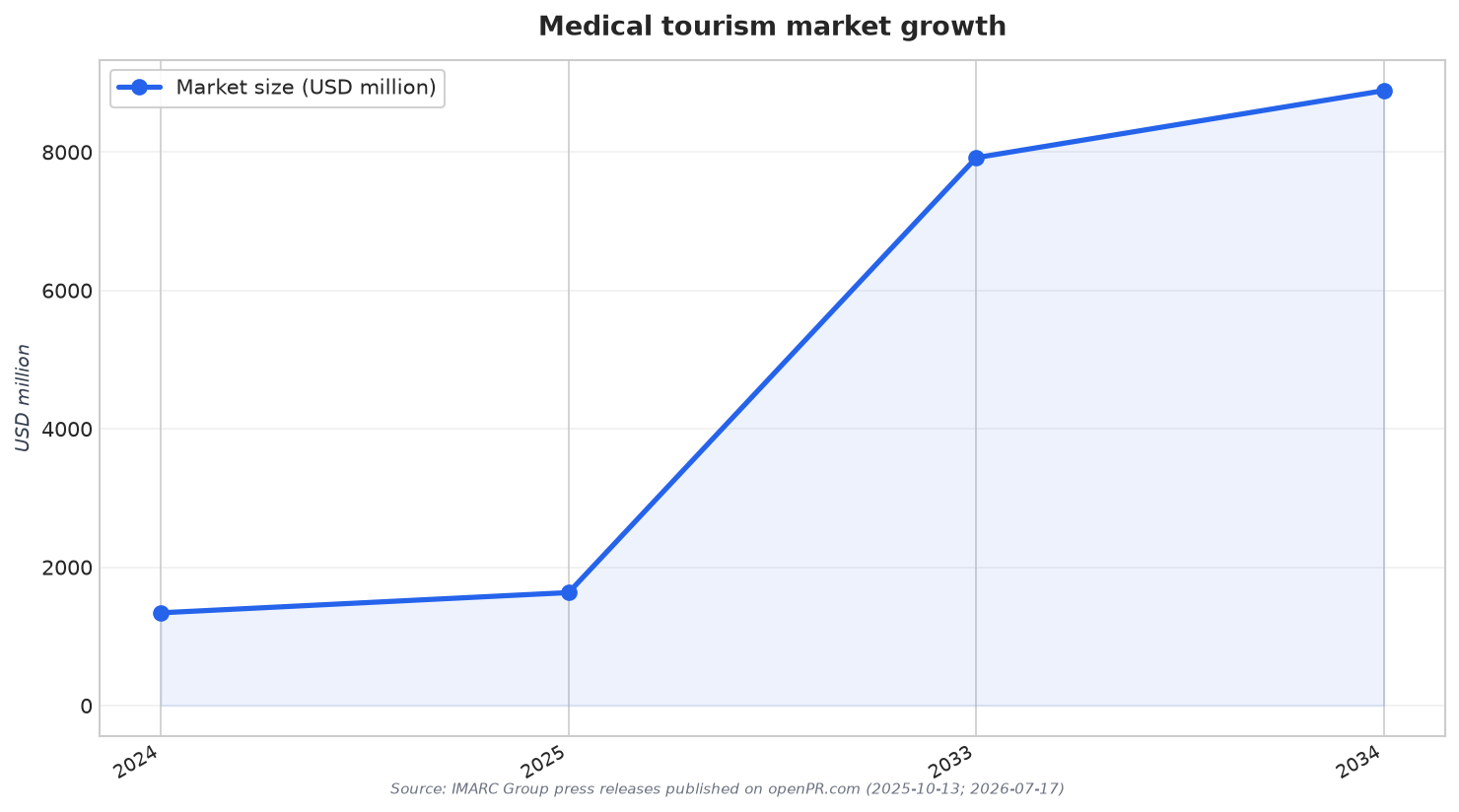
Saudi Arabia is building a destination proposition where advanced care and travel experiences reinforce each other. Vision 2030 is a central driver in this shift, with policies that emphasize healthcare modernization, infrastructure development, and a more welcoming path for medical travelers. Multiple sources point to rapid market expansion: IMARC Group estimates the medical tourism market at USD 1,341.1 million in 2024 and USD 1,633.5 million in 2025, with projections reaching USD 7,918.6 million by 2033 and USD 8,887.9 million by 2034. Those projections are paired with cited growth rates of 21.80% (2025–2033) and 20.71% (2026–2034).
Momentum is also being framed through a separate tourism-industry lens. Travel And Tour World describes a market projected to grow from US$200 million to US$680 million by 2030, positioning Saudi Arabia as a fast-growing Middle East destination for travelers who want both healthcare and immersive tourism. The same source lists Riyadh, AlUla, Jeddah, the Red Sea coast, Aseer Highlands, and Diriyah among leading tourism destinations, and argues that the Kingdom is integrating advanced healthcare with luxury hospitality, wellness experiences, and cultural attractions. In this view, medical travel is no longer just about procedures, but also about the recovery environment and trip design.
What’s Powering the Kingdom’s Medical-Travel Proposition
On the healthcare side, sources repeatedly highlight specialization and technology. IMARC notes Saudi Arabia’s focus on building specialized facilities with advanced technologies for treatments such as cardiology, orthopedics, and oncology. Dimension Market Research adds that the broader Kingdom healthcare market is projected to rise from USD 68.3 billion in 2025 to USD 152.6 billion by 2034, alongside privatization and digital health transformation themes. It also points to major urban centers—Riyadh, Jeddah, and Dammam—as hubs for advanced facilities, naming King Faisal Specialist Hospital & Research Centre (KFSH&RC), Saudi German Hospitals Group, and Al Habib Medical Group as examples associated with these metropolitan clusters.
Policy and governance are being positioned as practical enablers of patient flows. Ken Research says the Saudi medical tourism market was valued at USD 1.3 Bn and notes that in 2023 the government issued Executive Regulations for Private Health Institutions under the Ministry of Health. The same source says the regulation mandates licensing and operational standards for private providers serving international patients and establishes a dedicated Medical Tourism Council to promote Saudi Arabia as a global healthcare destination. IMARC also describes simplified medical visa procedures and reduced bureaucratic hurdles, while Arab News points to eased visa processes and government-backed marketing as competitiveness levers.
The Kingdom is also tying its offer to measurable patient-facing benefits and operational innovation. Ken Research states that medical procedures in Saudi Arabia can be up to 60% less expensive than in the United States and Europe, presenting a cost-competitiveness argument while keeping the comparison explicit. IMARC further lists a broad range of treatment types in the market segmentation, including cosmetic, dental, cardiovascular, orthopedic, bariatric surgery, fertility, and ophthalmic care. Separately, an IMARC-linked note describes advanced AI-powered healthcare with robotic systems such as Da Vinci, ROSA, and CORI, plus virtual hospitals serving hundreds of thousands and contactless vital-sign technology that cut Hajj assessment time by 70%. Together, these elements frame Saudi medical tourism as a coordinated push across care quality, regulation, access, and the overall travel experience.
What is Saudi Arabia projecting for the growth of its medical tourism market?
Which Saudi cities are most associated with medical-travel hubs?
How is Vision 2030 connected to Saudi Arabia’s medical travel strategy?
What regulation changes were cited for private providers serving international patients?
How do sources describe Saudi medical tourism cost competitiveness?