
Saudi Arabia’s health insurance market sits on a compulsory foundation. Private-sector employers buy cooperative health policies for Saudi and expatriate employees and eligible dependents, and more than 14 million beneficiaries were covered during 2025. Group employer-sponsored policies remain the principal commercial engine, because they are directly tied to formal employment and workforce mobility. Demand and provider capacity are concentrated in Riyadh, Makkah, and the Eastern Province, where large employers and specialist hospitals cluster. With a total population of about 35.3 million in 2024 and a workforce of about 17.2 million, insurers that can build scale in these hubs can strengthen provider contracting, claims analytics, and managed-care networks.
Against that backdrop, market growth and market power are moving together. One estimate values the Saudi Arabia health insurance market at USD 12,720 million in 2025 and projects it to reach USD 24,010 million by 2032, implying a 9.50% forecast CAGR. The same outlook expects insured lives to rise from 14.1 million in 2025 to approximately 21.9 million in 2032, while average premium per life increases from about USD 902 to USD 1,096. Another view values the market at USD 7.8 billion in 2024, with expectations to reach USD 12.5 billion by 2033 at a 5.14% CAGR. Different forecasts vary, but they all reinforce why scale and operational discipline matter as volumes and costs move up.
Why Consolidation Is Accelerating
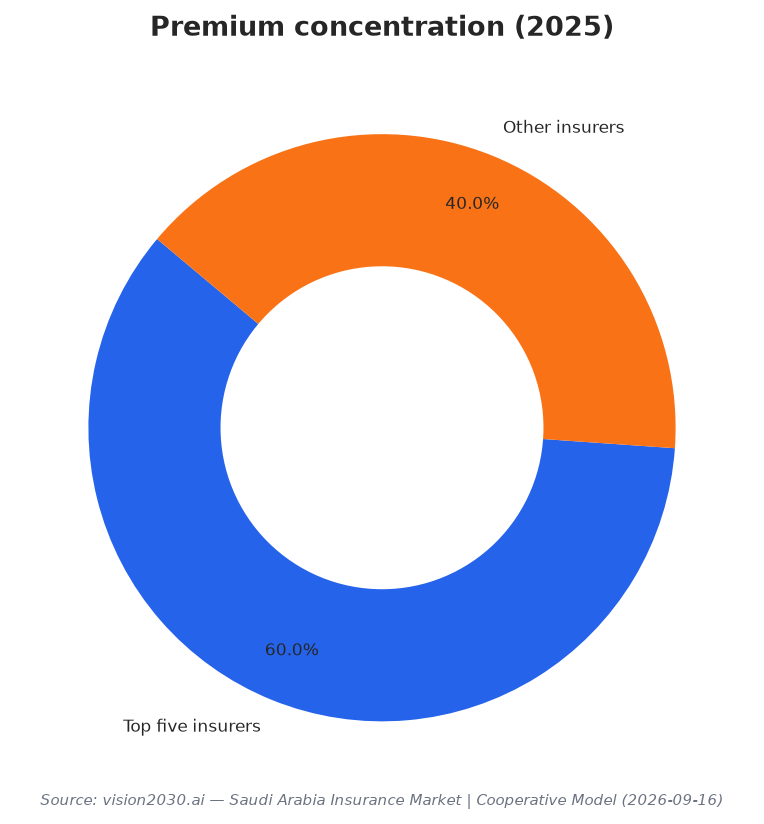
Consolidation is not only a health line story. Saudi Arabia’s broader insurance market has approximately 25 licensed insurers, down from over 30 after a wave of mergers and consolidations. In 2025, total gross written premiums exceeded SAR 55 billion, and health insurance premiums constituted approximately 55% of total market premiums, making health the largest revenue driver. Concentration is also visible at the top. The top five insurers, including Bupa Arabia, Tawuniya, Al Rajhi Takaful, Walaa Insurance, and Medgulf, account for approximately 60% of total market premiums. In health specifically, Bupa Arabia is described as dominating the segment with approximately 30% market share, while Tawuniya and Medgulf are significant providers with established corporate portfolios.
Regulatory and operating requirements add pressure that tends to favor fewer, stronger carriers. A March 2024 regulatory consolidation under the Insurance Authority is described as streamlining approval cycles and centralizing oversight. At the same time, sources point to tighter CCHI enforcement of minimum benefits and capital adequacy requirements that compress the carrier base and force consolidation among sub-scale operators. Data interoperability mandates require standardized electronic health record exchange between insurers and providers and unified coding protocols across hospital information systems. These kinds of investments, alongside digital claims controls and in-house claims adjudication technology, can be easier to fund at scale, especially as smaller insurers face profitability challenges linked to pricing pressure, limited scale economies, and rising compliance costs.
For employers and members, the practical impact of Saudi health insurers consolidation will likely show up in purchasing dynamics and network strategy. Group business is expected to remain the largest profit pool, and employer-sponsored coverage is expanding among SMEs as mandatory participation rules tighten. As carriers grow, they can negotiate network terms more aggressively in concentrated regions and invest in employer service platforms and digital claims processing that help manage utilization and medical-cost pass-through. However, the market also faces uncertainty. One outlook flags a potential downside scenario of structural reform toward a larger public single-payer role after 2027, which could reshape the competitive landscape even as private insurers pursue scale, solvency strength, and NPHIES-compatible platforms.
What is driving consolidation among Saudi health insurers?
How concentrated is Saudi Arabia’s insurance market today?
Why do group employer-sponsored policies matter so much?
What does Saudi health insurers consolidation mean for employers buying coverage?