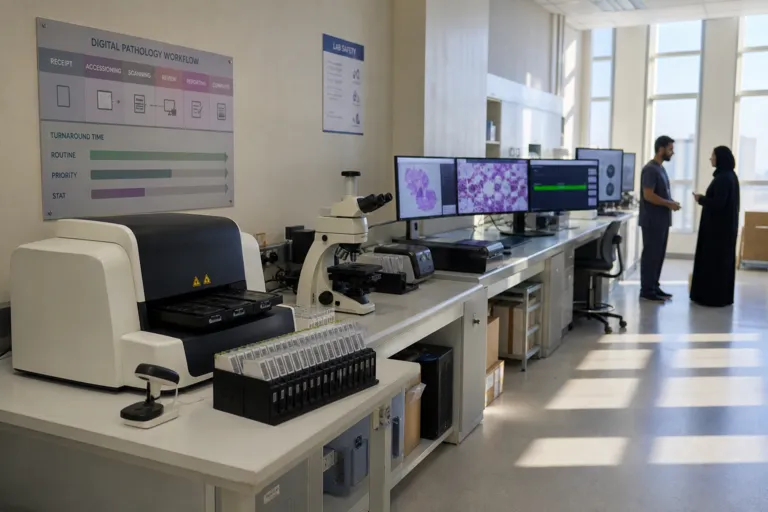
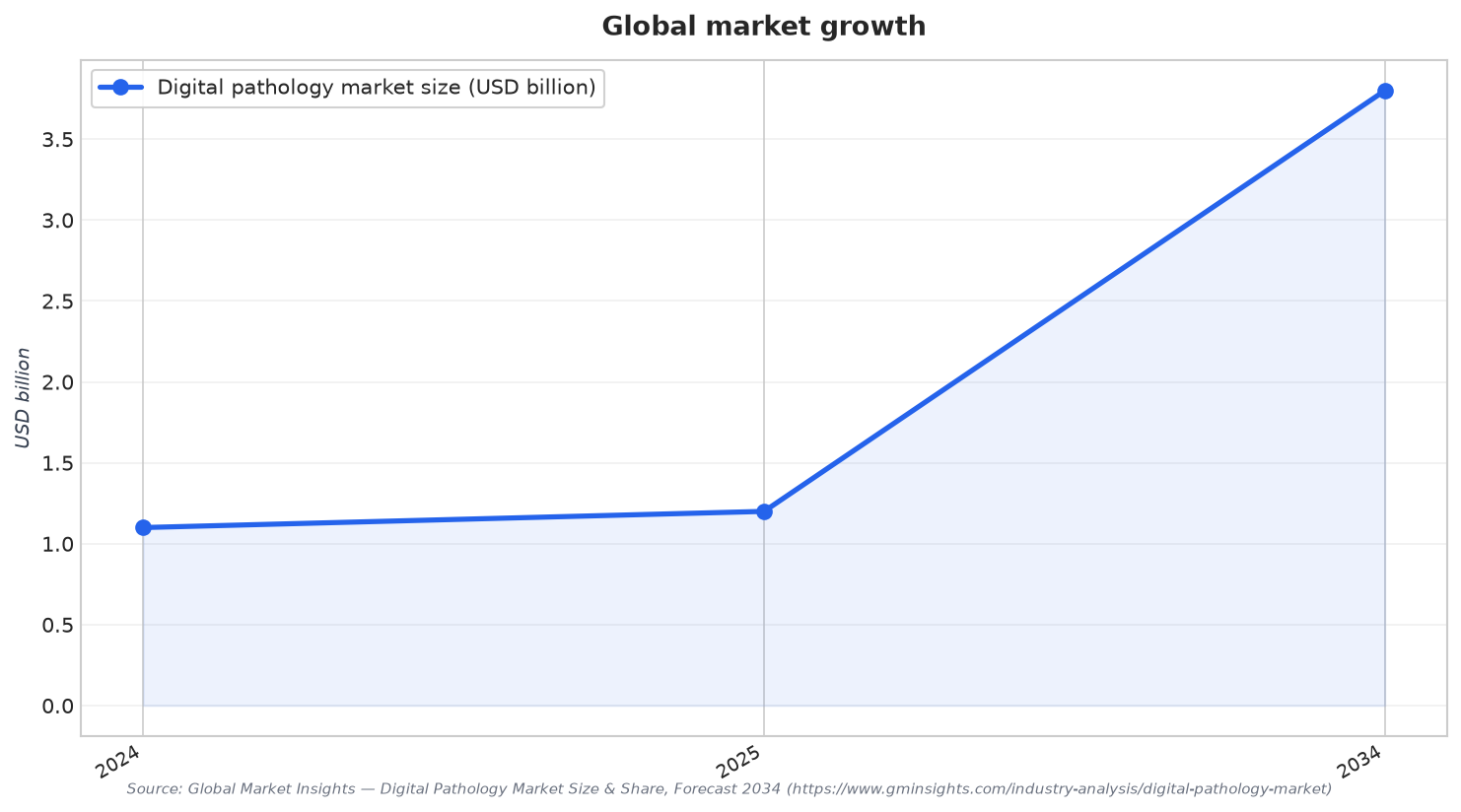
Pathology has long depended on fragile glass slides and manual microscope review. Digital pathology changes that by converting tissue slides into whole-slide images and managing the metadata, storage, review, and analysis around them. In clinical workflows, the goal is practical: interpret digitized tissue slides to detect disease without needing the physical slide at the microscope. This is where image analysis and AI tools can augment what the pathologist sees. Globally, momentum is visible. One forecast valued the global digital pathology market at USD 1.1 billion in 2024, projecting USD 1.2 billion in 2025 and USD 3.8 billion by 2034, reflecting how fast laboratories are shifting to whole-slide imaging, AI-powered diagnostics, and cloud-based platforms.
In Saudi Arabia, this modernization is closely tied to broader healthcare transformation and a strategic focus on digital health solutions under Vision 2030. One market source states the Saudi Arabia digital pathology market is valued at USD 150 million based on a five-year historical analysis, with growth linked to technology integration and demand for more efficient diagnostic solutions. Riyadh, Jeddah, and Dammam are cited as leading hubs due to advanced healthcare infrastructure and concentrated medical facilities, where hospitals and research institutions are adopting digital pathology to streamline operations. Regulation is also part of the shift. In 2023, the Saudi Arabian government implemented a regulation mandating the adoption of digital health technologies in public healthcare facilities, explicitly supporting integration of advanced tools, including digital pathology, into routine practice.
What Makes Digital Pathology Operationally Different
Moving from glass to pixels is not only about image quality. It changes cost, space, and collaboration assumptions inside the lab. One industry report estimates a damaged glass slide can cost a hospital about $200 to replace, while an entry-level scanner starts around $100,000 and high-capacity systems can exceed $300,000. Storage is another pressure point: storing 1 million glass slides can require about 1,500 square feet of climate-controlled space, while digital workflows reduce that burden significantly. Operationally, digitization also reduces the need to move physical slides. The same report estimates eliminating slide shipping can save a regional laboratory about $150,000 a year, and that AI triage can reduce pathologist overtime by roughly 15 hours a week, reinforcing why hospitals and labs are investing despite equipment costs.
The workload reality helps explain why the technology matters. A single diagnostic pathologist reviews roughly 3,000 complex cases every year, and high-volume reference laboratories can process more than 600,000 anatomical pathology tests in a year. Slide volume can climb quickly. A breast biopsy may generate 12 to 15 glass slides, while a radical prostatectomy can produce up to 40 slides, and complex oncology cases may require evaluation of as many as 50 tissue slides before a complete diagnosis is possible. These numbers illustrate why whole-slide imaging is often described as the backbone of modern workflows: scanners create high-resolution digital replicas that are easier to store, share, and annotate at scale across teams.
Market segmentation also reflects where adoption concentrates. In Saudi Arabia, one analysis lists product subsegments such as Whole Slide Imaging, digital scanners, software solutions, image analysis tools, and storage solutions, and notes Whole Slide Imaging as the leading subsegment due to high-resolution images and growing hospital and laboratory adoption. Hospitals are described as the dominant end-user segment, with diagnostic laboratories also playing a major role due to the need for reliable, efficient processing systems. In global context, hospitals and diagnostic labs are reported to capture 65% market share, while primary diagnosis leads workflow share at 62% and diagnostics accounts for 48% market share in 2025. Together, these signals frame why Saudi digital pathology efforts increasingly emphasize scalable scanners, software, and secure access that fit routine diagnosis.
What is digital pathology in day-to-day diagnosis?
What is driving adoption of Saudi Arabia’s digital pathology?
How large is the Saudi Arabia digital pathology market in the cited sources?
What operational benefits come from digitizing slides instead of storing glass?
Why do scanners and whole-slide imaging matter for modern pathology workloads?